组成图示
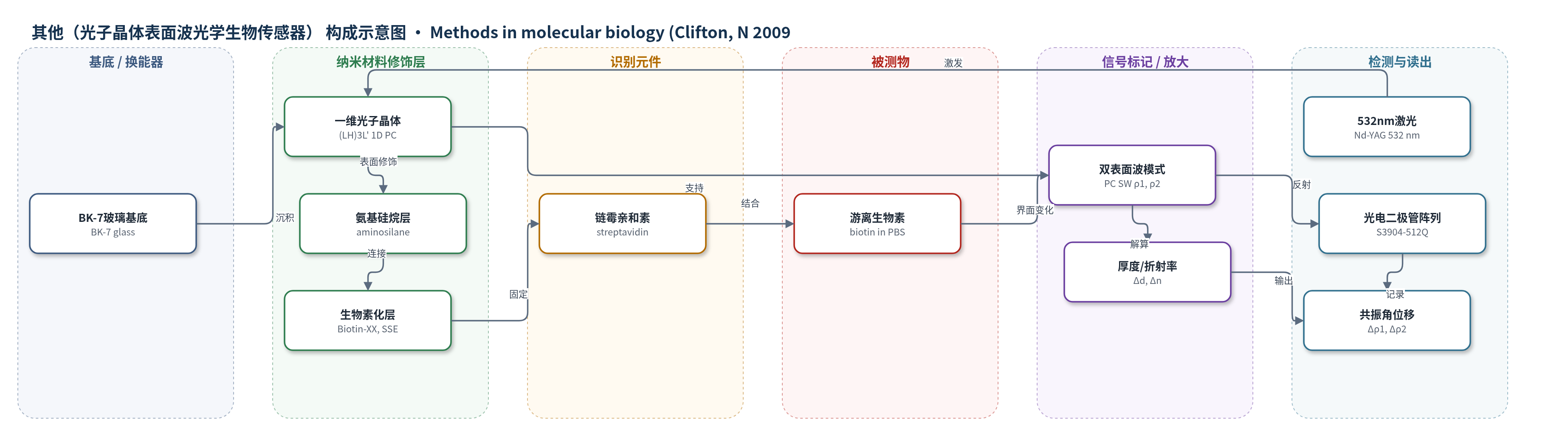
点击图片查看大图 · 依据论文自动绘制
传感器类型
其他(光子晶体表面波光学生物传感器)
检测对象
游离生物素(biotin, vitamin H)、链霉亲和素(streptavidin);样品基质为 PBS 缓冲液(pH 7.2),绝对角度测量用纯水。
检测原理
该传感器利用一维光子晶体表面支持的两个 s 偏振表面波实现无标记检测。其中一个模式激发角接近水的全反射角,穿透深度大,对液体体积折射率变化敏感,作为参考;另一模式对表面吸附层厚度变化更敏感。当游离生物素与固定链霉亲和素结合时,表面吸附层厚度及链霉亲和素结合后构象发生变化,引起两个表面波共振角参数 ρ1 和 ρ2 位移。系统同时记录反射光强分布,通过光电二极管阵列获得双共振峰位置,利用泰勒展开和偏导系数将 Δρ1、Δρ2 解算为 Δn 和 Δd,从而分离体积折射率漂移与表面结合信号。由于无金属损耗,表面波传播长度较长,共振峰尖锐,角度测量精度高,信号随结合量变化而改变。
检测灵敏度
LOD: about 20 fg of the analyte on the probed spot of the surface(streptavidin);biotin: about 50 fg of the analyte on our probed spot;噪声: δd = std(da) ≅ 1.3 pm/√Hz;δn = std(ne) ≅ 5 × 10⁻⁷/√Hz;SNR: (signal/noise)b ratio of about 15;(signal/noise)str ratio of about 5,000
效应效果
该传感器在 PBS 重力流体系中实现了无标记、实时生物分子相互作用检测。链霉亲和素单分子层沉积的信噪比约 5000,对应最小可检测量约 200,000 个分子、20 fg;游离生物素结合过程中链霉亲和素构象变化的信噪比约 15(1 s 每点,无后处理平滑),对应最小可检测生物素约 1.3×10^8 个分子、50 fg。厚度测量噪声约 1.3 pm/√Hz,折射率测量噪声约 5×10^-7/√Hz。双模解耦可抑制温度或缓冲液折射率漂移造成的体积效应,提高表面信号特异性。作者认为该技术可用于设计温控流池作为表面生化反应器,并通过改善介质多层膜质量和降低激光噪声进一步降低噪声。
传感器的构成
- 基底/换能器:BK-7 玻璃棱镜与基底,用于 Kretschmann 型激发和反射光收集
- 一维光子晶体:SiO2/Ta2O5 七层结构 (LH)3L',L=SiO2 154.0 nm,H=Ta2O5 89.4 nm,L'=SiO2 638.5 nm,支持双 s 偏振表面波
- 传感表面:顶层 SiO2 638.5 nm,作为生物化学修饰界面
- 硅烷化层:3-(2-氨基乙基氨基)丙基二甲基甲氧基硅烷,将 SiO2 表面 OH 转为 NH2
- 生物素化层:Biotin-XX, SSE (Sulfo-NHS-LC-LC-Biotin),共价连接氨基表面并暴露生物素
- 识别元件:链霉亲和素 (streptavidin) 单分子层,结合游离生物素
- 样品池:玻璃流池与 Teflon 密封垫片(35 或 100 μm),PBS 重力流
- 光学读出:532 nm Nd-YAG 激光、保偏光纤、物镜、Hamamatsu S3904-512Q 光电二极管阵列,记录双共振角
中文摘要
光学生物传感器可在无标记条件下选择性识别目标生物分子并实时分析生物分子相互作用,避免标记干扰和繁琐预处理。然而,包括表面等离子共振(SPR)在内的无标记技术对特定信号灵敏度不足,且易受温度波动和漂移引起的液体折射率体积效应干扰,这限制了现有光学传感器性能。本文报道一种基于一维光子晶体表面同时记录双 s 偏振光学表面波的新光学生物传感器技术。由于同一表面点可同时探测两种不同光学模式,可将体积折射率变化与表面吸附信号分离;同时无金属阻尼可延长表面波传播长度并提高灵敏度。该技术以生物素与链霉亲和素单分子层结合为模型体系进行测试,在 1 s 信号积累时间内获得约 15 的信噪比,探测表面点的检测限约为 20 fg 分析物。
英文摘要
Optical biosensors have played a key role in the selective recognition of target biomolecules and in biomolecular interaction analysis, providing kinetic data about biological binding events in real time without labeling. The advantages of the label-free concept are the elimination of detrimental effects from labels that may interfere with fundamental interaction and the absence of a time-consuming pretreatment. The disadvantages of all label-free techniques--including the most mature one, surface plasmon resonance (SPR) technique, are a deficient sensitivity to a specific signal and undesirable susceptibilities to non-specific signals, e.g., to the volume effect of refraction index variations. These variations arise from temperature fluctuations and drifts and they are the limiting factor for many state-of-the-art optical biosensors. Here we describe a new optical biosensor technique based on the registration of dual optical s-polarized waves on a photonic crystal surface. The simultaneous registration of two different optical modes from the same surface spot permits the segregation of the volume and the surface signals, while the absence of metal damping permits an increase in the propagation length of the optical surface waves and the sensitivity of the biosensor. The technique was tested with the binding of biotin molecules to a streptavidin monolayer that has been detected with a signal/noise ratio of about 15 at 1 s signal accumulation time. The detection limit is about 20 fg of the analyte on the probed spot of the surface.