组成图示
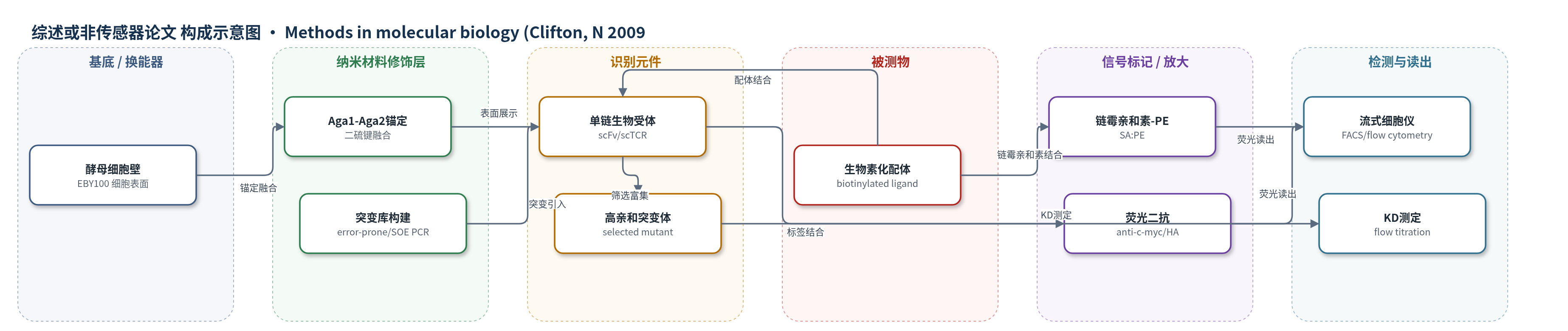
点击图片查看大图 · 依据论文自动绘制
传感器类型
综述或非传感器论文
检测对象
未指定具体被测物;泛指目标配体/抗原(ligand/antigen),样品基质为酵母细胞表面展示库/流式细胞悬液。
检测原理
本文未构建固定式生物传感器,其检测原理为酵母表面展示与流式荧光读出。将 scFv 或 scTCR 等受体基因与 Aga2 融合,经 GAL1 诱导后通过 Aga1-Aga2 二硫键展示于酵母细胞壁。构建错误倾向 PCR 或 SOE PCR 突变库并电转化 EBY100。诱导后,酵母表面受体与生物素化目标配体结合,链霉亲和素-PE 结合生物素产生荧光;同时抗 c-myc/HA 荧光二抗可监测全长表达。流式细胞仪按前向/侧向散射门控活细胞,并按荧光强度分选高结合、高表达或经热/pH 处理后仍保持荧光的细胞。配体浓度越低,高亲和突变体保留的结合量相对越高,荧光差异越大,从而通过多轮 FACS 富集高亲和、稳定受体;最后用配体滴定和流式分析估算 KD。
检测灵敏度
原文未报告 LOD、线性范围、灵敏度斜率或相关系数。
效应效果
该方法的核心效果是获得可用于生物传感器的稳定、高亲和识别元件。作者指出,酵母表面展示可通过 FACS 对突变体进行定量比较,并在酵母表面直接测量与可溶性靶标的结合常数,结果通常与 Biacore 定性一致。通过多轮错误倾向 PCR、SOE 定点随机化、热稳定性、pH 稳定性和亲和成熟筛选,可获得稳定单链抗体、T 细胞受体、MHC 等结合分子,亲和提高最高约 100 万倍,并能在大肠杆菌中表达稳定蛋白。文中未报告具体传感器 LOD、线性范围、RSD、实际样品回收率或与 ELISA/HPLC/qPCR 的定量对比,也未给出实际样品基质中的检测性能。
传感器的构成
- 体系说明:非固定式传感器,仅描述酵母表面展示受体工程化体系。
- 宿主展示平台:Saccharomyces cerevisiae EBY100,作为生物受体表面展示宿主。
- 展示载体:pCT302/pYD1,含 GAL1 启动子、Aga2 融合框、HA 标签与 Amp 抗性。
- 锚定系统:Aga1-Aga2 二硫键融合,将受体固定于酵母细胞壁。
- 识别元件:scFv 或 scTCR 等单链结合蛋白,用于结合目标配体。
- 表达监测标签:HA 与 c-myc 表位标签,配合荧光二抗监测全长表达。
- 筛选检测试剂:生物素化配体、链霉亲和素-PE、抗 c-myc/HA 荧光二抗,用于 FACS 分选。
中文摘要
本文介绍利用酵母表面展示技术对生物传感器中的生物受体进行定向进化,以获得更稳定、更高亲和力的配体结合分子。生物传感器通常由识别配体的生物受体和将结合事件转换为可测信号的换能器组成;其中受体的结合强度、特异性和稳定性直接决定检测灵敏度、重复使用能力和长期储存性能。作者以酿酒酵母 EBY100 和 pCT302/pYD1 展示载体为基础,将单链抗体、单链 T 细胞受体等结合蛋白与酵母交配凝集素 Aga2 融合,并通过 Aga1-Aga2 二硫键锚定于细胞表面。方法包括错误倾向 PCR 或重叠延伸 PCR 构建突变库,电转化酵母,诱导表达,再用流式细胞术和荧光激活细胞分选筛选高表达、正确折叠、热稳定、pH 稳定及高亲和突变体。该技术已用于获得亲和提高最高约 100 万倍的稳定单链抗体、T 细胞受体等分子,并可在大肠杆菌中表达稳定蛋白,为生物传感器识别元件工程化提供通用策略。
英文摘要
Over the past two decades, the field of biosensors has been developing fast, portable, and convenient detection tools for various molecules of interest, both biological and environmental. Although much attention is paid to the transduction portion of the sensor, the actual bioreceptor that binds the ligand is equally critical. Tight, specific binding by the bioreceptor is required to detect low levels of the relevant ligand, and the bioreceptor must be stable enough to survive immobilization, storage, and in ideal cases, regeneration on the biosensing device. Often, naturally-occurring bioreceptors or antibodies that are specific for a ligand either express affinities that may be too low to detect useful levels, or the proteins are too unstable to be used and reused as a biosensor. Further engineering of these receptors can improve their utility. Here, we describe in detail the use of yeast surface display techniques to carry out directed evolution of bioreceptors to increase both the stability of the molecules and their affinity for the ligands. This powerful technique has enabled the production of stabilized, single-chain antibodies, T cell receptors, and other binding molecules that exhibit affinity increases for their ligands of up to 1 million-fold and expression of stable molecules in E. coli.