组成图示
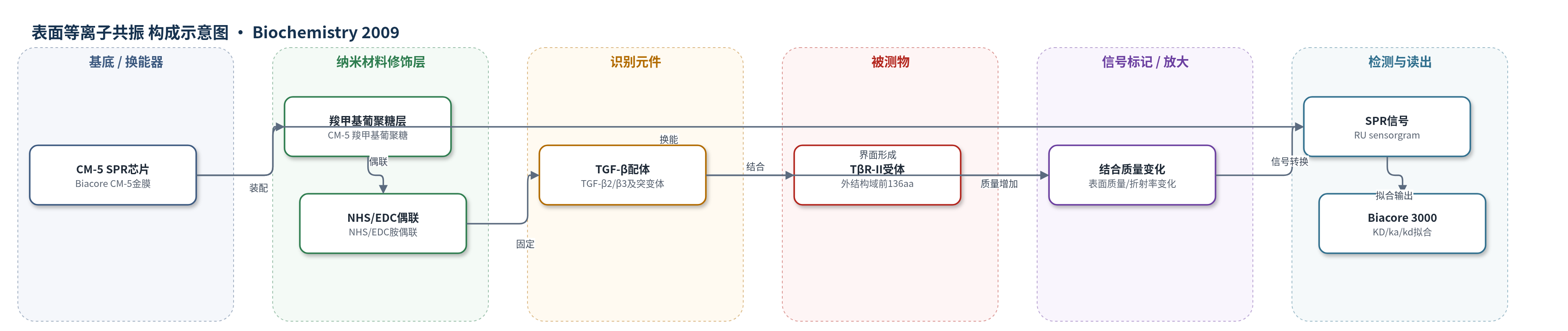
点击图片查看大图 · 依据论文自动绘制
传感器类型
表面等离子共振(SPR)生物传感器
检测对象
TGF-β配体变体(TGF-β2、TGF-β3及其点突变体)与TGF-β type II受体(TβR-II)的结合相互作用;样品基质:重组蛋白溶液(HBS缓冲液)
检测原理
重组TGF-β2/TGF-β3及其突变体经NHS/EDC胺偶联共价固定于Biacore CM-5 SPR芯片表面,作为识别元件。TβR-II外结构域以HBS缓冲液流过芯片,与固定TGF-β结合。结合事件使芯片表面质量/折射率增加,SPR共振条件改变,Biacore 3000记录为共振单位(RU)随时间变化的sensorgram。结合相与解离相分别反映ka和kd,不同TβR-II浓度下的平衡RU用于稳态KD拟合;因非定向固定产生异质结合位点,采用heterogeneous ligand模型全局拟合。TGF-β Arg25/Arg94胍基与TβR-II Glu119/Asp32羧基形成双氢键离子对,是信号差异的分子基础。温度依赖实验通过van't Hoff和Eyring图获得ΔH、ΔS、ΔG。无外源标记或酶放大,信号直接来自结合质量变化。
检测灵敏度
原文未报告 LOD、线性范围、灵敏度斜率或 R^2。
效应效果
SPR实验重复三次独立运行并报告标准差,TGF-β3与TβR-II的KD为73±1.9 nM,TGF-β2为17±0.41 µM,TGF-β2-TM为100±7.0 nM,显示TGF-β2-TM亲和力较TGF-β2提高约160–170倍。双精氨酸突变TGF-β2-K25R/K94R的KD为100±5.6 nM,与TGF-β2-TM接近,而单点突变仅小幅改变亲和力,说明TβR-II对高/低亲和异构体的区分主要由Arg25和Arg94决定,Arg94贡献最大。NMR证实突变未造成整体折叠扰动。在31.3 pM配体下,TGF-β3和TGF-β2-TM可抑制FBHE细胞生长,TGF-β2不能,双精氨酸突变呈中间抑制,提示Val92在细胞信号中可能具有额外作用。作者认为该机制有助于设计基于TβR-II结合位点的TGF-β抑制剂。
传感器的构成
- 基底/换能器:Biacore CM-5金膜SPR芯片,提供表面等离子共振换能。
- 固定层:CM-5羧甲基葡聚糖层,经NHS/EDC胺偶联固定TGF-β配体。
- 识别元件:重组TGF-β配体(TGF-β2/TGF-β3及突变体),共价固定于芯片表面,捕获TβR-II。
- 分析物:TGF-β type II受体外结构域(TβR-II,前136个氨基酸),以HBS缓冲液形式注入。
- 信号标记:无外源标记,结合引起SPR共振单位(RU)变化。
- 读出:Biacore 3000 SPR仪器,记录sensorgram并拟合KD/ka/kd。
中文摘要
TGF-β1、-β2和-β3序列同一性超过70%,结构几乎相同,但TGF-β2与TGF-β II型受体(TβR-II)的结合亲和力远低于TGF-β1和-β3。此前发现TGF-β1和-β3界面保守残基Arg25、Val92、Arg94负责高亲和结合。本研究通过单点、双点和三点突变构建TGF-β3失活及TGF-β2功能获得变体,并用一维1H NMR确认突变未引起明显结构扰动。采用表面等离子共振(SPR)生物传感器测定各变体与TβR-II的亲和力、动力学和热力学。双突变显示高亲和结合主要由Arg25和Arg94贡献,单点突变中Arg94贡献最大。将Arg25和Arg94突变为丙氨酸证实精氨酸胍基对形成TGF-β1/-β3与TβR-II Glu119/Asp32之间高度特异性氢键离子对的必要性。进一步动力学和热力学分析表明Arg25/Arg94是主要决定因素,TGF-β结构框架的非界面长程效应也有轻微贡献。细胞生长抑制实验显示结合变化通常与功能直接相关,但揭示了Val92在细胞环境中的特殊作用。
英文摘要
The TGF-beta isoforms, TGF-beta1, -beta2, and -beta3, share greater than 70% sequence identity and are almost structurally identical. TGF-beta2 differs from the others, however, in that it binds the TGF-beta type II receptor (TbetaR-II) with much lower affinity than either TGF-beta1 or -beta3. It has been previously shown that three conserved interfacial residues, Arg25, Val92, Arg94, in TGF-beta1 and -beta3 are responsible for their high-affinity interaction with TbetaR-II. In this study, the role of each of these residues was examined by creating single, double, and triple substitutions resulting in both TGF-beta3 loss-of-function and TGF-beta2 gain-of-function variants. One-dimensional 1H NMR spectra of the variants confirmed a lack of large structural perturbations. Affinities, kinetics, and thermodynamics for TbetaR-II binding were determined by surface plasmon resonance biosensor analysis. Double substitutions revealed that nearly all of the high-affinity binding is contributed by Arg25 and Arg94. Single site substitutions showed that Arg94 makes the greatest contribution. Substitution of Arg25 and Arg94 with alanine verified the requirement of the arginine guanidinium functional groups for the highly specific hydrogen-bonded ion pairs formed between Arg25 and Arg94 of TGF-beta1 and -beta3, and Glu119 and Asp32 of TbetaR-II. Further kinetic and thermodynamic analyses confirmed that Arg25 and Arg94 are primarily responsible for high-affinity binding and also revealed that noninterfacial longer range effects emanating from the TGF-beta structural framework contribute slightly to TbetaR-II binding. Growth inhibition assays showed that binding changes generally correlate directly with changes in function; however, a role Val92 in this cellular context was uncovered.