组成图示
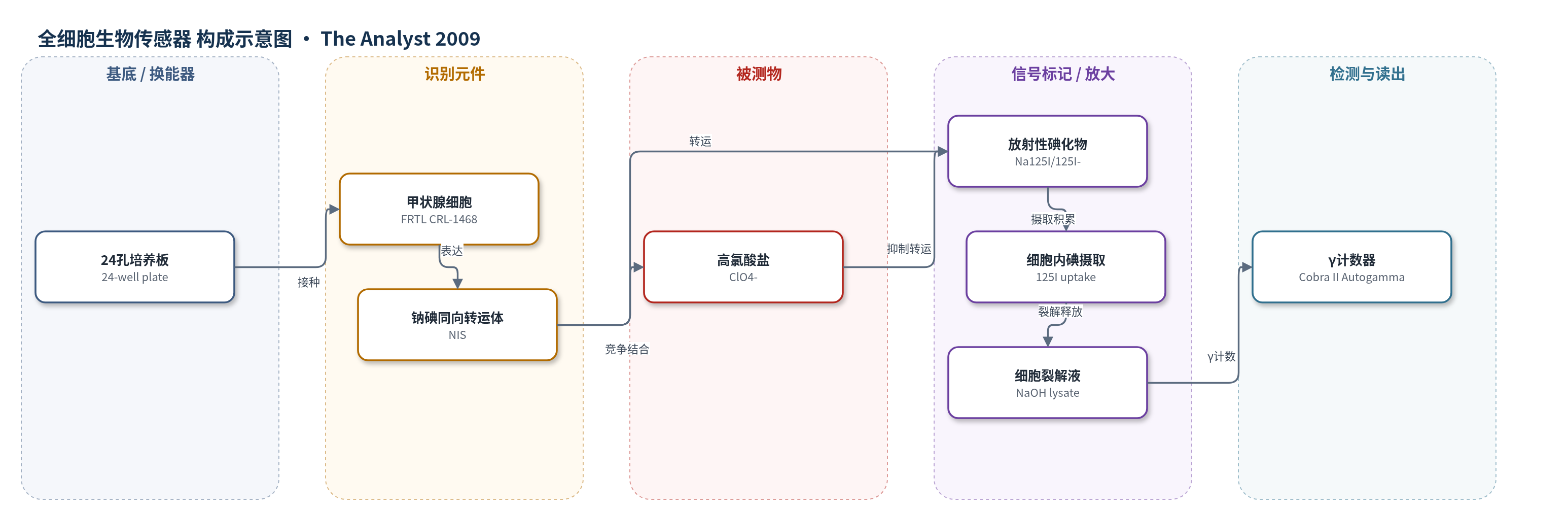
点击图片查看大图 · 依据论文自动绘制
传感器类型
全细胞生物传感器
检测对象
高氯酸盐(perchlorate, ClO4-);样品基质:水样(饮用水/环境水样,实验在F12K细胞培养基中进行)
检测原理
检测基于甲状腺细胞膜上钠碘同向转运体(NIS)对碘离子和高氯酸根离子的竞争性转运。将FRTL甲状腺细胞与含125I-的F12K培养基及待测水样共孵育10 min,ClO4-作为竞争性底物/抑制剂与NIS结合,占据转运位点并降低125I-进入细胞的速率。ClO4-浓度越高,细胞内放射性碘积累越少,信号呈负相关。孵育结束后用冰PBS洗涤终止摄取,再用0.1 M NaOH裂解细胞释放放射性,γ计数器测量裂解液计数。该法以放射性示踪提供高灵敏度,无需酶或纳米放大,但依赖NIS对ClO4-的高亲和竞争抑制,IC50为180 nM。
检测灵敏度
可定量范围: 50 nM (5 ppb)–2 mM (200 ppb)(摘要);结果中亦称 50 nM–5 mM(IC20–IC90);IC50: 180 nM (18 ppb);最低显著抑制浓度: 50 nM (5 ppb, p < 0.05);NaClO4 IC50: 180 nM;NH4ClO4 IC50: 140 nM;KClO4 IC50: 150 nM
效应效果
该法10 min室温孵育,125I-摄取半最大<3 min、15 min达最大。ClO4- IC50为180 nM,较Tonacchera等500 nM(5 min)和2.8 mM(45 min)低约3倍;SCN-、ClO3-、NO3- IC50不变,选择性提高约3倍。抑制顺序ClO4->SCN-≈I->ClO3->NO3-,NO3- IC50为293±98 mM,ClO4-/NO3-差异1600倍;NO3-达45 mg/L(725 mM)可致约400 nM假阳性并抑制70%摄取,需分离。Na+、NH4+、K+盐IC50为180、140、150 nM。相比IC/ESI-MS约2 nM LOD但需实验室前处理,本方法更便于现场;未报告RSD和回收率,作者认为可发展为近实时、高灵敏、高选择性水样高氯酸盐生物传感器。
传感器的构成
- 反应容器/基底:24孔组织培养板(24-well tissue culture plate),承载细胞并限定500 μL反应体积
- 识别元件:Fischer大鼠甲状腺细胞(FRTL cells, CRL-1468)膜上的钠碘同向转运体(NIS),竞争性结合/转运ClO4-并抑制I-摄取
- 信号标记物:无载体放射性碘化钠(Na125I, 125I-),作为被抑制的示踪底物,其细胞内放射性代表碘摄取
- 反应介质:Kaighn改良Ham's F12培养基(F12K)含六激素混合物,维持细胞活性与NIS功能
- 终止/裂解试剂:冰PBS与0.1 M NaOH,终止摄取并释放细胞内放射性
- 信号读出装置:γ计数器(Perkin-Elmer Packard Cobra II Autogamma),测量细胞裂解液放射性
中文摘要
高氯酸盐是广泛用于军工和民用含能材料的强氧化剂,也是受关注的环境污染物。高氯酸根离子(ClO4-)与碘离子电荷和半径相近,是甲状腺滤泡细胞基底侧膜钠碘同向转运体(NIS)介导碘转运的强竞争性抑制剂。本研究建立竞争性放射性转运体检测法,利用Fischer大鼠甲状腺细胞(FRTL细胞)快速、可重复摄取125I-的特性,通过ClO4-对125I-摄取的抑制来测定水样中nM级高氯酸盐。优化条件为10 min室温共孵育、仅加入125I-、直接分析竞争阴离子。结果显示可定量范围为50 nM(5 ppb)至2 mM(200 ppb),IC50为180 nM(18 ppb),较先前报道低近3倍;其他竞争阴离子IC50不变,使ClO4-选择性提高约3倍。该细胞基方法有望发展为高氯酸盐生物传感器,并提示NIS可作为高氯酸盐选择性富集与转运的生物机械机制。
英文摘要
Perchlorates are strong oxidants widely employed in military and civilian energetic materials and recently have been scrutinized as persistent environmental pollutants. The perchlorate anion, ClO(4)(-), is a well-known and potent competitive inhibitor of iodide transport by the sodium iodide symporter (NIS) expressed in the basolateral membranes of thyroid follicular cells (thyrocytes). Iodide uptake by thyroid follicular cells is rapid and reproducible. The competitive radiotransporter assay in this study shows promise as a rapid and convenient method to assay for ClO(4)(-) in water samples at the nM level. This work describes the initial efforts to define the assay conditions that enhance NIS selectivity for ClO(4)(-). Experiments of 10 min co-incubation of ClO(4)(-) and (125)I(-) demonstrate a more significant effect on (125)I(-) transport, with a quantifiable ClO(4)(-) concentration range of 50 nM (5 ppb) to 2 microM (200 ppb), and IC(50) of 180 nM (18 ppb), nearly three-fold lower than previous reports. Since the IC(50) in our assay for other known competitor anions (SCN(-), ClO(3)(-), NO(3)(-)) remains unchanged from previous research, the increased sensitivity for ClO(4)(-) also produces a three-fold enhancement in selectivity. In addition to the possible applicability of the thyrocyte to the development of a cellular perchlorate biosensor, we propose that the high affinity of the NIS for ClO(4)(-) also creates the potential for exploiting this membrane protein as a selective, sensitive, and broadly applicable biomechanical mechanism for controlled movement and concentration of perchlorate.