组成图示
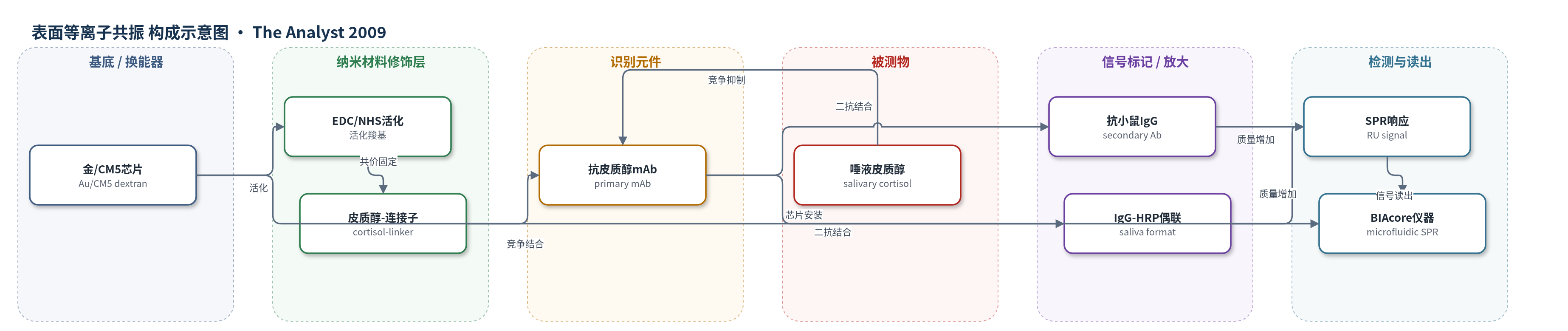
点击图片查看大图 · 依据论文自动绘制
传感器类型
表面等离子共振(SPR)生物传感器
检测对象
皮质醇(cortisol);样品基质:人唾液(human saliva),标准曲线亦使用活性炭脱除皮质醇的唾液(charcoal-stripped saliva)和HBS-EP缓冲液
检测原理
皮质醇衍生物通过4位连接子共价固定于CM5羧甲基葡聚糖表面,形成竞争性包被抗原。样品中的皮质醇与表面固定皮质醇竞争结合抗皮质醇单克隆抗体(mAb):皮质醇浓度越高,表面结合的mAb越少。随后加入抗小鼠IgG二抗或IgG-HRP偶联二抗,与表面mAb结合,增加界面结合质量并放大SPR信号。SPR通过监测金表面附近折射指数变化实时输出响应单位(RU),信号与皮质醇浓度呈反向关系。0.01% SDS用于降低唾液基质非特异结合,NaOH/MeCN用于表面再生。
检测灵敏度
LOD: 13 pg/mL(缓冲液);LOD: 49 pg/mL(人唾液);动态范围: 91–934 pg/mL(唾液);灵敏度: 72 RU.mL/ng(缓冲液)、162 RU.mL/ng(人唾液);IC50: 376 pg/mL(缓冲液)、297 pg/mL(人唾液);与RIA相关: r = 0.94
效应效果
该SPR免疫生物传感器在40例健康男性唾液样品中与RIA呈强相关(r=0.94,95% CI 0.88–0.97),无需溶剂提取或稀释。批内浓度变异系数为15.3%,信号批内变异系数为8.5%,批间变异系数为13.5%;加标回收率为96.8%(0.1 ng/mL)、102.8%(1 ng/mL)和102.4%(10 ng/mL)。共价固定表面可稳定经历超过140次结合/再生循环,其他类似表面可超过1100次。每份复孔仅需50 µL唾液,单样品结合与再生约10 min,整体约15 min出结果。作者认为其自动化、低放射性、低成本,可用于压力监测和疾病诊断。
传感器的构成
- 基底/换能器:金表面(Au)与羧甲基葡聚糖(CM5)芯片,提供SPR换能表面和羧基固定位点
- 活化层:EDC/NHS活化CM5羧基,形成活性酯用于共价偶联
- 包被抗原:皮质醇-寡乙二醇连接子偶联物(cortisol-linker conjugate,compound 6),经4位连接子共价固定,作为竞争性抗原
- 识别元件:鼠源抗皮质醇单克隆抗体(mAb),与表面皮质醇竞争结合
- 信号放大:抗小鼠IgG二抗(anti-mouse IgG)或IgG-HRP偶联二抗,结合表面mAb增加质量
- 界面处理:乙醇胺(ethanolamine)失活未反应位点;SDS(0.01% w/v)减少唾液非特异结合
- 运行/再生:HBS-EP运行缓冲液;NaOH/MeCN再生表面
中文摘要
唾液皮质醇检测对疾病诊断和人体压力监测具有重要意义。目前主要采用放射免疫分析(RIA),但该方法昂贵、劳动密集、使用放射性同位素且结果延迟。本文报道一种基于纳米连接子化学与表面等离子共振(SPR)检测的微流控免疫生物传感器,用于快速、超灵敏检测唾液皮质醇。作者理性设计了皮质醇-连接子偶联物,并将其作为包被抗原共价固定于SPR传感表面;检测采用竞争性免疫分析,并利用二抗进行信号增强。该方法无需化学提取或复杂样品前处理,即可应对高粘度唾液基质。缓冲液优化后的方法在唾液中检出限为49 pg/mL,与RIA结果相关良好(r=0.94)。生物传感器批间变异系数为13.5%,回收率接近100%;共价固定表面可稳定经历超过140次结合与再生循环,支持重复使用。该系统可在约15分钟内获得结果,有望用于主动压力监测和疾病诊断。
英文摘要
Cortisol detection in saliva is of great interest for the diagnosis of various disease states and the monitoring of stress in humans. Currently, measurements are performed predominantly by radioimmunoassay (RIA) which is expensive, labour intensive, uses hazardous radioisotopes and involves extensive delays in obtaining results. A rationally designed cortisol-linker conjugate allowing high assay sensitivity was employed as a coating antigen in a microfluidic surface plasmon resonance (SPR) biosensor immunoassay for the ultrasensitive and rapid detection of salivary cortisol. Detection of cortisol is by competitive immunoassay using a secondary antibody for signal enhancement. The method requires no chemical extraction or complex sample pre-treatment despite high saliva viscosity. The cortisol assay was optimized for maximum sensitivity in buffer before being adapted for the salivary matrix, where it showed a limit of detection of 49 pg/mL. The results showed good correlation to RIA (r = 0.94). The biosensor assays showed an inter-assay coefficient of variation (CV) of 13.5% and recoveries close to 100%. The covalently immobilized sensor surface provided stable responses for more than 140 binding and regeneration cycles, enabling re-use. Cortisol in saliva was detected across the physiologically relevant range using the SPR immunobiosensor by employing a rationally designed assay format including signal enhancement for maximum sensitivity. The system can handle saliva matrix effects by use of chemical treatment during the assay to reduce non-specific binding to sensor surfaces. This sensor system provides an automated, high sensitivity analytical tool capable of yielding results in approximately 15 min. This biosensor could potentially be used for active stress-monitoring and in the diagnosis of disease.