组成图示
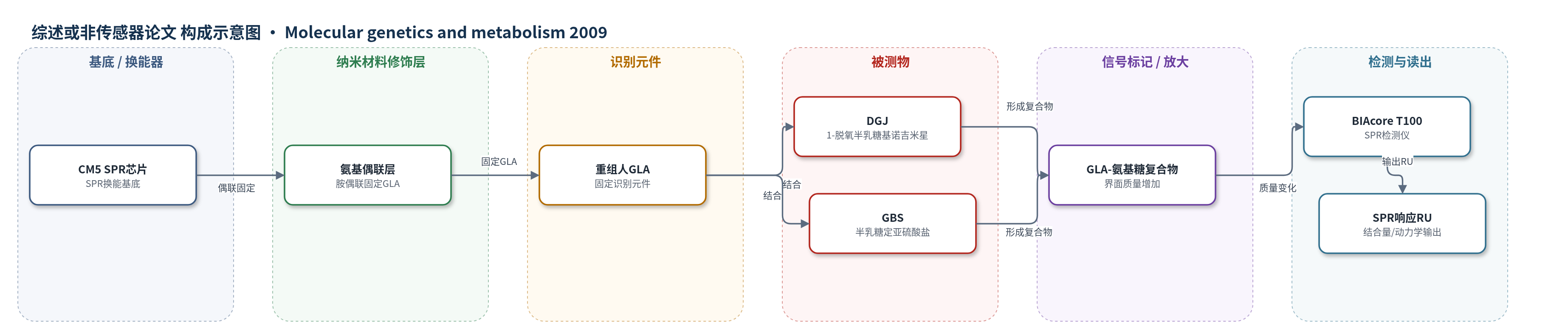
点击图片查看大图 · 依据论文自动绘制
传感器类型
综述或非传感器论文
检测对象
氨基糖(imino sugars,如 1-脱氧半乳糖基诺吉米星 DGJ、半乳糖定亚硫酸盐 GBS);样品基质:磷酸盐缓冲液(SPR 配体溶液)、重组人 GLA 溶液及法布里成纤维细胞裂解液。
检测原理
本研究以固定于 CM5 芯片的重组人 GLA 作为识别元件,将 DGJ、GBS 等氨基糖配体以不同浓度流过芯片表面。氨基糖与 GLA 活性位点竞争性结合,形成约 1:1 复合物;结合使芯片界面质量或折射率发生变化,SPR 共振角发生偏移,BIAcore T100 以响应单位(RU)记录结合与解离过程。配体浓度越高,结合量越大,响应越大;通过变浓度和变温拟合可得到 ka、kd、KD 及 ΔG、ΔH、ΔS。ITC 在溶液中直接测量结合热,与 SPR 结果相互验证。该过程无酶催化或信号放大,信号直接来源于蛋白-小分子结合引起的界面光学变化。
检测灵敏度
未报告 LOD、线性范围、灵敏度斜率或相关系数。
效应效果
SPR 与 ITC 结果一致,支持 1:1 结合。DGJ Ki 0.041±0.002 µmol/L,GBS 0.10±0.01 µmol/L,强于 Altro-DNJ(31±1)和 NB-DGJ(81±1 µmol/L);其他氨基糖无抑制。SPR 得 DGJ KD 1.1×10^-8 mol/L、ka 1.4×10^5 L mol^-1 s^-1,GBS KD 3.2×10^-7 mol/L、ka 5.7×10^3 L mol^-1 s^-1,DGJ 结合更强更快。Q279E 法布里成纤维细胞中,20 µmol/L DGJ/GBS 使 GLA 活性恢复至健康对照约 20%,200 µmol/L DGJ 约 50%,高浓度下降。作者认为这些信息有助于设计低抑制药理学伴侣,改善法布里病 EET。
传感器的构成
- 基底/换能器:CM5 芯片(SPR 换能基底,用于固定 GLA 并检测界面质量变化)
- 修饰/偶联层:氨基偶联试剂(胺偶联试剂盒,将 GLA 固定到芯片表面)
- 识别元件:重组人 α-半乳糖苷酶A(GLA,固定于芯片,作为氨基糖结合靶点)
- 封闭剂:乙醇胺(封闭芯片未反应位点,降低非特异结合)
- 被测物/配体:DGJ、GBS 等氨基糖溶液(流过芯片,与 GLA 结合)
- 信号读出:BIAcore T100 SPR 响应(以 RU 表示结合量,用于计算结合动力学)
中文摘要
法布里病酶增强治疗(EET)使用氨基糖,认为氨基糖可作为野生型和突变型人α-半乳糖苷酶A(GLA)的药理学伴侣,但氨基糖与酶之间的分子相互作用机制尚未明确。作者检测了多种氨基糖,发现半乳糖定亚硫酸盐(GBS)在体外抑制 GLA,并在培养的法布里成纤维细胞中增加酶活性,作用类似 1-脱氧半乳糖基诺吉米星(DGJ)。随后通过等温滴定量热(ITC)和表面等离子共振(SPR)生物传感器检测分析氨基糖与重组人 GLA 的分子相互作用,首次确定了复合物形成的热力学和结合动力学参数。结果显示 DGJ 比 GBS 与酶结合更强,DGJ 的结合主要为焓驱动;GBS 的结合也主要受焓驱动,但可能涉及熵驱动因素。分子对接分析表明,两者均可进入 GLA 活性位点口袋,并与包括催化残基在内的活性位点残基形成氢键;GBS 的侧链朝向活性位点入口,可能与活性位点口袋壁残基接触。这些热力学、动力学和结构研究可为改善法布里病 EET 提供重要信息。
英文摘要
Enzyme enhancement therapy (EET) for Fabry disease involving imino sugars has been developed and attracted interest. It is thought that imino sugars act as pharmacological chaperones for wild-type and mutant alpha-galactosidases (GLAs) in cells, but the mechanisms underlying the molecular interactions between the imino sugars and the enzyme have not been clarified yet. We examined various kinds of imino sugars and found that galactostatin bisulfite (GBS) inhibited GLA in vitro and increased the enzyme activity in cultured Fabry fibroblasts as in the case of 1-deoxygalactonojirimycin (DGJ). Then, we analyzed the molecular interactions between the imino sugars and recombinant human GLA by means of isothermal titration calorimetry and surface plasmon resonance biosensor assays, and first determined the thermodynamic and binding-kinetics parameters of imino sugar and GLA complex formation. The results revealed that DGJ bound to the enzyme more strongly than GBS, the binding of DGJ to the enzyme protein being enthalpy-driven. In the case of GBS, the reaction was mainly enthalpy-driven, but there was a possibility that entropy-driven factors were involved in the binding. Structural analysis in silico revealed that both the chemicals fit into the active-site pocket and undergo hydrogen bonding with residues comprising the active-site pocket including the catalytic ones. The side chain of GBS was oriented towards the entrance of the active-site pocket, and thus it could be in contact with residues comprising the wall of the active-site pocket. Thermodynamic, kinetic and structural studies should provide us with a lot of information for improving EET for Fabry disease.