组成图示
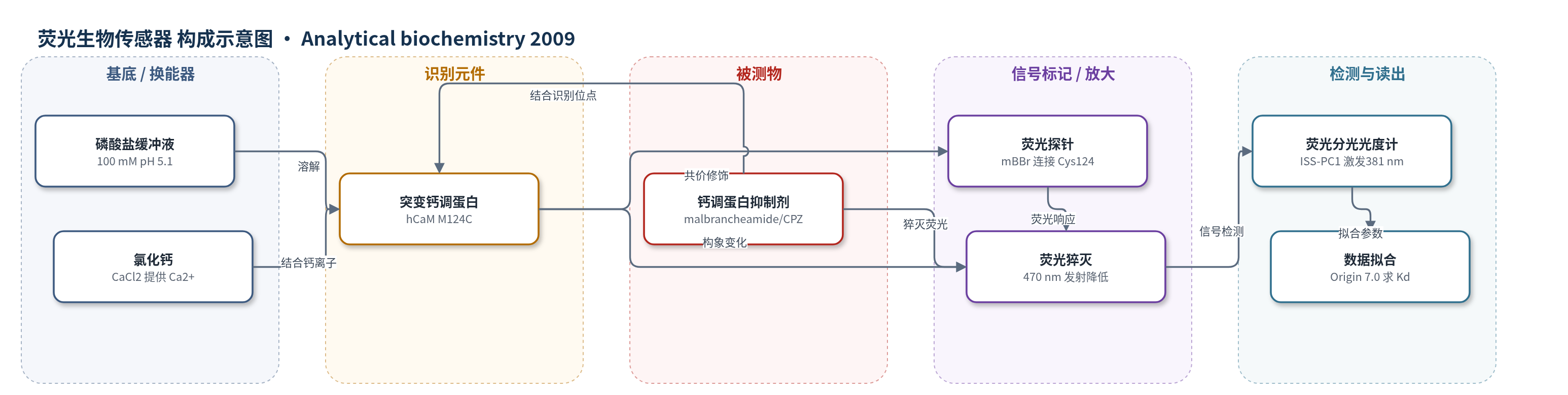
点击图片查看大图 · 依据论文自动绘制
传感器类型
荧光生物传感器
检测对象
钙调蛋白抑制剂(calmodulin inhibitors):malbrancheamide、tajixanthone hydrate、chlorpromazine(CPZ);样品基质为含 Ca2+ 的磷酸盐/醋酸钾缓冲液,PDE1 功能检测中化合物以 ACN/水 1:1 加入。
检测原理
hCaM M124C 在 Ca2+ 存在下形成 Ca2+-CaM 构象,暴露疏水结合口袋。当 malbrancheamide、tajixanthone hydrate 或 CPZ 等抑制剂进入疏水口袋时,Cys124 附近微环境改变,共价连接的 mBBr 荧光被猝灭。检测时以 381 nm 激发,监测 420–640 nm 发射,470 nm 处荧光强度随抑制剂浓度增加而下降,最大猝灭约 78%–84%。将 470 nm 荧光变化对抑制剂/蛋白总浓度比拟合,可得到表观 Kd。该方法不依赖酶催化放大,而依靠位点特异性荧光标记将蛋白构象变化转换为可定量荧光信号。
检测灵敏度
未报告 LOD、线性范围、灵敏度斜率或 R^2;荧光法表观 Kd:malbrancheamide 0.261 ± 0.023 μM;tajixanthone hydrate 0.033 ± 0.006 μM;chlorpromazine 1.714 ± 0.184 μM。
效应效果
标记蛋白的远紫外 CD 二级结构为 84.27% α-螺旋和 1.24% β-结构,热变性温度 Tm 为 57 °C,野生型为 61 °C,说明突变与 mBBr 修饰未显著破坏稳定性。hCaM M124C–mBBr 保留激活 PDE1 的功能,CPZ 的 PDE1 IC50 为 19.20 ± 0.36 μM,与野生型 21.98 ± 1.94 μM 及文献值一致。荧光法中 CPZ 和 tajixanthone hydrate 猝灭约 84%,malbrancheamide 约 78%;量子产率 0.494,约为野生型 0.025 的 20 倍。作者认为该荧光生物传感器可用于高通量筛选 CaM 抑制剂及潜在蛋白-蛋白相互作用。
传感器的构成
- 识别元件:人钙调蛋白突变体 hCaM M124C(CALM1 基因经 pET12b 在 E. coli BL21-AI 表达,Met124→Cys,提供唯一反应性 Cys 并保留 Ca2+ 结合与靶标识别)
- 信号标记物:单溴双咪胺 mBBr(硫醇反应性荧光团,共价连接 Cys124,形成 hCaM M124C–mBBr 并产生荧光猝灭信号)
- 离子/缓冲介质:磷酸盐缓冲液与 CaCl2(100 mM phosphate pH 5.1 或 5 mM KAc pH 5.1,含 10 mM/1 mM CaCl2,维持 Ca2+-CaM 构象)
- 功能验证体系:CaM 依赖性 cAMP 磷酸二酯酶 PDE1、5'-核苷酸酶、cAMP 与 Malachite green(用于酶活读出,验证 hCaM M124C–mBBr 保留激活 PDE1 的功能)
中文摘要
本文报道了一种用于发现潜在钙调蛋白(CaM)抑制剂的荧光检测新方法。作者通过定点突变将人钙调蛋白第124位甲硫氨酸替换为半胱氨酸,获得 hCaM M124C,并经疏水交换层析和阳离子交换层析纯化。随后用硫醇反应性荧光探针单溴双咪胺(mBBr)共价修饰 Cys124,得到 hCaM M124C–mBBr。该标记蛋白在远紫外圆二色和 CaM 依赖性 cAMP 磷酸二酯酶(PDE1)功能实验中表现出与野生型相近的稳定性和功能。其荧光量子产率为 0.494,约为野生型 hCaM 的 20 倍,并在饱和抑制剂存在下出现约 80% 的荧光猝灭。Malbrancheamide、tajixanthone hydrate 和氯丙嗪(CPZ)均能猝灭该蛋白荧光,所得 IC50 与野生型蛋白及文献值一致。结果表明 hCaM M124C–mBBr 可作为荧光生物传感器,用于高通量筛选 CaM 抑制剂。
英文摘要
This article describes the development of a new fluorescent-engineered human calmodulin, hCaM M124C-mBBr, useful in the identification of potential calmodulin (CaM) inhibitors. An hCaM mutant containing a unique cysteine residue at position 124 on the protein was expressed, purified, and chemically modified with the fluorophore monobromobimane (mBBr). The fluorophore-labeled protein exhibited stability and functionality to the activation of calmodulin-sensitive cAMP phosphodiesterase (PDE1) similar to wild-type hCaM. The hCaM M124C-mBBr is highly sensitive to detecting inhibitor interaction given that it showed a quantum efficiency of 0.494, approximately 20 times more than the value for wild-type hCaM, and a large spectral change ( approximately 80% quenching) when the protein is in the presence of saturating inhibitor concentrations. Two natural products previously shown to act as CaM inhibitors, malbrancheamide (1) and tajixanthone hydrate (2), and the well-known CaM inhibitor chlorpromazine (CPZ) were found to quench the hCaM M124C-mBBr fluorescence, and the IC(50) values were comparable to those obtained for the wild-type protein. These results support the use of hCaM M124C-mBBr as a fluorescence biosensor and a powerful analytical tool in the high-throughput screening demanded by the pharmaceutical and biotechnology industries.