组成图示
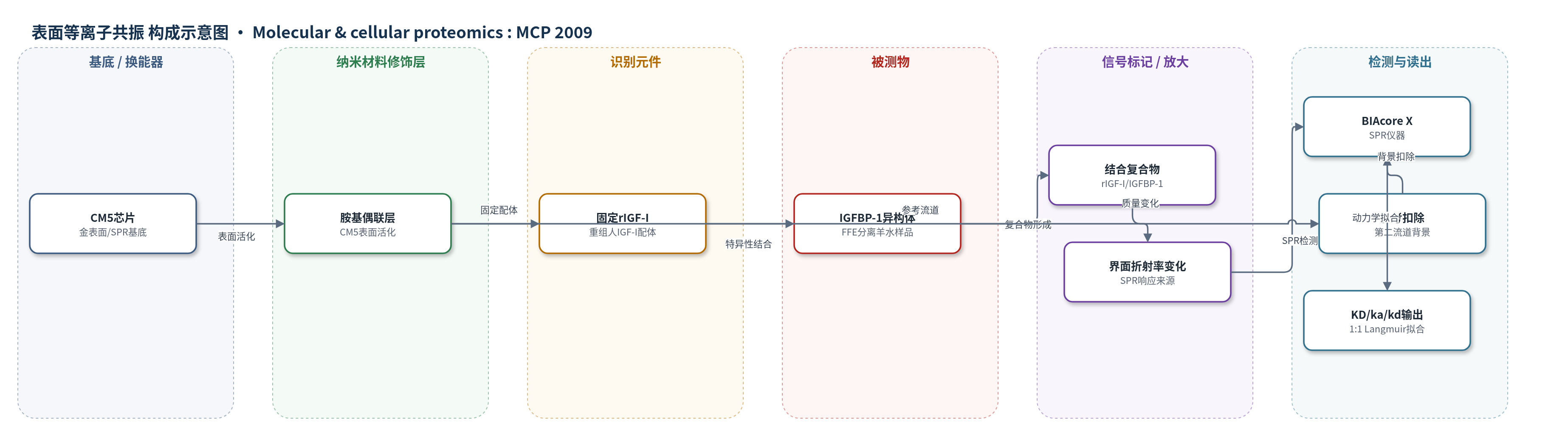
点击图片查看大图 · 依据论文自动绘制
传感器类型
表面等离子共振(SPR)生物传感器
检测对象
胰岛素样生长因子结合蛋白-1 磷酸化异构体(IGFBP-1 phosphoisoforms);样品基质:人羊水(amniotic fluid, AF)
检测原理
该检测基于表面等离子共振(SPR)无标记生物传感器。重组人 IGF-I(rIGF-I)通过胺基偶联固定于 CM5 芯片样品流道,作为配体;羊水经自由电泳(FFE)按等电点分离得到不同磷酸化状态的 IGFBP-1 异构体。当 FFE 分数流过芯片时,IGFBP-1 与固定 rIGF-I 特异性结合,结合复合物使芯片表面局部质量与折射率增加,SPR 角发生偏移,产生响应单位(RU)信号。信号在结合相随 IGFBP-1 浓度升高而增大,在解离相随复合物解离而下降。通过扣除参考流道背景,并用 1:1 Langmuir 模型拟合结合/解离曲线,得到 ka、kd 和 KD。磷酸化改变 IGFBP-1 构象或界面结合能力,从而改变 KD;其中 Ser119 磷酸化与更高 IGF-I 亲和力相关。
检测灵敏度
原文未报告 LOD、线性范围、灵敏度斜率、相关系数。
效应效果
FFE 分离总 IGFBP-1 回收率约 79%,宽范围与窄范围 FFE 的 BIAcore 动力学模式一致,显示可重复性。配体印迹显示 FFE 分数中仅检测到 IGFBP-1,其他 IGF 结合蛋白被去除,选择性较好。无蛋白酶抑制剂时 IGFBP-1 降解,加入抑制剂后 4°C 放置 30 h 仅出现 20 kDa 片段。BIAcore 分析三次重复并报告标准差;未分馏羊水 KD 为 4.88e-07 M,各 FFE 分数 KD 介于 1.12e-08 与 4.59e-07 M。二维免疫印迹显示 FGR 妊娠羊水中 IGFBP-1 磷酸化异构体斑点更多、更强,酸性端迁移更明显。作者认为该策略可用于建立 IGFBP-1 磷酸化与 FGR 的关联,并推广至其他磷酸化蛋白。
传感器的构成
- 基底/换能器:CM5 传感器芯片(金表面/SPR 换能器),提供表面等离子共振检测界面
- 修饰层:胺基偶联(amine coupling)活化 CM5 表面,用于固定重组人 IGF-I(rIGF-I)
- 识别/配体层:rIGF-I 固定于样品流道,作为与 IGFBP-1 磷酸化异构体特异性结合的配体
- 参考层:第二流道作为参考通道,用于扣除非特异结合和背景信号
- 再生条件:10 mM glycine-HCl 缓冲液(pH 2.0),用于解离结合复合物并恢复芯片表面
- 样品/分析物层:自由电泳(FFE)分离的羊水 IGFBP-1 磷酸化异构体,以不同浓度注入样品流道
- 读出层:BIAcore X 仪器记录 SPR 响应,经 1:1 Langmuir 模型拟合得到 ka、kd 和 KD
中文摘要
胎儿生长受限(FGR)是胎儿无法达到其遗传决定体型的常见疾病,羊水中胰岛素样生长因子结合蛋白-1(IGFBP-1)浓度升高与 FGR 相关。IGFBP-1 磷酸化可调节胰岛素样生长因子-I(IGF-I)的生物利用度。本研究设计了一种新策略,用于建立 IGF-I 亲和力与 IGFBP-1 磷酸化异构体磷酸化状态特征之间的联系。利用自由电泳(FFE),在 pH 4.43–5.09 范围内将羊水中多种 IGFBP-1 磷酸化异构体分离;随后采用 BIAcore 生物传感器分析测定各 FFE 分数中 IGFBP-1 与 IGF-I 的结合。不同 IGFBP-1 异构体对 IGF-I 的亲和力(KD)介于 1.12e-08 与 4.59e-07 M 之间。LC-MS/MS 鉴定出四个磷酸化位点:Ser(P)98、Ser(P)101、Ser(P)119 和 Ser(P)169,其中 Ser(P)98 为新发现位点。尽管各 FFE 分数中 IGF-I 结合亲和力与 Ser(P)101、Ser(P)98 和 Ser(P)169 磷酸肽强度不相关,但与 Ser(P)119 呈明显关联。数据表明 Ser119 磷酸化在调节 IGFBP-1 对 IGF-I 的亲和力中起重要作用。此外,FGR 与健康妊娠之间 IGFBP-1 磷酸化异构体谱存在差异,可能源于位点特异性磷酸化。该研究为利用这一新方法建立 IGFBP-1 磷酸化与 FGR 之间的联系提供了有力基础,并可用于其他具有临床和功能意义的磷酸化蛋白。
英文摘要
Fetal growth restriction (FGR) is a common disorder in which a fetus is unable to achieve its genetically determined potential size. High concentrations of insulin-like growth factor-binding protein-1 (IGFBP-1) have been associated with FGR. Phosphorylation of IGFBP-1 is a mechanism by which insulin-like growth factor-I (IGF-I) bioavailability can be modulated in FGR. In this study a novel strategy was designed to determine a link between IGF-I affinity and the concomitant phosphorylation state characteristics of IGFBP-1 phosphoisoforms. Using free flow electrophoresis (FFE), multiple IGFBP-1 phosphoisoforms in amniotic fluid were resolved within pH 4.43-5.09. The binding of IGFBP-1 for IGF-I in each FFE fraction was determined with BIAcore biosensor analysis. The IGF-I affinity (K(D)) for different IGFBP-1 isoforms ranged between 1.12e-08 and 4.59e-07. LC-MS/MS characterization revealed four phosphorylation sites, Ser(P)(98), Ser(P)(101), Ser(P)(119), and Ser(P)(169), of which Ser(P)(98) was new. Although the IGF-I binding affinity for IGFBP-1 phosphoisoforms across the FFE fractions did not correlate with phosphopeptide intensities for Ser(P)(101), Ser(P)(98), and Ser(P)(169) sites, a clear association was recorded with Ser(P)(119). Our data demonstrate that phosphorylation at Ser(119) plays a significant role in modulating affinity of IGFBP-1 for IGF-I. In addition, an altered profile of IGFBP-1 phosphoisoforms was revealed between FGR and healthy pregnancies that may result from potential site-specific phosphorylation. This study provides a strong basis for use of this novel approach in establishing the linkage between phosphorylation of IGFBP-1 and FGR. This overall strategy will also be broadly applicable to other phosphoproteins with clinical and functional significance.