组成图示
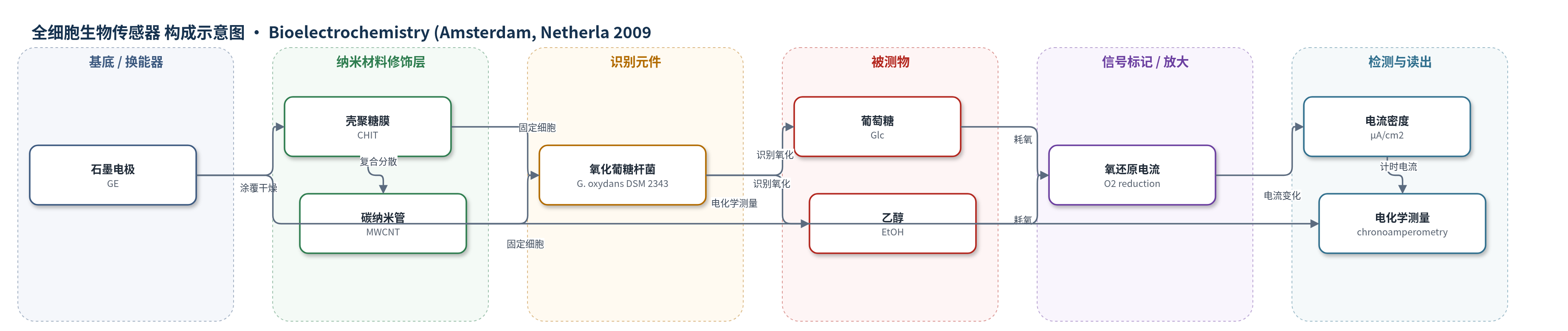
点击图片查看大图 · 依据论文自动绘制
传感器类型
全细胞生物传感器
检测对象
葡萄糖(glucose, Glc)、乙醇(ethanol, EtOH);样品基质为 50 mM PBS 缓冲液(pH 7.0,30 °C)
检测原理
氧化葡糖杆菌全细胞被固定在石墨电极表面的壳聚糖或壳聚糖-MWCNT 膜中。加入葡萄糖或乙醇后,细胞膜上的 PQQ 依赖脱氢酶催化底物氧化,细胞呼吸以溶解氧为终端电子受体,使电极附近 O2 浓度下降。工作电极在 -0.7 V(vs Ag|AgCl)下发生氧还原反应,产生与氧浓度相关的电流。底物浓度越高,细胞耗氧越快,稳态氧还原电流下降越多;传感器响应定义为加入底物前后两个稳态电流之差,因此电流密度差随底物浓度增加而增大。MWCNT 修饰壳聚糖可增强导电性、提高细胞负载量,从而获得略高的电流响应。
检测灵敏度
葡萄糖: 线性范围 0.05–1.0 mM;线性方程 y=1.160x+0.151(R^2=0.990)和 y=1.261x+0.197(R^2=0.982);响应时间 40 s。乙醇: 线性范围 0.2–1.0 mM;线性方程 y=0.918x+0.151(R^2=0.990)和 y=0.930x+0.058(R^2=0.997);响应时间 80 s。
效应效果
该传感器对葡萄糖选择性较好:0.2 mM 葡萄糖存在下,半乳糖、甘露糖、果糖、木糖、N-乙酰氨基葡萄糖、乳糖、蔗糖、麦芽糖、纤维二糖和甲醇无干扰,回收率 99%–105%;乙醇在 0.2–1.0 mM 线性。0.4 mM 葡萄糖 10 次重复,CNT-free 与 CNT-modified 的变异系数分别为 2.9% 和 2.3%。30 °C 缓冲液中 5 h 响应分别下降 24% 和 15%。CNT 修饰体系电流略高、稳定性更好。作者认为其制备简单,可用于葡萄糖/乙醇监测。
传感器的构成
- 基底/换能器电极:光谱石墨棒(graphite electrode, GE),抛光后作为工作电极,传导氧还原电流
- 修饰层:壳聚糖(CHIT)或壳聚糖-多壁碳纳米管(CHIT-MWCNT)膜,超声分散 MWCNT 后涂覆干燥,作为生物固定基质并增强导电/负载
- 识别元件:氧化葡糖杆菌 DSM 2343(Gluconobacter oxydans DSM 2343)全细胞,含膜结合 PQQ 依赖脱氢酶,氧化葡萄糖/乙醇并消耗 O2
- 交联固定剂:戊二醛(glutaraldehyde),与细胞表面氨基交联,固定细胞并维持代谢活性
- 工作介质:50 mM PBS 缓冲液(pH 7.0,30 °C),提供离子环境、溶解氧和底物扩散通道
- 参比电极:Ag|AgCl 电极(3 M KCl 饱和 AgCl),提供稳定电位参考
- 对电极:铂电极(Pt),完成三电极电化学回路
中文摘要
本研究构建了一种由氧化葡糖杆菌(Gluconobacter oxydans DSM 2343)全细胞作为生物材料、壳聚糖(CHIT)及壳聚糖-多壁碳纳米管(CHIT-MWCNT)作为固定基质的生物电化学系统。检测基于细胞在底物存在下的呼吸活性,通过工作电极在相对于 Ag|AgCl 参比电极 -0.7 V 下测定氧消耗产生的电流变化。系统对测量条件、细胞量、底物特异性、pH、温度和工作电位进行了优化。在 30 °C、pH 7.0 条件下,两种传感器(CNT 修饰与未修饰)均可在 0.05–1.0 mM 范围内定量葡萄糖,响应时间为 40 s。传感器响应(y,µA/cm²)与底物浓度(x,mM)的线性关系分别为 y=1.160x+0.151(R²=0.990)和 y=1.261x+0.197(R²=0.982)。文中同时比较了 CNT 修饰与未修饰体系的各项性能。
英文摘要
A bio-electrochemical system consisting of Gluconobacter oxydans DSM 2343 cells as a biological material and carbon nanotube (CNT)-free and CNT-modified chitosan as immobilizing matrices has been developed. The measurement was based on the respiratory activity of the cells estimated by the oxygen consumption at -0.7 V (versus the Ag|AgCl reference electrode) due to the metabolic activity in the presence of substrates. The system was calibrated and dependence of signal amplitude on the measuring conditions and cell amount was studied as well as the substrate specificity, pH, temperature and working potential. The biosensors (CNT-modified and unmodified) were demonstrated for the quantification of glucose in the range of 0.05-1.0 mM, at 30 degrees C and pH 7.0 with the 40 s of response time. The linear relationships between sensor response (y; microA/cm(2)) and substrate concentration (x; mM) were defined by the equations of y=1.160x+0.151 (R(2)=0.990) and y=1.261x+0.197 (R(2)=0.982), respectively. All other data were also given as comparison of two systems one with CNT-modified and CNT-free.