组成图示
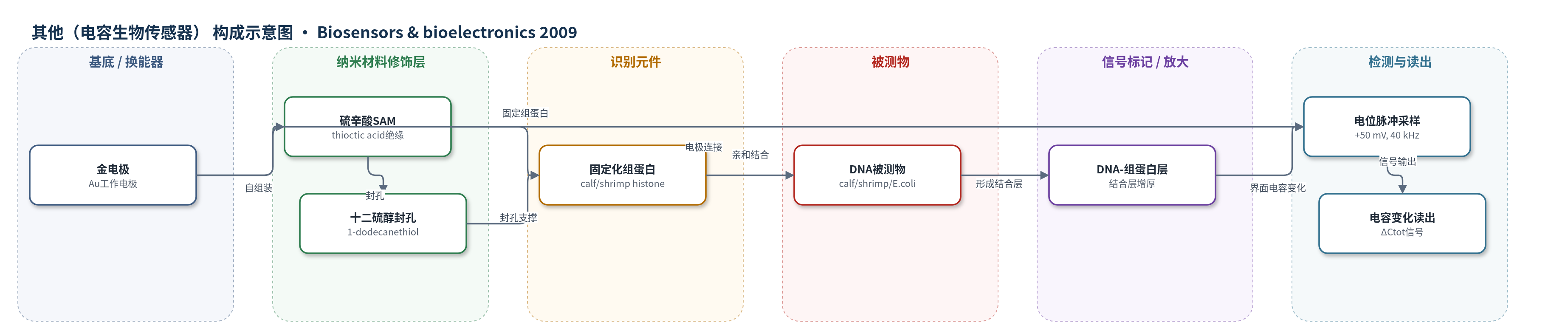
点击图片查看大图 · 依据论文自动绘制
传感器类型
其他(电容生物传感器)
检测对象
DNA(deoxyribonucleic acid,包括牛胸腺DNA、白虾DNA、大肠杆菌DNA);样品基质:标准缓冲液及白虾粗蛋白提取物(crude shrimp protein extract)
检测原理
该传感器为无标记亲和电容检测。金电极表面先形成硫辛酸自组装单分子层,提供绝缘界面和羧基位点,再固定牛胸腺或白虾组蛋白作为识别元件。当样品中的DNA流过电极时,DNA与组蛋白通过静电和非共价作用结合,使电极表面生物层厚度增加,电极/溶液界面总电容下降。系统施加+50 mV电位脉冲并采样电流,由电流响应计算总电容,电容变化ΔCtot随DNA浓度增加而增大。同源DNA与同源组蛋白结合更强,长链DNA形成更厚界面层,因此响应更高。低pH甘氨酸-HCl再生液可解离DNA,使电极重复使用。
检测灵敏度
LOD: 10−5 ng l−1;线性范围: 10−5 to 10−2 ng l−1 and 10−1 to 10^2 ng l−1;灵敏度斜率: 87 ± 2 nF cm−2 ng−1 l;26.6 ± 0.3 nF cm−2 ng l−1(牛胸腺DNA)
效应效果
无组蛋白电极对DNA无响应,说明组蛋白提供特异性识别。BSA在0.01–100 ng/L响应几乎恒定且低于DNA,蛋白非特异干扰小。同源DNA灵敏度更高:牛胸腺组蛋白对牛胸腺DNA斜率26.6±0.3 nF cm−2 ng l−1,对白虾DNA 7.6±0.3;白虾组蛋白对白虾DNA 13.8±0.1,对牛胸腺DNA 15.3±0.3。再生43次保留95.2±3.1%活性,RSD 3.1%。白虾粗蛋白加标回收80%–116%,稀释法73%–117%。与UV法(LOD约5 μg/mL)相比,可检测10−8 ng/mL DNA,分析13–15 min,短于30 min–5 h。
传感器的构成
- 基底/换能器电极:金电极(Au electrode),作为工作电极并测量界面电容
- 自组装单分子层:硫辛酸(thioctic acid, TA)SAM,在金表面形成绝缘层并提供羧基用于固定组蛋白
- 识别元件:牛胸腺组蛋白或白虾组蛋白(histone),通过亲和结合捕获DNA
- 封闭/绝缘层:1-十二硫醇(1-dodecanethiol),封闭SAM针孔并提高电极绝缘性
- 流动池:三电极流动池(three-electrode flow cell),用于流动注射样品和缓冲液
- 载体/再生液:10 mM Tris-HCl(pH 7.00)维持结合;25 mM glycine-HCl(pH 2.4)再生解离DNA
- 信号读出:Powerlab系统施加+50 mV电位脉冲并采样电流,计算总电容变化
中文摘要
开发了一种基于固定化组蛋白与DNA亲和结合的流动注射电容生物传感器系统,用于检测痕量DNA。将牛胸腺和白虾组蛋白固定化于覆盖硫辛酸自组装单分子层(SAM)的金电极上。分别用这两种组蛋白检测牛胸腺、白虾和大肠杆菌DNA。结果表明,组蛋白与同源DNA结合更好,灵敏度高于异源DNA。在最佳条件下,牛胸腺和白虾组蛋白对三种来源DNA均具有相同检出限10^-5 ng/L。牛胸腺组蛋白与DNA亲和反应标准曲线呈S形,可得到两个线性范围:10^-5–10^-2 ng/L和10^-1–10^2 ng/L。固定化组蛋白稳定,再生后信号重现性好,可重复使用43次,RSD为3.1%。用于分析白虾粗蛋白提取物中残留DNA,回收率为80%–116%。
英文摘要
A flow injection capacitive biosensor system to detect trace amounts DNA has been developed based on the affinity binding between immobilized histone and DNA. Histones from calf thymus and shrimp were immobilized on gold electrodes covered with self-assembled monolayer (SAM) of thioctic acid. Each of these histones was used to detect DNA from calf thymus, shrimp and Escherichia coli. The studies indicated that histones can bind better with DNA from the same source and give higher sensitivity than the binding with DNA from different sources. Under optimum conditions, both histones from calf thymus and shrimp provided the same lower detection limit of 10(-5) ng l(-1) for DNA from different sources, i.e., calf thymus, shrimp and E. coli. The standard curve for the affinity reaction between calf thymus histone and DNA shows sigmoidal behavior and two linear ranges, 10(-5) to 10(-2) ng l(-1) and 10(-1) to 10(2) ng l(-1), could be obtained. The immobilized histones were stable and after regeneration good reproducibility of the signal could be obtained up to 43 times with a %R.S.D. of 3.1. When applied to analyze residual DNA in crude protein extracted from white shrimp recoveries were obtained between 80% and 116%.