组成图示
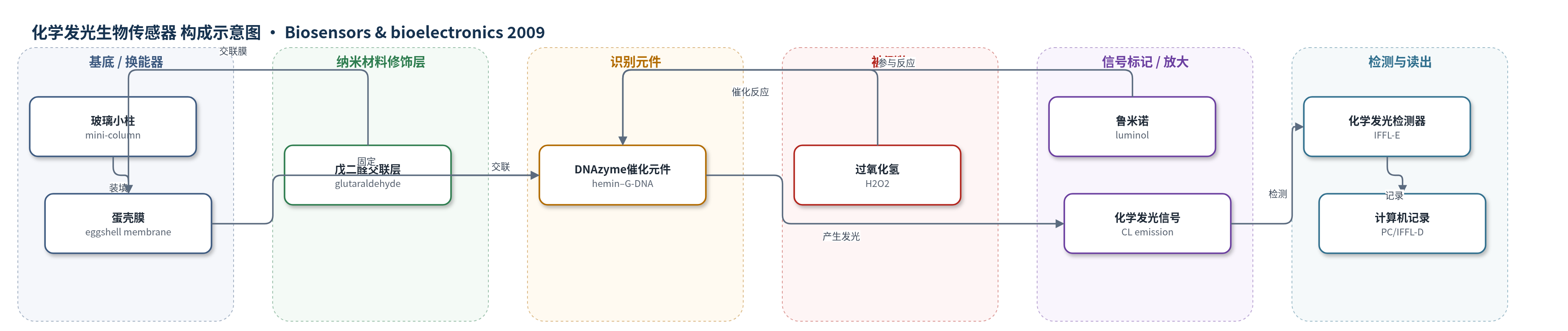
点击图片查看大图 · 依据论文自动绘制
传感器类型
化学发光生物传感器
检测对象
过氧化氢(hydrogen peroxide, H2O2,缓冲液/样品溶液)、葡萄糖(glucose,血清)
检测原理
该传感器以hemin与富鸟嘌呤DNA适配体形成的DNAzyme为催化识别单元。DNAzyme折叠成G-四联体结构,hemin嵌入其中,获得过氧化物酶样活性。在pH 11.5的磷酸盐缓冲液中,H2O2作为底物进入固定化DNAzyme反应器,催化氧化鲁米诺;反应生成激发态中间体,退激发射化学发光。H2O2浓度越高,单位时间内催化氧化鲁米诺越多,CL峰强度越大。样品经六通阀注入载流液,与鲁米诺混合后流经小柱,IFFL-E检测器记录CL信号,从而实现定量。DNAzyme可循环催化,且其强碱活性与鲁米诺CL体系匹配,避免了HRP最适pH与CL条件不匹配的问题。
检测灵敏度
LOD: 5 × 10⁻⁸ M (3σ);线性范围: 1 × 10⁻⁵–1 × 10⁻⁷ M;灵敏度斜率: 2.99 × 10^7 M−1;相关系数: 0.9979
效应效果
该传感器抗干扰好:对1×10⁻⁶ M H2O2,常见无机离子容忍比达10–1000倍,Mn2+、Co2+、Cu2+、Cr3+正干扰可加EDTA消除。连续200次测1×10⁻⁵ M H2O2 RSD<2%,1×10−6 M RSD<2%(n=11),三个反应器RSD 9%。室温保存3个月基本稳定,100 d后约87%,可重复>200次;分析1 min,通量60 h−1。KM,app为1.03×10⁻⁴ M,低于HRP的5.12×10⁻⁴ M。用于血清葡萄糖检测与医院比色法一致,RSD 3.4%。
传感器的构成
- 基底/载体:蛋壳膜(eggshell membrane, ESM),双层蛋白纤维膜,用于固定DNAzyme并提供生物相容微环境
- 催化识别元件:DNAzyme,由血红素(hemin)与富鸟嘌呤单链DNA适配体(5′-GTG GGT AGG GCG GGT TGG-3′)结合形成G-四联体结构,具有过氧化物酶样活性
- 交联固定剂:戊二醛(glutaraldehyde, GA, 1% w/w),交联DNAzyme与蛋壳膜氨基,提高固定稳定性
- 流动池:无色玻璃小柱(mini-column, 55 mm×3 mm i.d.),两端海绵固定膜,作为CL流动池
- 发光底物:鲁米诺(luminol, 5×10⁻⁴ M),被H2O2氧化产生化学发光
- 载流液:磷酸盐缓冲液(PBS, 0.025 M),作为反应介质并控制pH
- 读出单元:IFFL-E化学发光分析仪(CL analyzer)与计算机(PC),记录CL强度
中文摘要
本文报道了一种基于DNAzyme的化学发光(CL)生物传感器,用于灵敏检测过氧化氢(H2O2)。血红素(hemin)与富鸟嘌呤单链DNA适配体结合形成具有过氧化物酶催化活性的DNAzyme,可催化H2O2氧化鲁米诺(luminol)并产生化学发光。将DNAzyme固定在蛋壳膜(eggshell membrane)上,再装入小柱作为CL流动池。在鲁米诺存在下,H2O2流经流动池产生CL发射并被检测。H2O2浓度在1×10⁻⁵–1×10⁻⁷ M范围内响应线性,检出限为5×10⁻⁸ M(3σ)。与HRP基H2O2传感器相比,DNAzyme在强碱性介质中催化活性高,与鲁米诺CL体系兼容性好。固定化DNAzyme可在室温(约20 °C)保存,稳定性良好,保质期至少3个月。包括进样和清洗的完整分析可在1 min内完成,相对标准偏差小于2%。该H2O2传感器有望作为设计葡萄糖、尿酸等其他分子传感器的通用平台。
英文摘要
A DNAzyme-based chemiluminescence (CL) biosensor for sensitive detection of hydrogen peroxide (H(2)O(2)) has been developed. The complexation of hemin with a guanine-rich single-stranded nucleic acid yields the DNAzyme with peroxidase catalytic activity. The DNAzyme catalyzes the oxidation of luminol by H(2)O(2) and the generation of CL. The DNAzyme is immobilized on eggshell membrane, and then packed into mini-column as CL flow cell. In the presence of luminol, H(2)O(2) passed through the CL flow cell to produce CL emission, and then was sensed. The response to H(2)O(2) concentration was linear in the range of 1x10(-5)-1x10(-7) M with a detection limit of 5x10(-8) M (3sigma). Compared to the HRP-based biosensor for H(2)O(2), the DNAzyme possessed high catalytic activity in strong alkaline medium, which was well compatible with the luminol CL system. The immobilized DNAzyme could be stored at room temperature (approximately 20 degrees C) and exhibited good stability with a shelf life of at least 3 months. A complete analysis, including sample and washing, could be performed in 1 min with a relative standard deviation of less than 2%. This biosensor for H(2)O(2) has the potential to serve as a general platform for design sensors for other molecules (such as glucose and uric acid).