组成图示
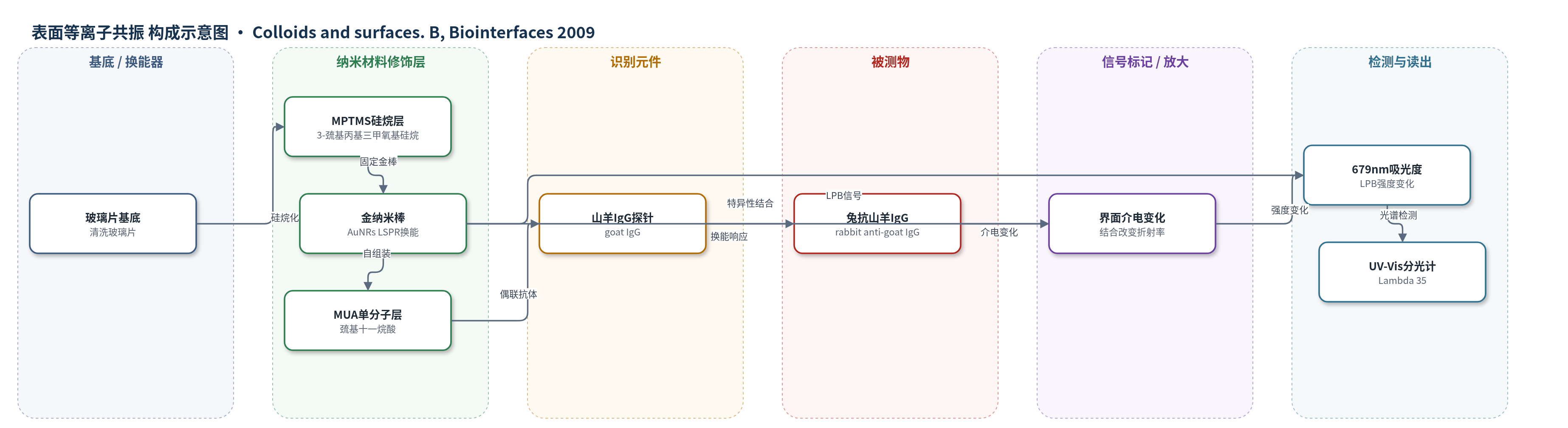
点击图片查看大图 · 依据论文自动绘制
传感器类型
表面等离子共振(SPR)生物传感器
检测对象
兔抗山羊IgG(rabbit anti-goat IgG),样品基质为PBS缓冲液/免疫检测样品(未明确临床基质)
检测原理
该传感器采用固定化金纳米棒作为光学换能元件。玻璃片经MPTMS修饰后固定金纳米棒,再用MUA自组装、EDC/NHS活化并偶联山羊IgG。当兔抗山羊IgG加入PBS样品时,与固定化山羊IgG发生特异性免疫结合,使金纳米棒周围局部介电常数/折射率升高。由于金纳米棒被固定,其浓度保持恒定,结合事件主要引起纵向等离子体带(LPB)在679 nm处的吸光强度增加,而峰位仅移动1–2 nm,因此以固定波长吸光度作为信号。分析物浓度越高,表面结合量越大,LPB强度线性增强,可实时监测结合动力学。
检测灵敏度
LOD: 0.1 pM;线性方程: Y = 0.0881 + 12.9502X;灵敏度斜率: 12.9502;线性回归系数: 0.9959
效应效果
该传感器以固定化金纳米棒为基底,避免游离纳米棒洗涤中浓度变化造成假信号。不同长径比金纳米棒固定化后对浓度响应相近,灵敏度不强烈依赖长径比。结合动力学显示大部分结合在前10 min完成,芯片可用酸、碱或高离子强度盐洗脱后重复使用。固定化金纳米棒4°C保存1年后消光谱基本不变,而游离金纳米棒会蓝移,稳定性更好。文中未报告RSD、实际样品回收率或系统抗干扰数据,但指出高浓度兔抗人IgG可能交叉反应。作者认为性能与动态SPR免疫检测相当,可实时监测受体-分析物反应,适用于蛋白质组学、系统生物学和体外诊断。
传感器的构成
- 基底:玻璃片(glass slides),经piranha溶液清洗,作为光学窗口和支撑基底。
- 硅烷化修饰层:3-巯基丙基三甲氧基硅烷(MPTMS),在玻璃表面形成巯基终止自组装层,用于固定金纳米棒。
- 换能纳米材料:金纳米棒(AuNRs),固定于玻璃表面,提供局域表面等离子共振(LSPR)光学换能。
- 识别元件修饰层:巯基十一烷酸(MUA),在金纳米棒表面形成自组装单分子层,提供羧基用于抗体偶联。
- 交联活化层:EDC/NHS,活化MUA羧基形成NHS酯,实现山羊IgG共价偶联。
- 识别元件:山羊IgG(goat IgG),作为固定化探针,特异性结合兔抗山羊IgG。
- 封闭剂:1 M乙醇胺(ethanolamine, pH 8.5),封闭未反应表面,减少非特异性吸附。
- 信号读出:UV-Vis分光光度计(Lambda 35),监测679 nm处纵向等离子体带(LPB)吸光强度变化。
中文摘要
本文报道了一种基于固定化金纳米棒局域表面等离子共振(LSPR)的无标记光学生物传感器。金纳米棒通过巯基丙基三甲氧基硅烷(MPTMS)修饰的玻璃片固定,再经巯基十一烷酸(MUA)自组装、EDC/NHS活化后共价偶联山羊IgG作为识别探针。与游离金纳米棒对纵向等离子体波长(LPW)变化敏感不同,固定化金纳米棒在受体-分析物结合时主要表现为纵向等离子体带(LPB)吸光强度变化,且峰位移动很小。以兔抗山羊IgG为模型分析物,在679 nm处监测LPB强度,得到浓度X与强度Y的线性关系Y=0.0881+12.9502X,线性回归系数为0.9959,检出限为0.1 pM。该传感器芯片在4°C保存1年后消光谱基本不变,可实时监测免疫结合动力学,性能与动态SPR免疫检测相当,适用于蛋白质组学、系统生物学和体外诊断。
英文摘要
We describe the fabrication and characterization of a localized surface plasmon resonance (LSPR) biosensor that utilizes gold nanorods immobilized as the optical transducer which requires the intensity change at a single wavelength to be monitored as a function of receptor-analyte binding at the nanorod surface. In contrary to free gold nanorods suspended in an aqueous solution with high sensitivity to the longitudinal plasmon wavelength to the surrounding environment, the intensity of the longitudinal plasmon band based on immobilized gold nanorods is more sensitive to changes in the surrounding dielectric properties than the change in the longitudinal plasmon wavelength. Quantitative calculation gives a linear equation between the concentration (X) of the test sample and intensity of LPB (Y) as Y=0.0881+12.9502X and 0.1 pM anti-goat can be detected using this IgG probe in this study. This sensor chip made of immobilized gold nanorods is very stable. The immobilized gold nanorods preserved under 4 degrees C for 1 year yield almost the same extinction spectrum as the original nanorods. This study reveals a reliable and sensitive method to measure the intensity of longitudinal plasmon bands based on the highly stable LSPR substrate. Moreover, the performance is comparable to dynamic SPR measurements in immunoassays and can monitor the receptor-analyte reactions in real time.