组成图示
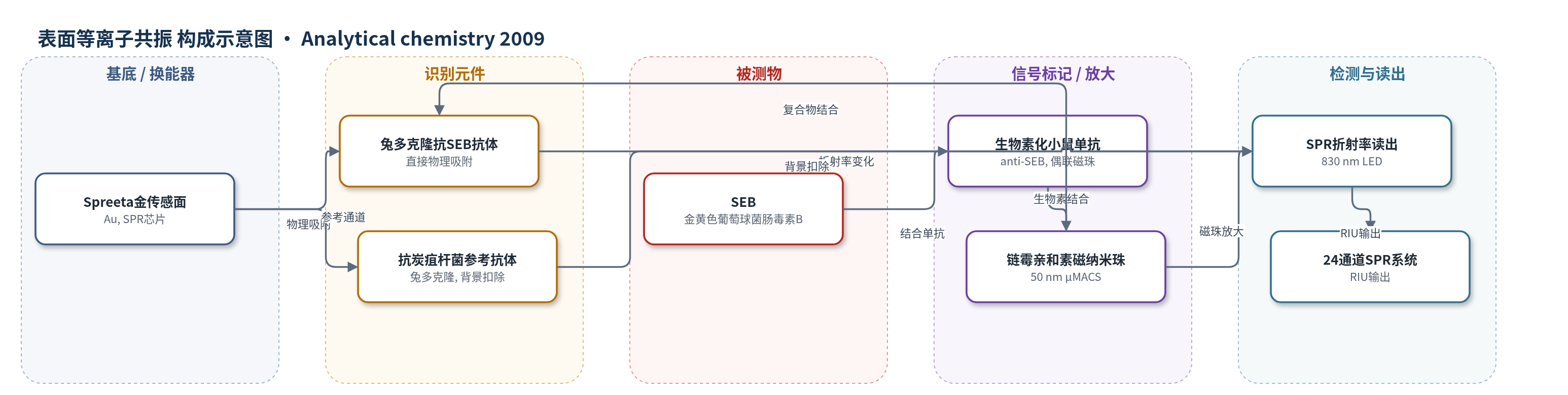
点击图片查看大图 · 依据论文自动绘制
传感器类型
表面等离子共振(SPR)生物传感器
检测对象
金黄色葡萄球菌肠毒素 B(Staphylococcal enterotoxin B, SEB);样品基质:PBS-T 缓冲液、人粪便、胎牛血清(FBS)
检测原理
兔多克隆抗SEB抗体物理吸附于Spreeta SPR芯片金表面,作为捕获识别元件;样品中SEB先与偶联在50 nm链霉亲和素磁纳米珠上的生物素化小鼠单克隆抗SEB抗体结合,形成“兔多抗—SEB—单抗—磁珠”复合物。磁珠用于磁分离、洗涤和10倍浓缩,去除复杂基质干扰;随后复合物注入传感面,SEB另一端与表面兔多抗结合。结合事件改变金表面附近约400 nm探测深度内的折射率,830 nm LED激发SPR,系统以RIU读出。50 nm磁珠位于探测范围内,其质量/折射率体积远大于SEB,因此显著放大RIU响应;双抗体识别不同表位同时提供特异性验证。SEB浓度越高,结合复合物越多,RIU响应越大。
检测灵敏度
可检测浓度: 100 pg/mL(缓冲液和粪便);测试浓度: 100、200、500、1000 pg/mL;1 ng/mL 经 IMB 处理可检测
效应效果
PBS-T中100、200、500、1000 pg/mL SEB响应为71±3.7、132±8.8、326±74.2、655±48.8 RIU;粪便中为46±4.6、76±4.3、183±17.0、372±12.9 RIU,三重复标准差显示可重复性。1 ng/mL经IMB处理后缓冲液信号663 RIU(58.2 RIU/min),粪便365 RIU(30.6 RIU/min),直接检测10 ng/mL仅7 RIU,背景约±1 RIU。参考通道非特异结合可忽略,未加标对照70/17 RIU已扣除。pH 2.2再生后粪便100、500、1000 pg/mL为33±7.4、156±7.1、269±19.8 RIU。相比ELISA 1 ng/mL和RPLA 2 ng/mL,该方法粪便可检测100 pg/mL,适用于食品安全与毒素监测。
传感器的构成
- 基底/换能器:Spreeta SPR 芯片金传感面(Au),承载抗体并产生 SPR 折射率信号
- 识别元件:兔多克隆抗 SEB 抗体(rabbit polyclonal anti-SEB),直接物理吸附于金表面,捕获 SEB
- 参考识别元件:兔多克隆抗 Bacillus anthracis 抗体(rabbit polyclonal anti-B. anthracis),修饰参考通道,用于扣除非特异背景
- 纳米材料修饰/捕获放大层:50 nm 链霉亲和素包被超顺磁纳米珠(Miltenyi µMACS streptavidin-coated magnetic nanobeads),用于磁分离、浓缩和 SPR 信号放大
- 识别/信号标记元件:生物素化小鼠单克隆抗 SEB 抗体(biotinylated murine monoclonal anti-SEB),通过链霉亲和素-生物素结合偶联到磁珠,捕获 SEB 并作为 SPR 放大标记
- 偶联化学:链霉亲和素-生物素(streptavidin-biotin),连接磁珠与生物素化抗体
- 样品处理/洗脱介质:PBS-T(含 0.1% Tween 20 的 PBS),用于孵育、洗涤和洗脱磁珠-SEB 复合物
- 再生剂:100 mM 甘氨酸 pH 2.2 缓冲液,用于洗脱传感面上结合的 SEB-磁珠复合物并再生表面
中文摘要
复杂基质中低浓度分析物的快速、灵敏、准确检测是关键挑战。血浆、尿液、粪便和环境样品中的干扰会降低生物传感器灵敏度与特异性。作者开发了基于抗体包被超顺磁纳米珠(免疫磁珠,IMBs)的方法,用于从复杂基质中快速纯化、浓缩并检测目标分析物。以金黄色葡萄球菌肠毒素B(SEB)为例,将IMBs用作检测放大器时,表面等离子共振(SPR)信号显著增强;采用10倍浓缩/纯化IMB协议后,检测灵敏度明显提高。该方法成功从血清和粪便样品中纯化浓缩SEB并放大SPR信号,在缓冲液和粪便中均可检测100 pg/mL的SEB。IMB协议还通过两种不同抗SEB抗体实现检测验证:磁纳米珠上偶联小鼠单克隆抗体,SPR传感面上固定兔多克隆抗体。使用pH 2.2缓冲液再生传感面后,同一传感面可多次检测粪便中的SEB。
英文摘要
Rapid, sensitive, and accurate detection of analytes present in low concentrations in complex matrixes is a critical challenge. One issue that affects many biosensor protocols is the number and nature of the interferences present in complex matrixes such as plasma, urine, stool, and environmental samples, resulting in loss of sensitivity and specificity. We have developed a method for rapid purification, concentration, and detection of target analytes from complex matrixes using antibody-coated superparamagnetic nanobeads (immunomagnetic beads, or IMBs). The surface plasmon resonance (SPR) detection signal from staphylococcal enterotoxin B (SEB) was dramatically increased when the IMBs were used as detection amplifiers. When SEB detection included a 10-fold concentration/purification IMB protocol, a substantial increase in detection sensitivity was observed. This procedure was used to successfully purify and concentrate SEB from serum and stool samples, then amplify the SPR detection signal. SEB at a concentration of 100 pg/mL was easily detected in both buffer and stool samples using this procedure. The IMB protocol also served to verify the analyte detection by using two different anti-SEB antibodies, mouse monoclonal antibodies attached to the magnetic nanobeads and rabbit polyclonal antibodies on the SPR sensor surface. Multiple detections of SEB in stool were performed using the same sensor surface by regenerating the sensor surfaces with a pH 2.2 buffer wash.