组成图示
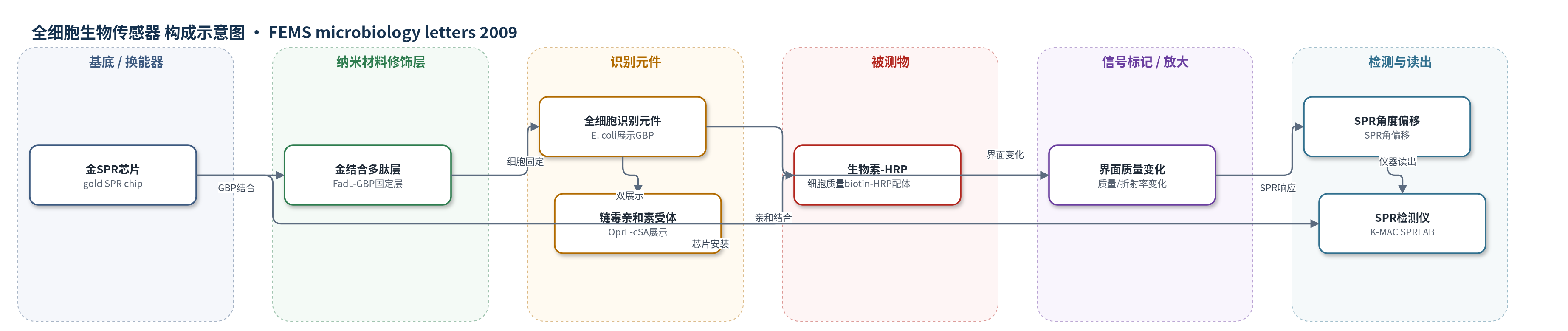
点击图片查看大图 · 依据论文自动绘制
传感器类型
全细胞生物传感器
检测对象
展示金结合多肽的大肠杆菌细胞(E. coli cells displaying FadL–GBP)、生物素–辣根过氧化物酶(biotin–HRP);样品基质为PBS缓冲液(pH 7.4)细胞悬液/溶液
检测原理
该传感器基于大肠杆菌细胞表面展示与SPR换能。截短FadL–GBP融合蛋白由tac启动子诱导展示于E. coli表面,GBP富含丝氨酸/苏氨酸,通过极性侧链与金薄膜SPR芯片非共价结合,使细胞稳定固定。细胞固定增加金表面界面质量/折射率,引起SPR共振角偏移;细胞浓度越高,固定量越大,角偏移越大(1×10^5、1×10^6、1×10^7 CFU/mL对应0.049°、0.248°、0.507°)。双展示系统中,OprF–cSA作为生物素受体,biotin-HRP结合后进一步增加界面质量,使SPR反射率/角度变化(9.95%至10.57%)。SPR仪实时无标记读出,无需酶促放大。
检测灵敏度
—
效应效果
选择性方面,展示FadL–GBP的XL1-Blue细胞固定后PBS洗涤1 h仍保留,SPR角偏移0.51°;无质粒XL1-Blue和仅展示cSA的XL1-Blue无角偏移且被洗去,说明GBP介导固定特异。稳定性方面,展示GBP细胞固定后PBS洗涤60 h,SPR角偏移0.51°且下降不超过0.1°,表明固定稳定。重复性方面,1×10^5、1×10^6、1×10^7 CFU/mL的SPR角偏移分别为0.049±0.007°、0.248±0.033°、0.507±0.043°。双展示XL10-Gold固定后SPR反射率由0.86%升至10.70%;biotin-HRP结合使双展示细胞SPR角由9.95%升至10.57%,仅GBP细胞变化小,HRP比色和SDS-PAGE支持。作者认为该平台可用于多功能全细胞生物传感器芯片和抗体库筛选。
传感器的构成
- 基底/换能器:金薄膜SPR传感芯片(gold-thin-layered sensor chip, K-MAC SPRLAB),提供SPR换能表面和GBP结合位点
- 识别/固定元件:大肠杆菌(E. coli XL1-Blue/XL10-Gold)表面展示的截短FadL–GBP融合蛋白,通过GBP特异性结合金表面实现细胞固定
- 双展示识别元件:大肠杆菌XL10-Gold表面展示的截短OprF–cSA融合蛋白,作为生物素结合受体捕获biotin-HRP
- 信号标记物:生物素–辣根过氧化物酶(biotin-HRP),与cSA结合后改变SPR界面质量并可用比色法验证HRP活性
- 表达调控元件:tac启动子与IPTG(1 mM),诱导fadL-GBP和oprF-cSA融合基因表达
- 质粒载体:pTacFadLGBP-1(pBR322 ori)和pACYCtacOprF164cSA(p15A ori),分别携带并表达两种融合蛋白实现双展示
- 缓冲介质:PBS(pH 7.4),用于细胞重悬、芯片平衡和洗去未结合组分
- 检测仪器:SPR仪(K-MAC SPRLAB),实时无标记监测金表面SPR角度/反射率变化
中文摘要
本研究采用细胞表面展示策略,将金结合多肽(GBP)融合蛋白展示于大肠杆菌表面,从而实现细胞在金表面的固定。编码GBP的DNA与截短fadL基因融合,由tac启动子表达;为展示Streptomyces avidinii的核心链霉亲和素(cSA),将cSA基因与截短oprF基因融合。在大肠杆菌表面同时展示FadL–GBP和OprF–cSA后,利用表面等离子共振(SPR)分析研究细胞在金表面的结合以及OprF–cSA与生物素–辣根过氧化物酶(HRP)的相互作用。展示FadL–GBP的细胞可固定于SPR传感芯片上,SPR角偏移为0.51,并在洗涤液中稳定保持至少60 h。当同一细胞表面同时展示FadL–GBP和OprF–cSA时,前者用于将细胞固定于金表面,后者用于与生物素–HRP的相互作用研究,表明该策略可用于开发全细胞生物传感器芯片。
英文摘要
Cell surface display was used as a strategy to display the gold-binding polypeptide (GBP) fusion protein on the surface of Escherichia coli, and consequently to immobilize the cells on the gold surface. The DNA encoding the GBP was fused to the truncated fadL gene and was expressed by the tac promoter. For the display of the core streptavidin (cSA) of Streptomyces avidinii, the cSA gene was fused to the truncated oprF gene. After the dual display of FadL-GBP and OprF-cSA on the surface of E. coli, binding of cells on the gold surface and the interaction of OprF-cSA with the biotin-horseradish peroxidase (HRP) were studied by surface plasmon resonance (SPR) analysis. Cells displaying the FadL-GBP fusion protein could be immobilized on the SPR sensor chip as shown by the SPR angle shift of 0.5 degrees , which was stably bound at least for 60 h with a washing solution. When the FadL-GBP and OprF-cSA fusion proteins were displayed on the same cell surface, the former was used to immobilize the cells on the gold surface and the latter was used for the interaction studies with the biotin-HRP, which demonstrates that the strategy should be useful for developing whole-cell biosensor chips.