组成图示
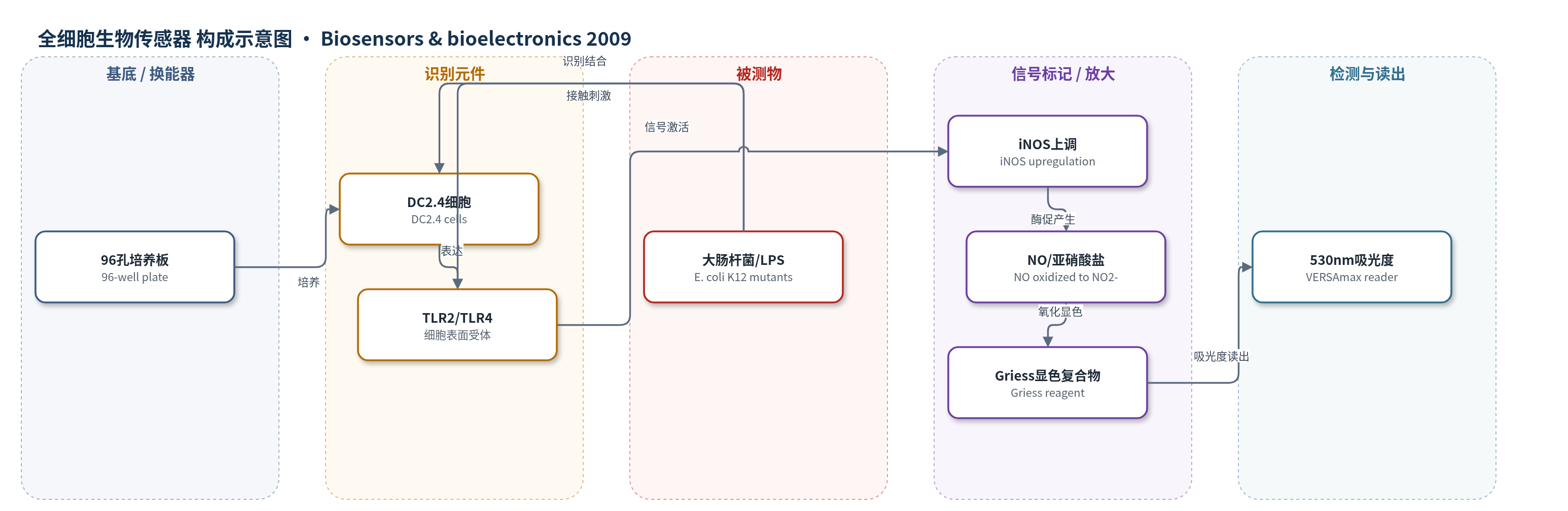
点击图片查看大图 · 依据论文自动绘制
传感器类型
全细胞生物传感器
检测对象
大肠杆菌K12 D21及其LPS突变体(E. coli K12 D21, D21f1, D21f2, D21e7, D21e19)、脂多糖(LPS);样品基质:细菌悬液/细胞培养上清
检测原理
DC2.4细胞表面的Toll样受体2/4(TLR2/TLR4)识别大肠杆菌K12 D21及其突变体表面的脂多糖(LPS)。LPS与TLR结合后激活细胞内信号级联,经NF-κB等通路诱导诱导型一氧化氮合酶(iNOS)表达,使细胞产生一氧化氮(NO)。NO在生理条件下迅速氧化为亚硝酸盐(NO2-),上清中的NO2-与Griess试剂中的磺胺酸和N-(1-萘基)乙二胺二盐酸盐发生偶联显色反应,生成在530 nm处有特征吸光度的有色产物。吸光度与NO生成量相关,从而反映细菌/LPS刺激强度。不同LPS核心寡糖结构改变TLR识别与下游信号效率,导致NO产生的时间动力学和剂量响应差异,因此可通过响应速率和强度区分菌株。
检测灵敏度
LOD: 2–3 bacteria/cell;剂量响应范围: 2.5–50 bacteria/DC
效应效果
DC2.4细胞在不同培养代次(9、12、15、18天)下对10 nM LPS的NO响应波动在3.5%以内,未刺激时NO产生不显著,稳定性较好。时间响应显示,短核心寡糖突变体D21f1、D21f2、D21e7在30 min内出现显著NO,而D21e19和D21有约1 h滞后;前30 min NO产生速率顺序为D21f2 > D21f1 > D21e7 > D21e19、D21。剂量响应在2.5–50 bacteria/DC范围内,低于12.5 bacteria/DC时菌株差异不显著,高于25 bacteria/DC时差异明显。与RAW264.7巨噬细胞相比,DC2.4能区分LPS突变体,而巨噬细胞差异不明显。作者认为其可用于临床诊断、食品分析和环境监测。
传感器的构成
- 培养基底:96孔板/6孔板(96-well/6-well plates),承载DC2.4细胞并容纳细菌样品与上清
- 细胞识别/换能层:DC2.4树突状细胞系(DC2.4 dendritic cell line),作为活细胞传感元件,响应LPS刺激
- 识别元件:Toll样受体2/4(TLR2/TLR4),位于DC2.4细胞表面,识别LPS并启动信号转导
- 信号产物:一氧化氮(NO)及其氧化产物亚硝酸盐(NO2-),由诱导型一氧化氮合酶(iNOS)产生,作为可检测信号
- 显色试剂:Griess试剂(sulfanilic acid、N-(1-naphthyl)ethylenediamine dihydrochloride),与亚硝酸盐反应生成有色产物
- 读出层:VERSAmax微孔板读板机(VERSAmax microplate reader),在530 nm检测吸光度
中文摘要
树突状细胞(DCs)是一类专职抗原呈递细胞,通过模式识别受体(PPRs),尤其是Toll样受体(TLRs),在感知和处理微生物信息中发挥关键作用。本研究以DC2.4细胞系作为细胞源,证明其可用于微生物的检测与区分,从而发展细胞基生物传感器。作为原理验证,采用革兰氏阴性菌大肠杆菌K12 D21菌株及其脂多糖(LPS)突变体作为模型靶标。通过监测细菌刺激后DCs产生的一氧化氮(NO),并采用比色Griess法定量NO水平。结果表明,DCs能在数分钟内检测并区分细胞表面成分(即LPS)组成存在细微差异的微生物。尽管当前基于比色的NO检测限制了灵敏度,但DCs可检测低至每细胞2–3个细菌。与巨噬细胞相比,DCs在区分LPS突变体方面更具优势。本研究证明DCs具有作为新型细胞基生物传感器细胞源的巨大潜力,可用于高选择性、高灵敏度和快速响应地检测微生物;若与其他生物传感器平台耦合,有望进一步提高灵敏度。
英文摘要
Dendritic cells (DCs) are a specialized family of antigen presenting cells. They play critical roles in sensing and processing microbial information through a series of pattern recognition receptors (PPRs), including the well-characterized toll-like receptors (TLRs). In this study, we demonstrated the utilization of a DC cell line, DC2.4, as a cell source for the detection and differentiation of microbes towards the development of cell-based biosensors. As a proof of principle, the gram-negative bacteria Escherichia coli K12 strain D21 and its lipopolysaccharide (LPS) mutants were used as model targets. The stimulation of DCs by bacterial strains was monitored by the production of nitric oxide (NO), and the colorimetric Greiss assay was used to quantify the level of NO produced. Our results demonstrated that DCs could detect and differentiate microbes with subtle differences in the composition of specific cell surface components, i.e. LPS, within minutes. Though the current colorimetric-based NO assay limited the detection sensitivity, we showed that DCs were able to detect as low as 2-3 bacteria per cell. Furthermore, compared to macrophages, DCs were superior in discriminating LPS mutants. Our study demonstrates that DCs possess great potential as cell sources for the development of novel cell-based biosensors for detecting microbes with high selectivity and sensitivity and rapid responsiveness. In addition, when DCs are coupled with other biosensor platforms, higher sensitivity can be expected.