组成图示
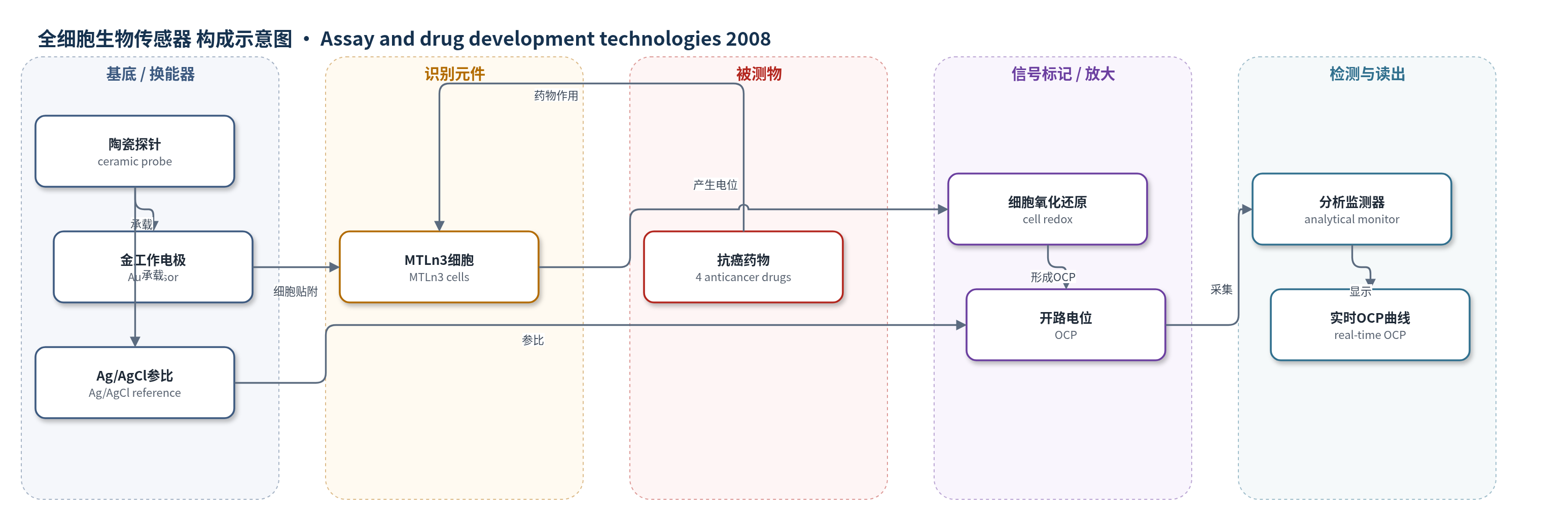
点击图片查看大图 · 依据论文自动绘制
传感器类型
全细胞生物传感器
检测对象
抗癌药物(cisplatin 顺铂、doxorubicin 阿霉素、paclitaxel 紫杉醇、vinblastine 长春碱)诱导的 MTLn3 细胞开路电位响应;样品基质:体外细胞培养液(MEM α 培养基)
检测原理
该传感器以贴附于金电极表面的 MTLn3 细胞作为识别元件。抗癌药物作用于细胞后,引起细胞凋亡、膜完整性改变、代谢及氧化还原反应变化,并改变细胞-金界面处的离子梯度与电子转移状态。金工作电极与 Ag/AgCl 参比电极之间被动测量开路电位(OCP),无需外加电压或外源标记。药物诱导的细胞损伤越强,OCP 下降越明显且出现越早;换液后若细胞可恢复,OCP 可回升。分析监测器每 10 min 采样,实时输出 OCP-时间曲线,从而比较不同药物的细胞毒性。
检测灵敏度
原文未报告 LOD、线性范围、灵敏度斜率或相关系数。
效应效果
体外实验中,四种药物均引起 MTLn3 细胞 OCP 变化;顺铂和阿霉素在 24 h 内使 OCP 明显降低,紫杉醇和长春碱响应较弱,换液后 42 h 左右开始恢复。体内实验使用 50 只 Fischer 344 大鼠,分 5 组、每组 10 只,第 12 天给药,14 天后称量肿瘤;顺铂和阿霉素组肿瘤重量较对照组、紫杉醇组和长春碱组显著降低(P<0.05)。与 LDH 释放和 Alamar Blue 终点法相比,OCP 法能更好预测体内药效:LDH 仅阿霉素组明显升高,Alamar Blue 各组降低幅度相近。作者认为该实时、非破坏性电化学方法可用于抗癌药物筛选。
传感器的构成
- 基底/换能器:陶瓷探针(ceramic probe)与亚克力培养腔(acrylic culture vessel),构成一次性多孔培养平台
- 工作电极:丝网印刷金电极(screen-printed gold sensors,1 mm),细胞贴附并传递开路电位
- 参比电极:银/氯化银电极(Ag/AgCl reference electrode),提供稳定电位参考
- 绝缘层:介电绝缘层(dielectric insulating layer),覆盖电极走线并隔离信号
- 互连层:金走线(gold tracking)与镀金弹簧触点(gold-plated spring-loaded contacts),连接电极与分析监测器
- 识别元件:大鼠乳腺腺癌 MTLn3 细胞(MTLn3 cells),贴附于金电极表面作为全细胞识别与信号源
- 培养介质:MEM α 培养基含 10% 胎牛血清(FBS)及抗生素/抗真菌剂,用于细胞接种与维持
- 分析监测器:Uniscan 分析监测器(analytical monitor),采集并实时显示 OCP
中文摘要
本文报道了一种电化学生物传感器 Oncoprobe 在体外抗癌药物筛选中的应用。将大鼠乳腺腺癌 MTLn3 细胞接种于传感器表面,分别暴露于顺铂、阿霉素、紫杉醇和长春碱四种细胞毒性抗癌药物,并连续监测 44 小时。实时电化学监测显示,四种药物均引起开路电位(OCP)变化,其中顺铂和阿霉素在更短时间内产生更大的 OCP 改变,而长春碱和紫杉醇响应较弱。随后,利用同基因型 MTLn3 细胞在 50 只雌性 Fischer 344 大鼠乳腺脂肪垫中建立可触及肿瘤模型,将动物分为五组,每组 10 只;第 12 天四组分别接受一种抗癌药物,一组接受生理盐水对照。14 天后处死动物并称量原发肿瘤。结果显示,顺铂和阿霉素处理组肿瘤重量较对照组、紫杉醇组和长春碱组显著降低。体外实时电化学监测所获得的药物诱导变化与体内动物模型结果良好相关,而常规终点法乳酸脱氢酶释放和 Alamar Blue 检测未能有效预测体内药效。
英文摘要
We report the application of an electrochemical biosensor (Oncoprobe; Marks & Clerk, Manchester, UK) to determine whether changes in the open circuit potential (OCP) of rat mammary adenocarcinoma cells (MTLn3) treated in vitro with four cytotoxic anticancer drugs could predict their effects in vivo. MTLn3 cells were seeded onto sensors, then exposed to each anticancer compound (cisplatin, doxorubicin, paclitaxel, or vinblastine), and monitored for 44 hours. Electrochemical monitoring in vitro detected OCP responses to all four drugs, with cisplatin and doxorubicin producing greater changes over a shorter period than vinblastine and paclitaxel. Syngeneic MTLn3 cells were used to generate palpable tumors in 50 female Fischer 344 rats. Animals were divided into five equal groups; on day 12 four of the groups received an anticancer drug, and one received a saline control. Fourteen days later the animals were killed, and primary tumor weights were determined. Tumors from cisplatin- and doxorubicin-treated rats were significantly reduced in weight compared to the control, paclitaxel-, and vinblastine-treated groups. The anticancer drug-induced changes observed through real-time electrochemical monitoring of MTLn3 cells in vitro correlated well with the in vivo animal model, unlike the conventional end-point assays of lactate dehydrogenase release and Alamar Blue.