组成图示
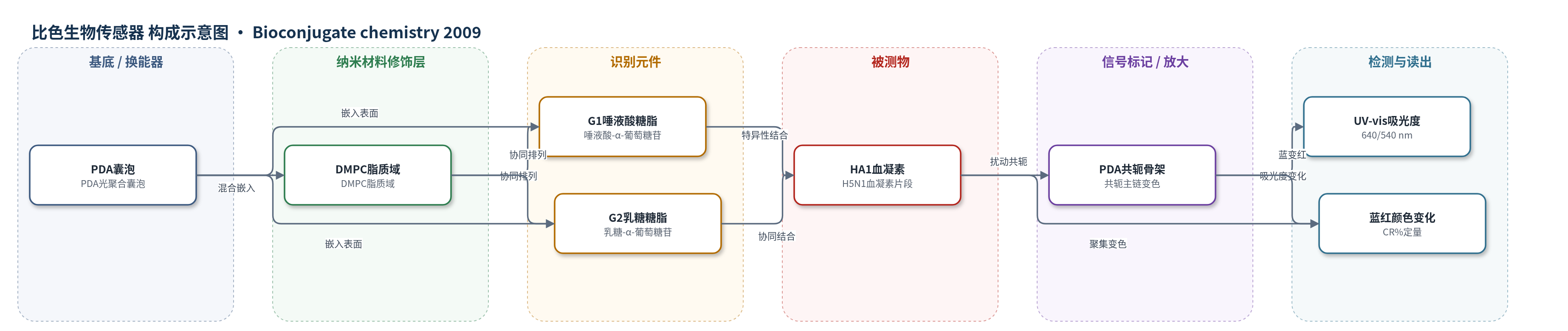
点击图片查看大图 · 依据论文自动绘制
传感器类型
比色生物传感器
检测对象
禽流感 H5N1 血凝素 HA1(Hemagglutinin HA1);样品基质:磷酸盐缓冲液/水溶液(pH 6.9)
检测原理
PDA 囊泡表面嵌入 G1 唾液酸糖脂和 G2 乳糖糖脂,头基朝外模拟细胞表面糖脂受体。HA1 主要与 G1 唾液酸结合,G2 虽非直接配体,但通过表面组合形成协同识别位点,增强结合与信号。结合后 HA1 覆盖囊泡表面并诱导囊泡形貌变化与聚集,扰动 PDA 主链的交替烯炔共轭长度,使吸收峰由约 640 nm 蓝移/红移至约 540 nm,宏观颜色由蓝变红。颜色响应 CR% 随 HA1 浓度增加而增大。该体系无酶或核酸放大,主要依靠多糖脂协同、DMPC 域增强和 PDA 共轭结构变化实现信号放大。
检测灵敏度
LOD: 10 ng/mL;响应时间: 5 min
效应效果
该比色囊泡对 HA1 具有良好选择性:BSA 和大肠杆菌 DH5R 在至少 5 min 内不引起明显变色;单独 G2 囊泡无结合,单独 G1 囊泡变色较弱。G1/G2=5:5 的混合囊泡在 10 ng/mL HA1 下出现显著蓝红变色,CR% 排序为 5:5 > 7:3 > 3:7 > 9:1 > 1:0 ≈ 1:9 > 0:1,显示 G1 与 G2 强协同。TEM 显示结合后囊泡由球形变为扁平矩形并聚集,ζ 电位逐渐变负并趋于稳定。作者称其响应快、灵敏度高,优于已知 HA1 生物传感器,可用于 H5N1 诊断、受体库及药物代谢/药代研究;文中未报告实际样品回收率或与 ELISA/HPLC/qPCR 的定量对比。
传感器的构成
- 基底/换能器:聚二炔(PDA,10,12-pentacosadiynoic acid)囊泡,经 254 nm 光聚合形成共轭主链,作为蓝红变色换能元件。
- 膜基质:二肉豆蔻酰磷脂酰胆碱(DMPC)与 PDA 按 4:6 摩尔比组成混合囊泡,DMPC 域提高敏感性并允许脂溶性生物分子插入。
- 识别元件:唾液酸-α-葡萄糖苷(G1)和乳糖-α-葡萄糖苷(G2)单头糖脂,含四乙二醇间隔臂和 C12 烃链,嵌入囊泡表面且头基朝外,模拟细胞表面糖脂受体。
- 信号标记物:无外源标记物,PDA 共轭主链本身作为信号换能/标记元件,结合 HA1 后发生蓝红变色。
- 封闭剂/电子供体:原文未提及。
中文摘要
快速灵敏检测流行病毒对公共卫生至关重要。现有基于宿主细胞糖脂与入侵病毒结合事件的生物传感器难以模拟细胞表面多头糖脂受体,因化学合成复杂。本文提出一种新策略,将两种单头糖脂——活性唾液酸-α-葡萄糖苷(G1)和非活性乳糖-α-葡萄糖苷(G2)——嵌入聚二炔(PDA)囊泡表面,以模拟天然细胞表面糖脂受体。所制备囊泡对禽流感 H5N1 血凝素 HA1 表现出良好选择性,检出限为 10 ng/mL,响应时间约 5 min,灵敏度高于已知 HA1 生物传感器。研究还发现 G1 与 G2 在变色囊泡形成中存在强协同效应,为构建高效生物传感器受体提供了新策略,也为研究流行病免疫学中的表面结合效应提供了新途径。
英文摘要
Fast and sensitive detection of epidemic virus is of the utmost importance for human being in nowadays. Various biosensors have been designed for this goal based on conjugation event between host cell glycolipids and invading virus. However, multihead glycolipids analogous to native receptors on cell surface are known to be very difficult to mimic because of the complexity of chemical synthesis. Here, we developed a new approach where two types of monohead glycolipids, active sialic acid-beta-glucoside (G1) and inactive lactose-beta-glucoside (G2), are embedded onto the surface of a polydiacetylene (PDA) vesicle to mimic native glycolipids on the cell surface. Vesicles prepared in this manner show good selectivity with a 10 ng/mL detection limit and 5 min response time to Hemagglutinin (HA1), which is more sensitive than any HA1 biosensors ever known. Moreover, in the formation of color-changeable vesicles, a very strong synergistic effect between G1 and G2 has been found, offering a novel strategy to construct effective biosensor receptors, as well as a new way to study the surface combination effect that is potentially important to the immunology study of epidemic disease.