组成图示
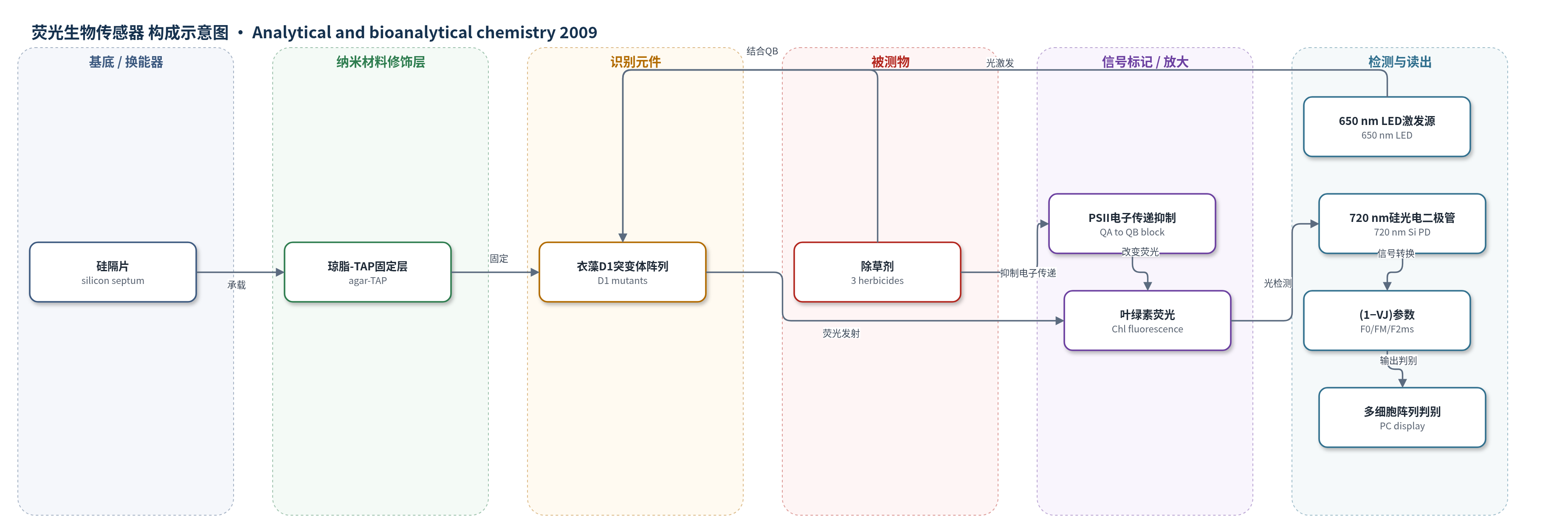
点击图片查看大图 · 依据论文自动绘制
传感器类型
荧光生物传感器
检测对象
莠去津(atrazine)、丙草丹(prometryn)、莠灭净(diuron);样品基质为含除草剂的水样/溶液(环境水样筛查)
检测原理
该传感器以衣藻完整细胞中的光系统II(PSII)为生物识别与换能单元。D1蛋白QB位点与三嗪类或脲类除草剂结合后,阻断初级受体QA向次级醌QB的电子传递,使QA−再氧化速率下降。暗适应藻体经650 nm LED激发后,叶绿素荧光诱导曲线(Kautsky曲线)的初始荧光F0、最大荧光FM和2 ms荧光F2ms发生变化,仪器据此计算相对可变荧光VJ=(F2ms−F0)/(FM−F0)及其互补参数(1−VJ)。除草剂浓度越高,电子传递抑制越强,(1−VJ)偏离基线越明显。通过定点突变改变D1蛋白QB口袋结构,获得不同敏感性和抗性的突变体阵列,实现除草剂亚类选择性识别;系统无化学放大,主要依靠工程化生物介导剂提高响应差异。
检测灵敏度
LOD (M): IL: atrazine 1.60×10⁻⁹, prometryn 6.50×10⁻¹⁰, diuron 2.35×10⁻¹⁰; I163N: atrazine 1.33×10⁻⁹, prometryn nd, diuron 2.35×10⁻¹⁰; F255N: atrazine 1.90×10⁻⁹, prometryn 5.12×10⁻¹⁰, diuron nr; A251C: atrazine 7.29×10⁻¹⁰, prometryn 1.08×10⁻⁹, diuron 5.87×10⁻¹⁰; A250R: atrazine 8.38×10⁻¹⁰, prometryn 3.52×10⁻¹⁰, diuron 6.40×10⁻¹⁰; A250L: atrazine 9.95×10⁻¹⁰, prometryn 3.12×10⁻¹⁰, diuron 6.40×10⁻¹⁰
效应效果
系统含24个测量细胞,可同测野生型IL、5个D1突变体及不同浓度除草剂,单次测量约20 s,快于色谱法。突变体LOD达10−10 M量级,较IL提高1–2个数量级;I163N对10−7 M atrazine最敏感,A250R对5.0×10⁻⁸ M prometryn敏感,A250L和A250R对10−7 M prometryn敏感。A250R、A250L、A251C、I163N对三嗪类和脲类敏感,F255N对脲类及diuron、atrazine抗性较强,可区分除草剂亚类。固定化藻体在琼脂-TAP/硅隔片上保持约1个月100%稳定性。作者认为该荧光阵列适合环境水样中多种除草剂快速预筛,阳性样品再送色谱分析。
传感器的构成
- 光学换能器:OPTICBIO-Multicell荧光仪,650 nm LED激发源与720 nm硅光电二极管(Si PD)及滤光片,用于激发和检测叶绿素荧光
- 测量细胞:24个由聚碳酸酯(polycarbonate)窗口分隔的生物/光学隔室,支持静态或流动测量
- 固定化基底:1 cm硅隔片(silicon septum,Pyrex/Bibby Sterlin),承载生物介导剂并适配测量细胞
- 固定化介质:琼脂-TAP培养基(agar–TAP),包埋并固定衣藻细胞
- 生物识别元件:衣藻野生型IL及D1蛋白突变株A250R、A250L、A251C、I163N、F255N,PSII D1蛋白QB位点作为除草剂识别位点
- 信号标记物:叶绿素荧光(chlorophyll fluorescence),以Kautsky曲线参数F0、FM、F2ms和(1−VJ)反映PSII电子传递抑制
- 样品接触层:含atrazine、prometryn、diuron的溶液,以静态或流动方式接触固定化藻
- 信号读出:仪器自动计算(1−VJ)并在PC显示,用于多生物介导剂阵列判别
中文摘要
本文报道了一种基于多生物介导剂的荧光生物传感器演示系统,用于快速筛查环境样品中的除草剂。系统以单细胞绿藻衣藻(Chlamydomonas reinhardtii)为生物识别元件,利用光系统II(PSII)中D1蛋白QB位点与除草剂结合后抑制QA到QB电子传递的机制,通过叶绿素荧光诱导曲线(Kautsky曲线)参数(1−VJ)的变化进行定量检测。作者通过定点突变构建A250R、A250L、A251C、I163N和F255N等D1突变株,并将其固定于琼脂-TAP/硅隔片上,置于OPTICBIO-Multicell多细胞荧光仪中,以650 nm LED激发、720 nm光电二极管检测。结果表明,A250R、A250L、A251C和I163N对三嗪类和脲类除草剂高度敏感,F255N对脲类除草剂表现出较强抗性,突变体阵列可实现不同除草剂亚类的选择性监测。
英文摘要
The unicellular green alga Chlamydomonas reinhardtii is employed here for the setup of a biosensor demonstrator based on multibiomediators for the detection of herbicides. The detection is based on the activity of photosystem II, the multienzymatic chlorophyll-protein complex located in the thylakoid membrane that catalyzes the light-dependent photosynthetic primary charge separation and the electron transfer chain in cyanobacteria, algae, and higher plants. Several C. reinhardtii mutants modified on the D1 photosystem II protein are generated by site-directed mutagenesis and experimentally tested for the development of a biosensor revealing the modification of the fluorescence parameter (1 - V (J)) in the presence of herbicides. The A250R, A250L, A251C, and I163N mutants are highly sensitive to the urea and triazine herbicide classes; the newly generated F255N mutant is shown to be especially resistant to the class of urea. It follows that the response of the multibiomediators is associated to a particular herbicide subclass and can be useful to monitor several species of pollutants.