组成图示
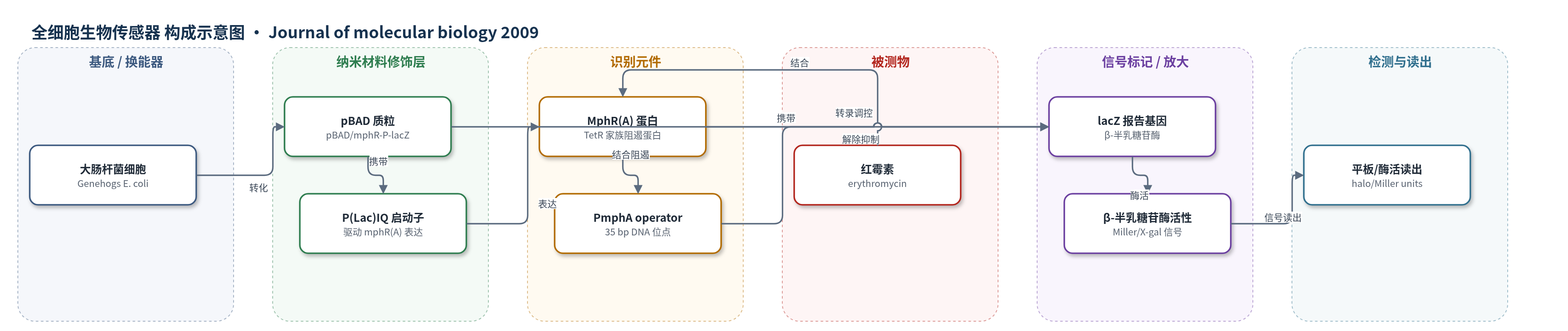
点击图片查看大图 · 依据论文自动绘制
传感器类型
全细胞生物传感器
检测对象
红霉素(erythromycin, ERY);样品基质:软琼脂平板/细胞培养物,文中亦提及链霉菌发酵提取物。
检测原理
MphR(A) 以同源二聚体形式存在,N 端 HTH 基序识别并结合 35 bp PmphA 操纵序列,阻遏下游 lacZ 报告基因转录。红霉素进入由 α4–α8 螺旋和二聚体界面围成的疏水口袋,与 R122、N123、H147 等残基形成氢键和静电作用。配体结合引起二聚体构象变化,HTH 域间距从无配体 42.9 Å 增至结合态 46.3 Å,降低 DNA 亲和力并释放操纵序列,使 PmphA-lacZ 转录。β-半乳糖苷酶活性随红霉素浓度升高而增加,在 125 μM 达到约 1250 Miller units,较背景 30 Miller units 提高约 41 倍。系统通过 P(Lac)IQ 过表达 MphR(A) 补偿其较低 DNA 结合亲和力,未使用额外化学放大。
检测灵敏度
未报告 LOD、线性范围、灵敏度斜率或相关系数。
效应效果
在无红霉素条件下,工程化细胞对 lacZ 报告基因保持约 100% 阻遏,活性接近背景 30 Miller units;加入红霉素后呈浓度依赖性激活,125 μM 时达到 1250 Miller units,约 41 倍诱导,但低于缺乏 mphR(A) 对照的 4000 Miller units,可能受细胞内抗生素浓度与毒性限制。平板扩散实验显示红霉素滤纸周围出现与浓度梯度相关的表达晕圈。突变分析表明 L30H、L44S、A153T 使阻遏功能丧失,活性约 3000 Miller units;V66L 和 V126L 保留阻遏但削弱红霉素结合,125 μM 时仅 149 和 63 Miller units。作者认为该全细胞线路可用于快速筛选大环内酯类抗生素及指导天然产物工程合成。
传感器的构成
- 细胞基底:Genehogs 大肠杆菌(E. coli)细胞,作为全细胞表达与传感平台。
- 遗传载体:pBAD 质粒(pBAD/mphR-P-lacZ),携带 mphR(A) 与 PmphA-lacZ 报告模块。
- 表达调控元件:P(Lac)IQ 强组成型启动子,驱动 mphR(A) 过表达以补偿低 DNA 亲和力。
- 识别元件:MphR(A) 蛋白(TetR 家族阻遏蛋白),结合大环内酯并调控 PmphA 启动子。
- 识别序列:35 bp DNA operator/PmphA 启动子,位于 mphA 起始密码子上游,被 MphR(A) 结合阻遏。
- 信号标记:lacZ 报告基因,编码 β-半乳糖苷酶(β-gal),作为可定量读出信号。
- 检测底物:X-gal 底物,用于平板显色;Miller 测定底物,用于酶活定量。
中文摘要
调控蛋白 MphR(A) 近期在合成生物学中用于代谢物传感和外源基因表达控制。该蛋白通过结合位于 mphA 起始密码子上游的 35 bp DNA 操纵序列,负向调控大环内酯 2′-磷酸转移酶 I 抗性基因 mphA 的表达,并在红霉素存在下解除抑制。本文报道了无红霉素结合态 MphR(A) 及红霉素结合态 MphR(A) 的精细晶体结构,分辨率分别为 2.00 Å 和 1.76 Å。作者还研究了该蛋白的 DNA 结合性质,并在基于细胞的报告子体系中鉴定了基因阻遏缺陷和配体结合缺陷突变体。两种结构共同阐明了红霉素诱导基因表达的分子基础,为将该蛋白用于大环内酯类天然产物的分离筛选和工程化生物合成提供了结构框架。
英文摘要
The regulatory protein MphR(A) has recently seen extensive use in synthetic biological applications, such as metabolite sensing and exogenous control of gene expression. This protein negatively regulates the expression of a macrolide 2'-phosphotransferase I resistance gene (mphA) via binding to a 35-bp DNA operator upstream of the start codon and is de-repressed by the presence of erythromycin. Here, we present the refined crystal structure of the MphR(A) protein free of erythromycin and that of the MphR(A) protein with bound erythromycin at 2.00- and 1.76-A resolutions, respectively. We also studied the DNA binding properties of the protein and identified mutants of MphR(A) that are defective in gene repression and ligand binding in a cell-based reporter assay. The combination of these two structures illustrates the molecular basis of erythromycin-induced gene expression and provides a framework for additional applied uses of this protein in the isolation and engineered biosynthesis of polyketide natural products.