组成图示
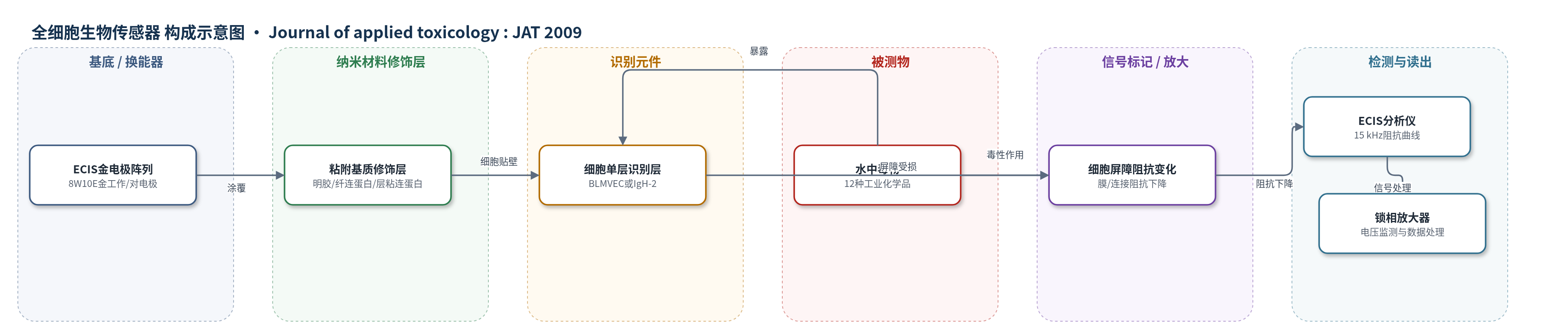
点击图片查看大图 · 依据论文自动绘制
传感器类型
全细胞生物传感器
检测对象
乙草丹(aldicarb)、氨(ammonia)、砷(arsenic)、铜(copper)、氰化物(cyanide)、汞(mercury)、甲胺磷(methamidophos)、烟碱(nicotine)、百草枯(paraquat)、五氯酚钠(pentachlorophenate)、苯酚(phenol)、甲苯(toluene);样品基质为水样(去离子水配制的毒物溶液/饮用水)
检测原理
传感器以金电极上的致密细胞单层为识别与响应元件。细胞贴附并铺展后,细胞膜及细胞间连接阻碍离子在工作电极与对电极间流动,使阻抗升高。加入含毒物的水样后,毒物改变细胞形态、细胞-基质或细胞-细胞相互作用,使屏障通透性增加,阻抗随毒物浓度和作用时间下降。ECIS通过1 MΩ电阻施加15 kHz、1 V交流信号,锁相放大器监测工作电极与对电极间电压,计算归一化阻抗曲线;在5–20 min窗口内比较暴露组与对照组,浓度越高阻抗下降越明显。该法无化学放大,直接以细胞生理响应作为信号。
检测灵敏度
最低效应浓度(LECs, μM):BLMVEC: aldicarb 105, ammonia 400, arsenic 40, copper 8, cyanide 230, mercury 2.5, methamidophos >1170, nicotine 40, paraquat 97.2, pentachlorophenate 3.8, phenol 270, toluene 240;IgH-2: aldicarb 105, ammonia 400, arsenic 4, copper 8, cyanide 23, mercury 2.5, methamidophos 117, nicotine 40, paraquat 972, pentachlorophenate 38, phenol 270, toluene 2400。
效应效果
作者筛选10种细胞系,4种可在ECIS芯片形成稳定单层;BLMVEC与IgH-2在1 h内对12种水中毒物中9种产生响应,优于BPAEC的7种。37 d长期培养中,BLMVEC(纤连蛋白、10% FBS)阻抗由2064±87 Ω降至2004±26 Ω,降幅3%;IgH-2(明胶、1% FBS)由1444±77 Ω降至1333±101 Ω,降幅8%,均低于20%阈值。前期研究显示BPAEC-ECIS对硬水和常见水添加剂干扰低,且为盲测中响应毒物最多的三种传感器之一。作者认为该全细胞阻抗传感器适合现场饮用水毒性筛查。
传感器的构成
- 换能器电极:ECIS芯片(8W10E)底部10个直径250 μm金工作电极和1个金对电极,施加15 kHz交流信号并测量阻抗
- 粘附修饰层:明胶(gelatin)、纤连蛋白(fibronectin)、层粘连蛋白(laminin)、I/IV型胶原(collagen I/IV)或多聚赖氨酸(poly-D-lysine)涂覆金电极,促进细胞贴壁
- 识别/响应元件:牛肺微血管内皮细胞(BLMVEC)或鬣蜥心脏细胞(IgH-2)致密单层,细胞膜与细胞间连接阻碍离子流,毒物引起阻抗变化
- 样品介质:无血清培养基含0.5%牛血清白蛋白(BSA),作为电解质并维持渗透压,用于加入毒物水样
- 培养维持层:含1%胎牛血清(FBS)培养基,用于37天维持细胞单层活力
- 信号读出:ECIS 1600分析仪与锁相放大器,经1 MΩ电阻施加15 kHz、1 V交流信号并监测工作电极-对电极间电压
中文摘要
针对现场水样毒性检测中传感器灵敏度与长期存活难以兼顾的问题,本研究基于电细胞-基底阻抗传感(ECIS)技术改进全细胞毒性传感器。作者筛选人源、非人哺乳动物及非哺乳脊椎动物细胞系,评估其对12种水溶性工业化学品的响应。结果表明,牛肺微血管内皮细胞(BLMVEC)单层和鬣蜥心脏细胞(IgH-2)单层可检测12种毒物中的9种,优于此前牛肺动脉内皮细胞(BPAEC)单层的7种。两种细胞单层在ECIS芯片上可维持高阻抗读数达37天,满足现场便携式水毒性传感器的长期存活要求。细胞系优化有助于开发可快速、灵敏检测多种水中毒物的现场全细胞生物传感器。
英文摘要
A number of toxicity sensors for testing field water using a range of eukaryotic cell types have been proposed, but it has been difficult to identify sensors with both appropriate sensitivity to toxicants and the potential for long-term viability. Assessment of bovine pulmonary artery endothelial cell (BPAEC) monolayer electrical impedance with electric cell-substrate impedance sensing (ECIS) showed promise in a previous systematic evaluation of toxicity sensor technologies. The goal of the study reported here was to improve toxicant responsiveness and field portability of this cell-based toxicity sensor. A variety of human cells, non-human mammalian cells, and non-mammalian vertebrate cells were screened for sensitivity to 12 waterborne industrial chemicals. The results of this assessment show that bovine lung microvessel endothelial cell (BLMVEC) monolayers and iguana heart (IgH-2) cell monolayers could detect nine out of the 12 waterborne industrial chemicals, an improvement over the seven chemicals previously detected using BPAEC monolayers. Both the BLMVEC and IgH-2 cell monolayers were tested for their ability for long-term survival on the ECIS test chips in a laboratory environment. Both cell lines were able to maintain high impedance readings on the ECIS electrodes for 37 days, a key trait in developing a field-portable toxicity sensor for water. Cell line optimization has greatly contributed to the on-going development of a field-portable cell-based biosensor that detects with sensitivity a wide range of waterborne toxicants.