组成图示
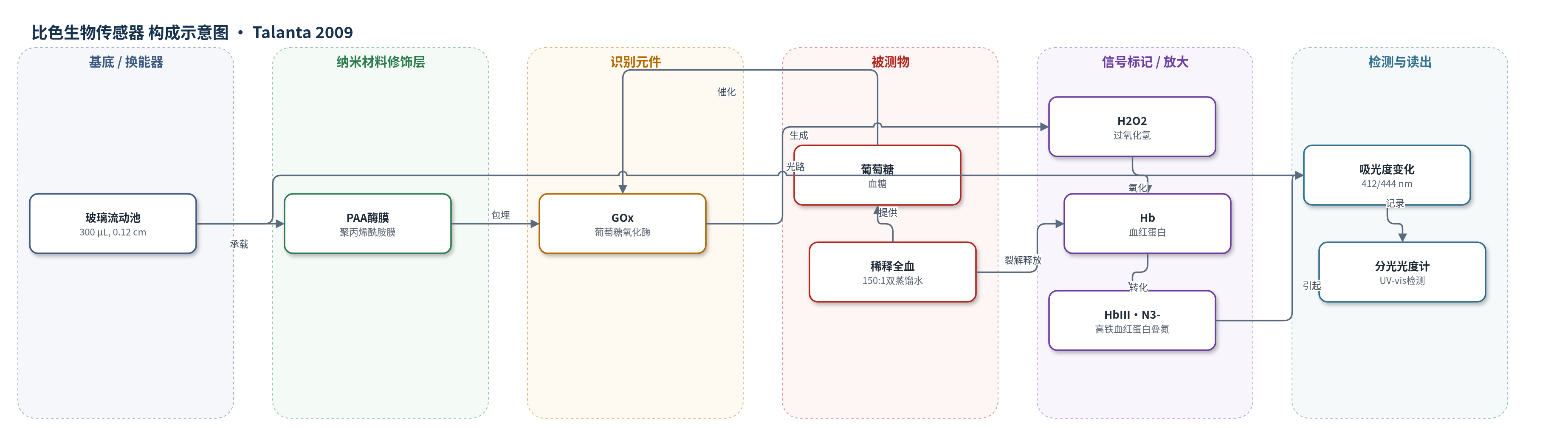
点击图片查看大图 · 依据论文自动绘制
传感器类型
比色生物传感器
检测对象
葡萄糖(glucose,血糖);样品基质:全血(经双蒸馏水150:1稀释裂解)
检测原理
全血稀释裂解释放血红蛋白(Hb)并保留葡萄糖。葡萄糖扩散进入PAA膜,被固定化葡萄糖氧化酶(GOx)催化氧化,生成H2O2。H2O2扩散回溶液,与HbII·O2反应,经高铁血红素中间体转化为HbIII;在叠氮化钠存在下形成HbIII·N3−。HbII·O2与HbIII·N3−在412 nm处吸收不同,444 nm为等吸收点,因此工作波长吸光度随HbIII·N3−生成而下降。模型给出ΔAbs与[HbIII·N3−]成正比,并近似与葡萄糖浓度、Hb浓度和反应时间平方相关,低浓度下呈线性。叠氮化钠抑制过氧化氢酶,减少H2O2消耗并简化反应,使信号不依赖氧浓度。
检测灵敏度
LOD: 20 mg dL−1(表2中1100 s线性下限,576 nm);线性范围: 20–1200 mg dL−1(摘要);灵敏度斜率: 2722 M−1(ΔAbs412/444,900 = 2722[G]0);140 M−1(900 s,表2);1219 M−1(412 nm);R^2 = 0.98(与Reflotron比较);r = 0.994(图5理论拟合)
效应效果
叠氮化钠抑制血液过氧化氢酶,阻断H2O2侧反应,且信号不依赖氧浓度,抗干扰能力较好。GOx-PAA膜至少可重复使用100次,连续2个月无损伤。77 mg/dL葡萄糖RSD为4%(n=5)。10个血样直接测定与Reflotron比较:斜率0.972、截距3.6、r^2=0.98,斜率和截距在95%置信区间内分别等于1和0。作者认为该方法可绝对校准、无需频繁校准,适合自动血液分析仪,并可竞争一次性安培血糖传感器和试剂盒。
传感器的构成
- 流动池/光学换能器:玻璃流动池(300 μL,光程0.12 cm),容纳反应体系并测量吸光度
- 酶膜载体:玻璃片(20 mm × 9 mm × 0.1 mm,0.5 mm凹槽),承载PAA膜
- 酶固定化膜:聚丙烯酰胺(PAA)膜,包埋GOx并允许葡萄糖扩散
- 识别/催化元件:葡萄糖氧化酶(GOx,Aspergillus niger,EC 1.1.3.4),催化葡萄糖生成H2O2
- 信号换能元件:血液血红蛋白(Hb,HbII·O2/HbIII·N3−),氧化态变化引起412 nm吸光度变化
- 载液/抑制剂:磷酸盐缓冲液(pH 6)加叠氮化钠(NaN3,10−3 M),抑制过氧化氢酶并简化Hb/H2O2反应
- 样品基质:全血经双蒸馏水150:1稀释裂解,释放Hb并保留葡萄糖
- 检测仪器:二极管阵列/紫外可见分光光度计(HP 8452A、PerkinElmer Lambda 5),监测412 nm和444 nm
中文摘要
本文提出一种基于血液血红蛋白(Hb)紫外-可见光谱特性的血糖自动测定方法。生物传感器由包埋葡萄糖氧化酶(GOx)的聚丙烯酰胺(PAA)膜置于流动池构成。全血用双蒸馏水按150:1稀释裂解后注入含叠氮化钠的载液;血糖在GOx催化下生成H2O2,H2O2与血液Hb反应,使HbII·O2向HbIII·N3−转化并引起吸光度变化。GOx-PAA膜至少可重复使用100次,叠氮化钠可抑制过氧化氢酶等侧反应。线性范围为20–1200 mg/dL,77 mg/dL时RSD为4%。方法可采用绝对校准法直接定量,且信号不依赖氧浓度。作者建立了Hb吸光度变化与葡萄糖浓度的数学模型,并用于10个血样直接测定,与自动分析仪结果比较相关系数大于0.98。该方法兼具一次性安培传感器的部分优点,且具有可逆性。
英文摘要
A new approach for glucose determination in blood based on the spectroscopic properties of blood hemoglobin (Hb) is presented. The biosensor consists of a glucose oxidase (GOx) entrapped polyacrylamide (PAA) film placed in a flow cell. Blood is simply diluted with bidistilled water (150:1, v:v) and injected into the carrier solution. When reaching the PAA film, the blood glucose reacts with the GOx and the resulting H(2)O(2) reacts with the blood Hb. This produces an absorbance change in this compound. The GOx-PAA film can be used at least 100 times. Lateral reactions of H(2)O(2) with other blood constituents are easily blocked (by azide addition). The linear response range can be fitted between 20 and 1200 mg dL(-1) glucose (R.S.D. 4%, 77 mg dL(-1)). In addition to the use of untreated blood, two important analytical aspects of the method are: (1) the analyte concentration can be obtained by an absolute calibration method; and (2) the signal is not dependent on the oxygen concentration. A mathematical model relating the Hb absorbance variation during the reaction with the glucose concentration has been developed to provide theoretical support and to predict its application to other compounds after changing the GOx by another enzyme. The method has been applied to direct glucose determination in 10 blood samples, and a correlation coefficient higher than 0.98 was obtained after comparing the results with those determined by an automatic analyzer. As well as sharing some of the advantages of disposable amperometric biosensors, the most significant feature of this approach is its reversibility.