组成图示
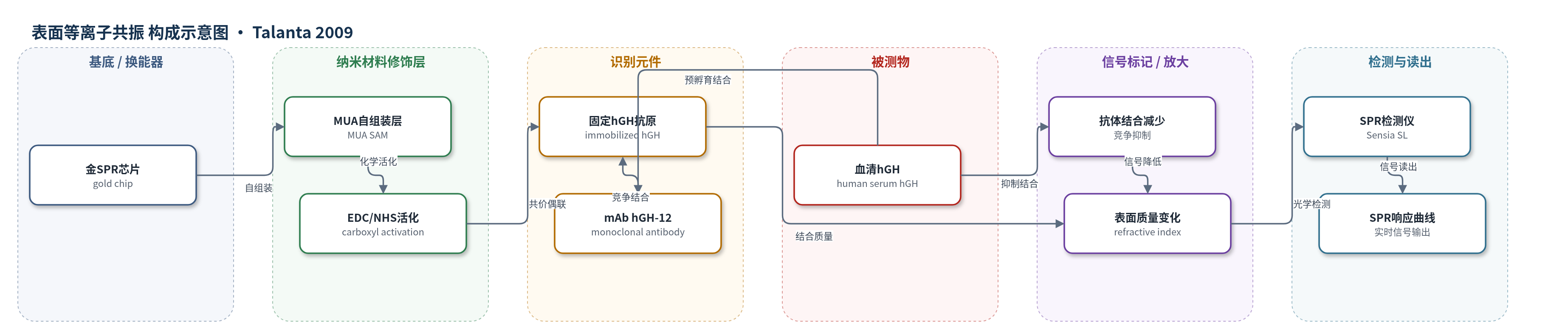
点击图片查看大图 · 依据论文自动绘制
传感器类型
表面等离子共振(SPR)生物传感器
检测对象
人生长激素(human growth hormone, hGH);样品基质:人血清(另用兔血清评估基质效应)
检测原理
该传感器采用无标记SPR免疫抑制分析。金芯片表面经MUA自组装形成羧基端单分子层,再用EDC/NHS活化并将重组hGH共价固定为竞争抗原。检测时,样品中的hGH与固定量mAb hGH-12预孵育;样品hGH浓度越高,抗体被占据越多,能结合到固定hGH上的抗体越少,传感表面结合质量降低。SPR通过监测表面质量/折射率变化产生响应,因此信号随hGH浓度升高而下降。方法不使用荧光或酶标记放大,而是通过高盐、高pH和Tween 20缓冲液降低血清非特异结合,并用强再生液恢复表面。
检测灵敏度
LOD: 6 ng/mL(人血清);4 ng/mL(PBST缓冲液);线性范围: 18–542 ng/mL(PBST缓冲液);血清工作范围: 6 ng/mL–1.3 μg/mL;R^2 = 0.985(与ELISA对比)
效应效果
非特异抗体响应可忽略,表明固定hGH单分子层选择性良好;PBST-S缓冲液使血清非特异结合降低88%,同时保留90%抗体信号。批内平均RSD低于3%,批间平均RSD为1.87%,所有个体变异低于5%;不同芯片间平均CV为2.19%。缓冲液中传感器可稳定使用100次以上,最大信号下降7%;血清中可连续使用50次以上,最大信号下降17%。10份真实血清样品中5份低于6 ng/mL检测限,其余5份与ELISA高度一致(R2 = 0.985),可识别低于10 ng/mL切值并定量高于切值样品,适用于临床即时诊断。
传感器的构成
- 基底/换能器:金SPR芯片(gold chip),提供表面等离子共振换能表面
- 自组装单分子层:巯基十一烷酸(mercaptoundecanoic acid, MUA)0.05 mM乙醇溶液吸附形成羧基端SAM,用于共价偶联并减少非特异吸附
- 活化层:EDC 0.2 M与NHS 0.05 M活化羧基,形成N-羟基琥珀酰亚胺酯中间体
- 识别元件:重组人生长激素(hGH)50 μg/mL、10 mM醋酸缓冲液pH 5下经氨基共价固定,作为竞争抗原
- 封闭剂:乙醇胺(ethanolamine)1 M、pH 8.5封闭未反应基团
- 检测抗体:单克隆抗体hGH-12(mAb hGH-12)与样品中hGH预孵育,识别hGH亚型并竞争结合固定hGH
- 信号标记物:无(label-free),SPR直接监测表面质量变化
- 运行/再生介质:PBST-S(10 mM磷酸盐pH 8、500 mM NaCl、0.1% Tween 20)降低非特异结合;2 M NaCl、0.1% Tween 20、pH 11再生液解离复合物
中文摘要
本文报道了一种基于表面等离子共振(SPR)的免疫测定方法,用于在人血清中直接、无预处理地检测人生长激素(hGH)。该传感器采用结合抑制免疫分析格式,通过优化抗体浓度、检测缓冲液和再生液,降低血清基质成分在传感表面的非特异性结合。方法最低检测限为6 ng/mL,工作范围覆盖生理浓度范围。批内和批间相对标准偏差均小于5%,不同传感器芯片间差异为2.19%。传感表面可重复使用50次以上,信号下降小于20%。与酶联免疫吸附测定(ELISA)验证结果高度相关(R2 = 0.985)。研究使用便携式全自动Sensia SL系统,表明该SPR免疫传感器可作为临床分析物快速诊断工具,具有即时检测应用潜力。
英文摘要
A surface plasmon resonance immunoassay has been developed to determine human growth hormone (hGH) directly and without pre-treatment in human serum samples. A binding inhibition immunoassay was employed. Antibody concentration, assay buffer and regeneration solution have been optimized in order to reach the best performance and the lower non-specific binding of the matrix components to the sensor surface. The lowest detection limit was 6 ng/mL, with a working range covering the physiological range. Reproducibility of the assay was excellent with both intra-assay and inter-assay relative standard deviations <5%, while a variation of 2.19% was obtained employing different sensor chips. Reutilization of the sensor surface allows its continuous use over 50 measurements with a signal drop <20%. The SPR immunoassay results were validated using enzyme-linked immunosorbent assay (ELISA) showing an excellent correlation (R(2)=0.985). A portable and fully automated system (Sensia SL) was employed in this work. This is the first SPR biosensor assay capable of detecting relevant concentrations of a clinical analyte in serum. This study shows the potentials of this device as a diagnostic tool for the detection of multiple clinical analytes.