组成图示
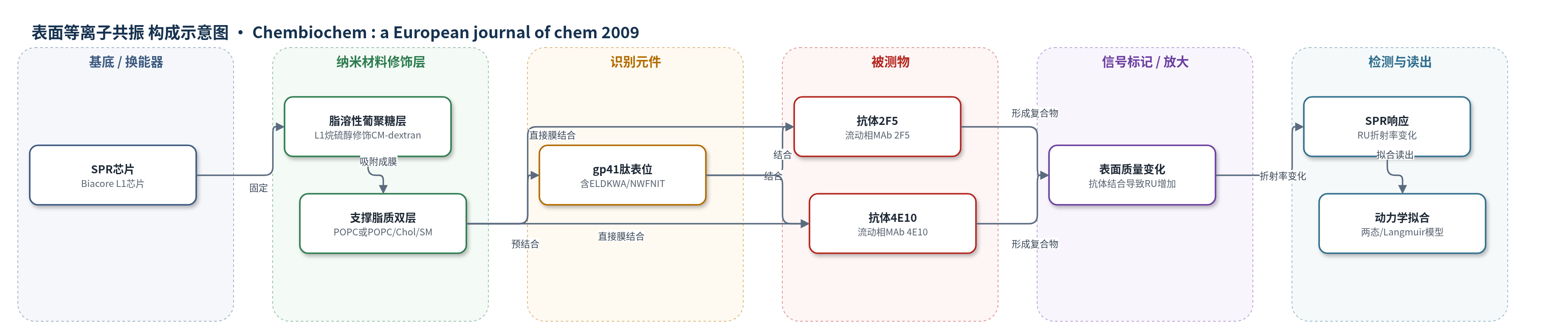
点击图片查看大图 · 依据论文自动绘制
传感器类型
表面等离子共振(SPR)生物传感器
检测对象
HIV-1 单克隆抗体 2F5(MAb 2F5)、HIV-1 单克隆抗体 4E10(MAb 4E10);样品基质:HEPES 缓冲液(含 0.14% DMSO)中的抗体溶液,固定相为 POPC 或 POPC/胆固醇/鞘磷脂(POPC/Chol/SM)脂质体模型膜及预结合 gp41 肽表位
检测原理
SPR 传感器以 L1 芯片上的脂溶性修饰葡聚糖层捕获 POPC 或 POPC/胆固醇/鞘磷脂小单层囊泡,形成支撑脂质双层;gp41 延伸肽表位预先结合到膜上,形成膜-肽识别界面。当 2F5 或 4E10 抗体流过表面时,抗体与膜和/或肽表位发生结合,使传感器表面质量增加,引起局部折射率变化,SPR 仪以响应单位(RU)实时读出。抗体浓度越高,结合质量越大,RU 越高。无肽时,4E10 对膜直接结合较强,2F5 结合较弱;有肽时,两者均出现强且几乎不可逆结合,可用两态模型描述:初始静电吸附后发生构象重排或疏水插入/重定向,4E10 更依赖膜组分作为联合抗原。
检测灵敏度
原文未报告 LOD、线性范围、灵敏度斜率或相关系数。
效应效果
无肽时,2F5 对 POPC 和 POPC/Chol/SM 结合较弱,4E10 结合较强;表观 kd 中 4E10 约 520×10^-6 s^-1,2F5 在 POPC 约 76.4×10^-6 s^-1。预结合 gp41 肽后,两者均几乎不可逆结合,2F5 亲和力约为 4E10 三倍,KD 约 1.16–1.95 nM(POPC-肽)和 0.02–1.22 nM(POPC/Chol/SM-肽),4E10 约 0.63–5.69 nM 和 0.54–4.21 nM。与文献 ITC/SPR 值(2F5 约 1.8–4 nM,4E10 约 6–21.5 nM)一致。未报告 RSD 或实际样品回收率,作者认为膜环境对 HIV 免疫原设计重要。
传感器的构成
- 基底/换能器:Biacore L1 SPR 芯片,提供光学换能表面并用于脂质体固定
- 修饰层:脂溶性化合物修饰的羧甲基葡聚糖/脂肪族烷硫醇修饰羧甲基葡聚糖层,促进脂质体吸附形成支撑膜
- 膜层:POPC 小单层囊泡(SUV)或 POPC/胆固醇/鞘磷脂(POPC/Chol/SM,1:1:1)SUV,模拟宿主细胞膜与病毒膜
- 识别/抗原层:gp41 延伸肽表位 H-NEQELLELDKWASLWNWFNITNWLWYIK-NH,预结合于膜上,提供 2F5(ELDKWA)和 4E10(NWFNIT)识别序列
- 识别元件:人源 HIV-1 单克隆抗体 2F5 或 4E10,作为流动相与膜/肽表位特异性结合
- 信号读出:SPR 折射率变化,以响应单位(RU)反映表面质量变化
- 再生体系:SDS、CHAPS、NaOH/甲醇和 NaOH,用于去除结合物并恢复传感器表面
中文摘要
人源 HIV-1 单克隆抗体 2F5 识别核心序列 ELDKWA,4E10 识别核心序列 NWFNIT,二者是 HIV-1 疫苗免疫原设计的有前景模型。然而,这些识别域单独免疫难以诱导广谱中和抗体,且相关抗体可能具有膜结合特性,提示高效免疫原可能需要膜组分等额外识别基序。本研究采用源自 gp41 天然序列、同时包含 2F5 和 4E10 识别域的延伸肽表位,考察模型细胞膜(POPC)和病毒样膜(POPC/胆固醇/鞘磷脂)在两种抗体识别中的作用。利用表面等离子共振生物传感器,比较 2F5 和 4E10 在有无预结合肽表位时与膜的结合。结果显示:2F5 在存在肽时与两种膜均发生强且几乎不可逆结合,无肽时结合较弱;4E10 无论有无肽均表现出较强膜结合,有肽时结合基本不可逆。总体而言,两种抗体均可在表位识别前结合膜,但对 gp41 衍生表位的高亲和力识别发生在膜环境中;4E10 可能利用膜接近并结合 gp41。这些膜特性可用于免疫原设计。
英文摘要
Two HIV-1 recognition domains for the human monoclonal antibodies (MAb) 2F5, which recognises the core sequence ELDKWA, and 4E10, which recognises the core sequence NWFNIT, serve as promising models for immunogens in vaccine development against HIV-1. However, the failure of these recognition domains to generate broadly reactive neutralizing antibodies, and the putative membrane-binding properties of the antibodies raised to these recognition domains, suggest that additional features or recognition motifs are required to form an efficient immunogen, which could possibly include the membrane components. In this study we used an extended peptide epitope sequence derived from the gp41 native sequence (H-NEQELLELDKWASLWNWFNITNWLWYIK-NH), which contains the two recognition domains for 2F5 and 4E10, to examine the role of model cell (POPC) and viral (POPC/cholesterol/sphingomyelin) membranes in the recognition of these two antibodies. By using a surface plasmon resonance biosensor, the binding of 2F5 and 4E10 to membranes was compared and contrasted in the presence and absence of prebound peptide epitope. The recognition of the peptide epitope by each MAb was found to be distinct; 2F5 exhibited strong and almost irreversible binding to both membranes in the presence of the peptide, but bound weakly in the absence of the peptide epitope. In contrast, 4E10 exhibited strong membrane binding in the presence or absence of the peptide epitope, and the binding was essentially irreversible in the presence of the peptide epitope. Overall, these results demonstrate that both 2F5 and 4E10 can bind to membranes prior to epitope recognition, but that high-affinity recognition of gp41-derived epitope sequences by 2F5 and 4E10 occurs in a membrane context. Moreover, 4E10 might utilise the membrane to access and bind to gp41; such membrane properties of 2F5 and 4E10 could be exploited in immunogen design.