组成图示
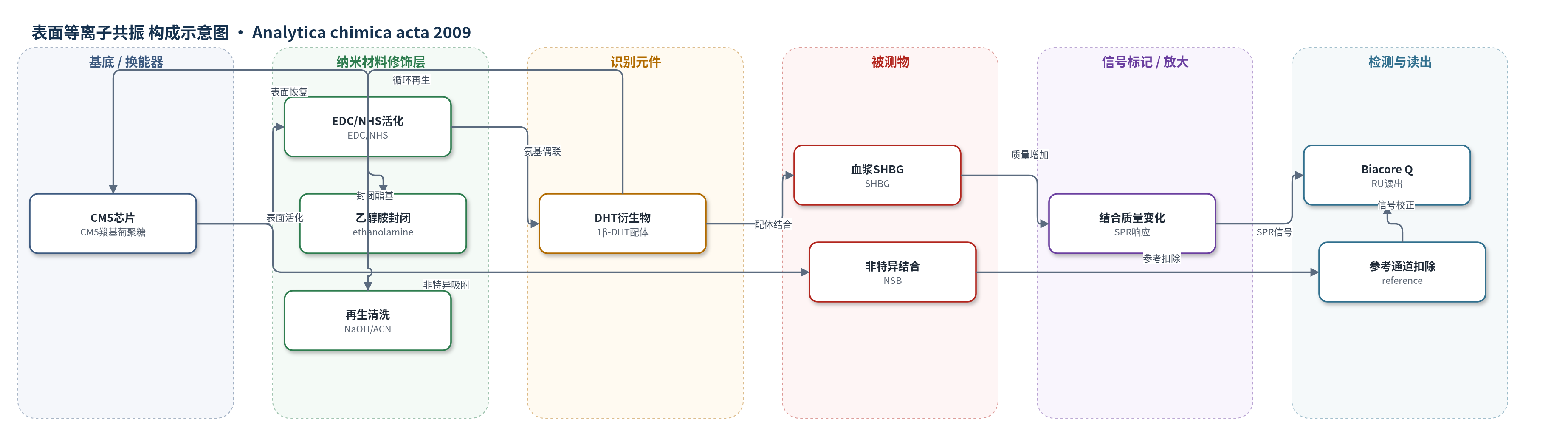
点击图片查看大图 · 依据论文自动绘制
传感器类型
表面等离子共振(SPR)生物传感器
检测对象
性激素结合球蛋白结合能力(SHBG binding capacity),样品基质:牛血浆(犊牛/成年牛);用于间接识别促生长剂处理动物
检测原理
CM5芯片表面的羧基先经EDC/NHS活化形成活性酯,随后1β-DHT衍生物通过氨基偶联固定于芯片,乙醇胺封闭未反应酯基。血浆样品稀释后流过芯片,其中SHBG与固定1β-DHT衍生物发生特异性配体-受体结合。结合事件使芯片界面质量/折射率发生变化,SPR系统以响应单位(RU)实时记录结合量;参考通道用于扣除非特异结合(NSB)。SHBG结合能力越高,固定DHT衍生物上结合的SHBG越多,RU响应越大;促生长剂处理(尤其诺龙等雄激素)使血浆SHBG水平或结合能力下降,RU响应降低。每个循环后用NaOH/乙腈再生表面,实现重复检测。
检测灵敏度
原文未报告LOD、线性范围、灵敏度斜率或相关系数。
效应效果
该SPR法可重复测定牛血浆SHBG结合能力,样品随机三重复并以均值±标准误表示。与放射性配体结合法相比,结果具有可比性,且更适合高通量筛查。犊牛反复给予苯甲酸雌二醇、诺龙癸酸酯和地塞米松后,处理组雌雄SHBG结合能力显著下降;第37天处理公犊牛约为对照的50%,处理母犊牛约为对照的40%。成年公牛给予苯甲酸雌二醇后SHBG未变,成年母牛给予诺龙癸酸酯后第39天较基线和对照低约20%,差异显著(p<0.05至p<0.001)。作者认为该方法采血方便、可高通量,可作为识别非法促生长剂使用,尤其雄激素暴露动物的间接生物标志物筛查工具。
传感器的构成
- 基底/换能器:CM5芯片(Biacore CM5,羧基化葡聚糖表面),提供SPR换能与固定平台
- 活化层:EDC/NHS(1-乙基-3-(3-二甲基氨基丙基)碳二亚胺盐酸盐/N-羟基丁二酸酯),活化羧基形成活性酯
- 识别/配体层:1β-DHT衍生物(1β-aminohexyl-17β-hydroxy-5α-androstan-3-one),通过氨基偶联固定并特异性结合SHBG
- 封闭层:乙醇胺盐酸盐(ethanolamine hydrochloride),封闭未反应酯基
- 参考通道:第二流道相同处理但不加1β-DHT衍生物,用于扣除非特异结合(NSB)
- 样品缓冲液:HBS-EP+(HEPES、NaCl、EDTA、P20),稀释血浆并维持结合条件
- 再生层:20%乙腈/200 mM NaOH,循环后再生芯片表面
- 信号读出:Biacore Q SPR系统,以响应单位(RU)输出结合信号
中文摘要
促生长剂在动物饲养中被非法使用,现有基于液相色谱-串联质谱和气相色谱-质谱的残留检测难以覆盖不断出现的新化合物及低剂量混合给药。本文提出以间接生物学证据作为筛查工具,通过检测血浆性激素结合球蛋白(SHBG)结合能力变化识别促生长剂处理动物。SHBG是结合并调控循环性激素水平的糖蛋白。作者建立基于表面等离子共振(SPR)的生物传感器配体结合法,将1β-二氢睾酮(1β-DHT)衍生物固定于CM5芯片表面,用于测定血浆SHBG结合能力。在犊牛反复给予苯甲酸雌二醇、诺龙癸酸酯和地塞米松的试验中,处理组雌雄犊牛SHBG结合能力均显著降低。成年母牛反复给予诺龙癸酸酯后第39天SHBG结合能力下降,而苯甲酸雌二醇处理的成年公牛水平未变。结果表明,SPR生物传感器测定SHBG结合能力可用于识别非法使用促生长剂的动物,尤其适用于雄激素暴露动物。
英文摘要
Growth-promoting agents are illicitly used during animal rearing processes and the detection of their use is limited by new compounds and dosing practices that limit the efficiency of current testing which is based on residue analysis by liquid chromatography-tandem mass spectrometry (LC-MS/MS) and gas chromatography-mass spectrometry (GC-MS) methodology. An alternative approach is to use indirect biological evidence as a screening tool to identify growth-promoter treated animals thus improving the effectiveness of residue testing through the targeted sampling of these animals. Sex hormone-binding globulin (SHBG) is a glycoprotein which binds and controls the levels of sex-hormones within the circulation. Using a biosensor assay based on measurement of binding to an immobilised 1alpha-dihydrotestosterone (1alpha-DHT) derivative, reduced SHBG binding capacities were detected in growth-promoter treated animals. During the course of a veal treatment regime based on repeated oestradiol benzoate, nortestosterone decanoate and dexamethasone administrations, treated male and female calves were shown to have significantly lower SHBG capacities. To assess the effectiveness of using SHBG binding capacities as a biomarker of treatment and to investigate the role of individual growth-promoter components to the SHBG capacity lowering effects, adult heifer animals were subjected to repeated doses of nortestosterone decanoate. These animals also demonstrated a reduction in SHBG capacity levels at Day 39 of the study, in contrast to oestradiol benzoate treated adult steers who were found to have unaltered levels. These findings suggest that the measurement of SHBG binding capacities using a biosensor assay has potential in the identification of illegally treated animals, particularly those exposed to androgens.