组成图示
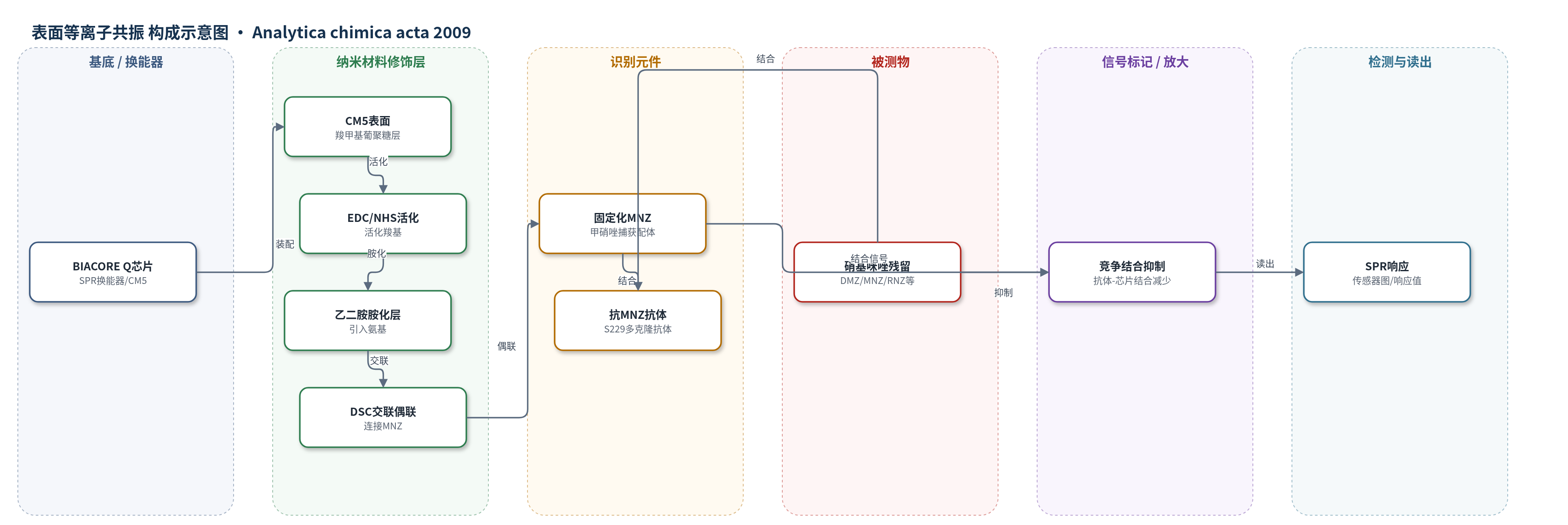
点击图片查看大图 · 依据论文自动绘制
传感器类型
表面等离子共振(SPR)生物传感器
检测对象
二甲硝咪唑(dimetridazole, DMZ)、甲硝唑(metronidazole, MNZ)、洛硝达唑(ronidazole, RNZ)、异丙硝唑(ipronidazole, IPZ)、羟二甲硝咪唑(hydroxydimetridazole, DMZOH)、羟甲硝唑(hydroxymetronidazole, MNZOH)、羟异丙硝唑(hydroxyipronidazole, IPZOH);样品基质:猪/牛/羊肾、禽肝、禽血清、鸡蛋、牛乳
检测原理
该法为竞争式SPR免疫生物传感器。CM5芯片表面羧甲基葡聚糖经EDC/NHS活化后与乙二胺反应形成氨基,再经DSC交联剂固定甲硝唑(MNZ)作为捕获配体,乙醇胺封闭未反应位点。样品提取液中的硝基咪唑与羊抗MNZ多克隆抗体结合,使抗体被占据;随后将抗体-样品混合液注入芯片,未结合被测物的抗体与固定化MNZ结合。被测物浓度越高,抗体被占据越多,芯片表面抗体结合量越低,SPR响应值下降。仪器通过监测表面折射率变化获得传感器图,实现无标记、无放大、基于竞争抑制的定性/半定量筛查。
检测灵敏度
CCα: <1.0 μg kg−1 (or μg L−1) DMZ;RNZ/IPZ: <1.0 μg kg−1 (or μg L−1);MNZ/MNZOH: <2.0 μg kg−1 (or μg L−1);DMZOH/IPZOH: <3.0 μg kg−1 (or μg L−1);校准点: 0.01、0.5、1.0、2.0、5.0、10.0 μg kg−1 (or μg L−1) DMZ
效应效果
方法按欧盟2002/657/EC验证,20个加标样品显示DMZ检测能力CCα<1.0 μg kg−1(或μg L−1),满足欧盟3 μg kg−1推荐浓度。交叉反应谱显示抗体对RNZ、IPZ、MNZ、MNZOH、DMZOH、IPZOH均有显著交叉反应,但为定性筛查,不能区分各硝基咪唑。实际鸡肝/血清样品与LC–MS/MS比较:6个肝样品中2个筛查高于3 μg kg−1,其中1个经LC–MS/MS确认;肝中生物传感器结果约1.44–6.42 μg kg−1,血清加药组均>10 μg L−1,LC–MS/MS为949.3–1356.8 μg L−1,对照组阴性。24个样品可在15 h内完成提取与分析,作者认为其比HPLC/LC–MS/MS更简便、低成本,比ELISA对代谢物交叉反应更好。
传感器的构成
- 基底/换能器:BIACORE Q SPR光学生物传感器与CM5传感器芯片(羧甲基葡聚糖表面),提供无标记光学生物分子相互作用检测平台。
- 活化修饰层:EDC/NHS活化羧甲基葡聚糖羧基,形成可偶联活性酯。
- 胺化修饰层:1 M乙二胺处理,引入氨基用于连接甲硝唑衍生物。
- 交联偶联层:DSC交联剂将甲硝唑(MNZ)偶联到芯片表面,形成固定化捕获配体。
- 封闭层:1 M乙醇胺(pH 8.5)封闭未反应位点,降低非特异性结合。
- 识别元件:羊抗甲硝唑多克隆抗体(S229),在样品中与硝基咪唑结合并竞争结合芯片MNZ。
中文摘要
开发了一种免疫生物传感器方法,用于多种硝基咪唑化合物在不同物种和样品类型中的多残留筛查,包括猪、牛和羊肾、禽肝、血清、鸡蛋及牛乳。以甲硝唑蛋白偶联物免疫绵羊,制备了可结合至少七种主要硝基咪唑及其代谢物的多克隆抗体。样品匀浆用乙腈提取并微离心后进行生物传感器分析。对20个加标样品的验证表明,该方法对所有受试物种和基质中二甲硝咪唑(DMZ)的检测能力(CCα)低于1 μg/kg(或μg/L)。此外,交叉反应数据和少量加标样品分析表明,该方法还可检测其他主要母体硝基咪唑及其代谢物,包括洛硝达唑(RNZ)、异丙硝唑(IPZ)、甲硝唑(MNZ)、羟甲硝唑(MNZOH)、羟二甲硝咪唑(DMZOH)和羟异丙硝唑(IPZOH)。文中给出了这些硝基咪唑的交叉反应谱、验证数据,以及用该方法分析少量实际样品所得结果。
英文摘要
An immunobiosensor assay was developed for the multi-residue screening of a range of nitroimidazole compounds in various species and sample types including porcine, bovine and ovine kidney, avian liver, serum and eggs and bovine milk. A polyclonal antibody which binds at least seven of the major nitroimidazoles and their metabolites was raised in a sheep after inoculation with a metronidazole protein conjugate. Sample homogenates were extracted into acetonitrile and subjected to micro-centrifugation prior to biosensor analysis. Validation data obtained from the analysis of 20 fortified samples has shown that the method has a detection capability (CCbeta) of less than 1 microgkg(-1) (or microgL(-1)) for dimetridazole (DMZ) in all species and matrices investigated. In addition, cross-reactivity data and the analysis of a small number of fortified samples have shown that the method will also detect a range of other major parent nitroimidazoles and their metabolites including ronidazole (RNZ), ipronidazole (IPZ), metronidazole (MNZ), hydroxymetronidazole (MNZOH), hydroxydimetridazole (DMZOH) and hydroxyipronidazole (IPZOH). The cross-reactivity profile and validation data for the detection of these nitroimidazoles are presented together with the results obtained following the analysis of a small number of incurred samples using the developed method.