组成图示
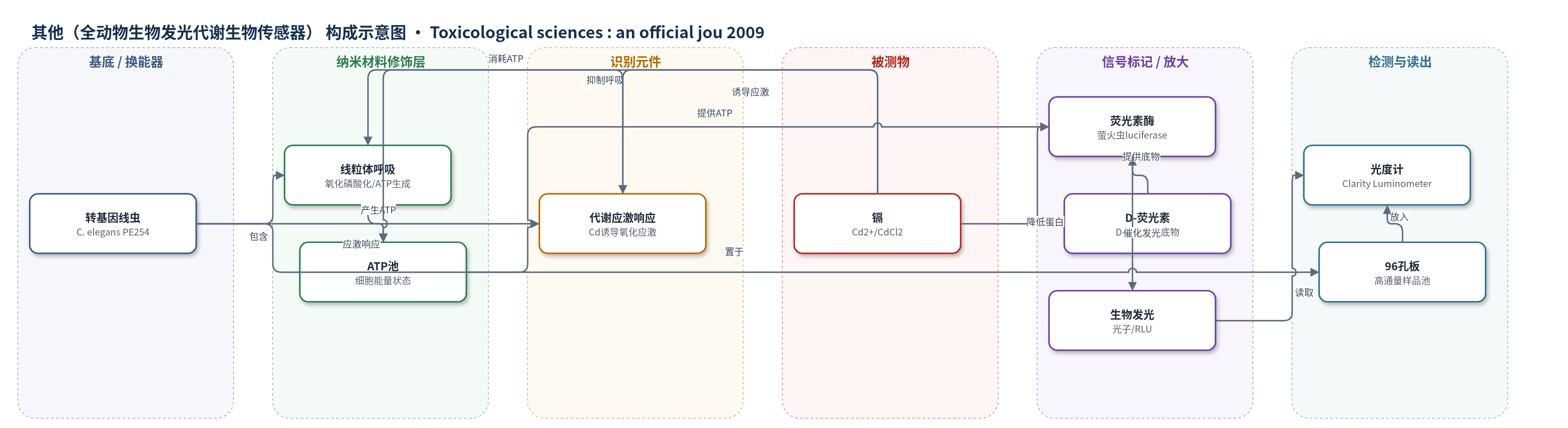
点击图片查看大图 · 依据论文自动绘制
传感器类型
其他(全动物生物发光代谢生物传感器)
检测对象
镉(cadmium, Cd,CdCl2);样品基质:K液体培养基(含胆固醇与大肠杆菌OP50)中的线虫暴露液
检测原理
镉进入转基因线虫后,作为氧化应激剂干扰线粒体功能,包括氧化磷酸化解偶联、电子传递链活性降低、氧化代谢酶抑制及活性氧/抗氧化失衡,同时诱导应激反应增加能量消耗,使细胞ATP池下降;较高浓度还抑制蛋白合成,降低萤火虫荧光素酶蛋白水平。萤火虫荧光素酶以ATP、D-荧光素和O2为底物,催化生成氧化荧光素并释放光子。ATP下降直接减少发光反应底物,荧光素酶蛋白减少进一步降低催化能力,因此生物发光强度随镉浓度升高而下降。信号以相对光单位(RLU)在96孔板中读取,实现全动物代谢状态的高通量检测。
检测灵敏度
测试浓度范围: 0–30 μM Cd;生物发光EC20: 11.8–13.0 μM Cd;繁殖EC20: 10.2 μM Cd;r^2 = 0.9050(PE255生物发光);r^2 = 0.8718(PE254生物发光)
效应效果
在19 h亚致死暴露条件下,0–30 μM Cd对线虫死亡率影响可忽略,100 μM Cd死亡率低于5%,200和400 μM分别约8%和13%。生物发光在10–15 μM Cd即出现下降,EC20为11.8–13.0 μM,与67 h繁殖终点EC20(10.2 μM)相当,而比72 h发育终点更快。最大测试浓度30 μM Cd约为报道24 h LC50的1/250,并比运动、摄食、生长和繁殖等亚致死参数24 h EC50低4–6倍。方法可在96孔板中自动化读取,支持高通量筛选,作者认为其可作为镉等污染物亚致死效应的快速预测指标,并有助于减少高等动物测试。
传感器的构成
- 生物传感主体:表达萤火虫荧光素酶的转基因秀丽隐杆线虫(C. elegans,PE254/PE255/PE322),作为全动物代谢响应单元
- 细胞代谢响应层:线虫线粒体氧化磷酸化与ATP池,响应镉诱导的氧化应激和能量代谢扰动
- 信号酶:萤火虫荧光素酶(luciferase),催化D-荧光素与ATP发光
- 发光底物:D-荧光素(D-luciferin,100 μM),与ATP和O2反应产生光子
- 发光缓冲液:柠檬酸磷酸盐缓冲液(pH 6.5,含1% DMSO、0.05% Triton X-100、100 μM D-luciferin),维持发光反应
- 暴露培养基:K培养基(52 mM NaCl、32 mM KCl)加胆固醇(5 μg/mL)和大肠杆菌OP50,作为线虫培养与镉暴露基质
- 读出装置:Clarity光度计(Biotek)在96孔板中读取相对光单位(RLU)
中文摘要
亚致死代谢效应是重要的毒理学终点。本研究采用表达萤火虫荧光素酶的转基因秀丽隐杆线虫(Caenorhabditis elegans)生物发光作为快速、定量的代谢终点,评估氧化应激剂和环境污染物镉(以氯化镉形式提供)在亚致死慢性暴露(19 h)下的效应。在0–30 μM Cd测试范围内,线虫生物发光呈浓度依赖性下降,其灵敏度与分别经67 h和72 h暴露的繁殖及发育终点相当。使生物发光降低20%的镉浓度(EC20)为11.8–13.0 μM,而繁殖EC20(67 h)为10.2 μM。在低浓度镉(≤15 μM)下,生物发光下降主要反映细胞ATP水平降低;在15–30 μM Cd下,发光下降既源于ATP水平降低,也源于荧光素酶蛋白合成减少及总蛋白水平下降。结果表明,全动物生物发光可作为有效的毒理学终点,是预测镉暴露对发育和繁殖影响的快速、敏感指标,并为高通量亚致死毒性筛选提供平台,有助于减少高等动物实验。
英文摘要
Sublethal metabolic effects are informative toxicological end points. We used a rapid quantitative metabolic end point, bioluminescence of firefly luciferase expressing Caenorhabditis elegans, to assess effects of sublethal chronic exposure (19 h) to the oxidative stress agent and environmental pollutant cadmium (provided as chloride salt). Bioluminescence declined in a concentration-dependent manner in the concentration range tested (0-30 microM Cd), with comparable sensitivity to reproduction and developmental assay end points (after 67 and 72 h, respectively). Cd concentrations that resulted in 20% reduction in bioluminescence (EC(20)) were 11.8-13.0 microM, whereas the reproduction EC(20) (67 h exposure) was 10.2 microM. At low concentrations of Cd (< or = 15 microM), the decline in bioluminescence reflected a drop in ATP levels. At Cd concentrations of 15-30 microM, decreased bioluminescence was attributable both to effects of Cd on ATP levels and decreased production of luciferase proteins, concomitant with a decline in protein levels. We show that whole-animal bioluminescence is a valid toxicological end point and a rapid and sensitive predictor of effects of Cd exposure on development and reproduction. This provides a platform for high-throughput sublethal screening and will potentially contribute to reduction of testing in higher animals.