组成图示
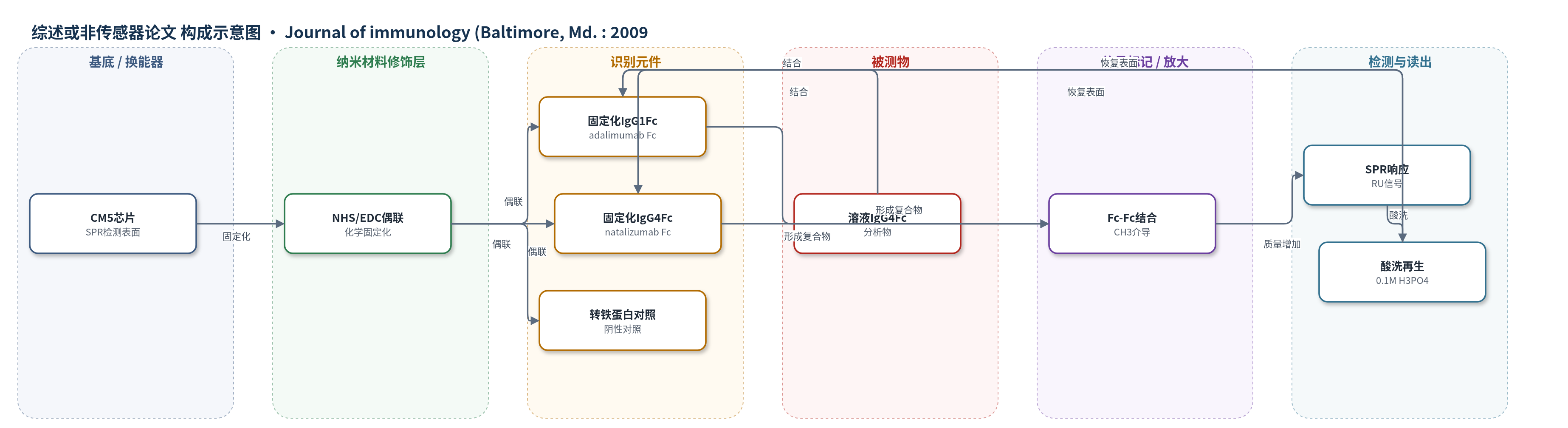
点击图片查看大图 · 依据论文自动绘制
传感器类型
综述或非传感器论文
检测对象
IgG4 Fc(natalizumab Fc)、IgG1 Fc(adalimumab Fc)、完整IgG4(natalizumab);样品基质:PBS-T缓冲液(非临床样品)
检测原理
SPR实验中,IgG1 Fc或IgG4 Fc通过NHS/EDC化学偶联固定于CM5芯片表面,作为配体。溶液中IgG4 Fc、IgG1 Fc或完整IgG4流过芯片时,IgG4 Fc可与固相IgG1 Fc或IgG4 Fc发生Fc-Fc相互作用。该结合被认为依赖CH3结构域的部分解离或构象改变,低pH处理或GSH可增强结合。结合事件使芯片表面质量增加,引起局部折射率变化,SPR仪以响应单位(RU)记录结合与解离曲线。RU随分析物浓度升高而增大,平衡值用于拟合表观解离常数;结合/解离动力学反映识别事件强度。实验无酶促或核酸信号放大,信号直接来自结合质量变化。
检测灵敏度
未报告LOD、线性范围、灵敏度斜率或相关系数。
效应效果
选择性:IgG4结合固相IgG1和IgG4,IgG1不结合固相IgG4;抗原捕获体系中仅IgG4结合抗原捕获IgG4。抗干扰:未标记IgG4和多克隆人IgG可抑制结合,热聚IgG与单体IgG抑制差异<2倍。稳定性:重复结合/再生循环结合较恒定。SPR动力学:IgG4 Fc对固相IgG1 Fc Kd,eq 0.12 μM,对固相IgG4 Fc 0.43 μM;结合IgG4 Fc可逆,koff 3.3×10^-4 s^-1,Kd,kin 1.0 μM;结合IgG1 Fc缓冲液冲洗不解离,需0.1 M H3PO4再生。作者认为可解释IgG4类风湿因子背景,并可能增强体内IgG4抗原结合。
传感器的构成
- 基底/换能器:CM5传感器芯片,SPR检测表面(原文未详述金膜,仅称CM5)
- 化学偶联层:NHS/EDC,在10 mM醋酸缓冲液pH 5.0中固定化配体
- 识别/配体层:固定化IgG1 Fc(adalimumab Fc)或IgG4 Fc(natalizumab Fc),27 nM
- 对照配体:固定化转铁蛋白(transferrin),作为阴性对照
- 分析物/样品:PBS-T中的IgG4 Fc、IgG1 Fc或完整IgG4(natalizumab)
- 再生/清洗:0.1 M H3PO4去除结合分析物,PBS-T平衡
中文摘要
人源IgG4的Fc片段可与另一IgG分子的Fc片段相互作用,该相互作用是测定IgG4类风湿因子水平时的干扰因素。作者此前证明IgG4半分子可交换形成双特异性抗体,推测两种现象相关,因此研究IgG4 Fc-Fc相互作用的理化特性。尺寸排阻色谱显示IgG4在液相中>99%为单体,提示若存在液相Fc-Fc相互作用也应短暂。但125I标记IgG4可结合固相偶联的IgG1和IgG4,而IgG1不结合固相IgG4。诱导CH3结构域部分解离或构象改变的条件可增强IgG4 Fc结合,提示结合主要由CH3介导。IgG4缓慢结合生物传感器芯片上的IgG4和IgG1,且从IgG4解离明显快于从IgG1解离。IgG4单抗结合Sepharose偶联抗原后,可观察到无关特异性IgG4的额外结合,而IgG1无此现象。作者提出IgG4-IgG4 Fc相互作用类似Fab臂交换中间态,因一个IgG4固定于固相而稳定;IgG4 Fc仅在IgG1构象改变使CH3可及后识别IgG1。此类Fc相互作用可能增强体内IgG4的抗原结合。
英文摘要
The Fc fragment of IgG4 can interact with the Fc fragment of another IgG molecule. This interaction is a confounding factor when measuring IgG4 rheumatoid factor levels. Recently, we demonstrated that half-molecules of IgG4 can exchange to form a bispecific Ab. We expected these two phenomena to be related and investigated the physicochemical aspects of IgG4 Fc-Fc interactions. We found that IgG4 is >99% monomeric by size-exclusion chromatography; therefore, IgG4 Fc-Fc interactions in the fluid phase (if any) would be short-lived. However, (125)I-labeled IgG4 does bind to IgG1 and IgG4 coupled to a solid phase. By contrast, IgG1 does not bind to coupled IgG4. Furthermore, conditions that induce partial unfolding/dissociation of the CH3 domains enhance IgG4 Fc binding, suggesting that Fc binding is primarily CH3 mediated. IgG4 slowly associates with both IgG4 and IgG1 coupled to a biosensor chip. Remarkably, subsequent dissociation was much faster for IgG4 than for IgG1. Moreover, after binding of an IgG4 mAb to Sepharose-coupled Ag, we observed additional binding of IgG4 with irrelevant specificity, whereas similar binding was not observed with Ag-bound IgG1. We propose that the IgG4-IgG4 Fc interaction resembles an intermediate of the Fab-arm (half-molecule) exchange reaction that is stabilized because one of the IgG4 molecules is coupled to a solid phase. By contrast, IgG4 Fc recognizes IgG1 only after a conformational change that renders CH3(IgG1) accessible to an interaction with the CH3(IgG4). Such Fc interactions may enhance Ag binding of IgG4 in vivo.