组成图示
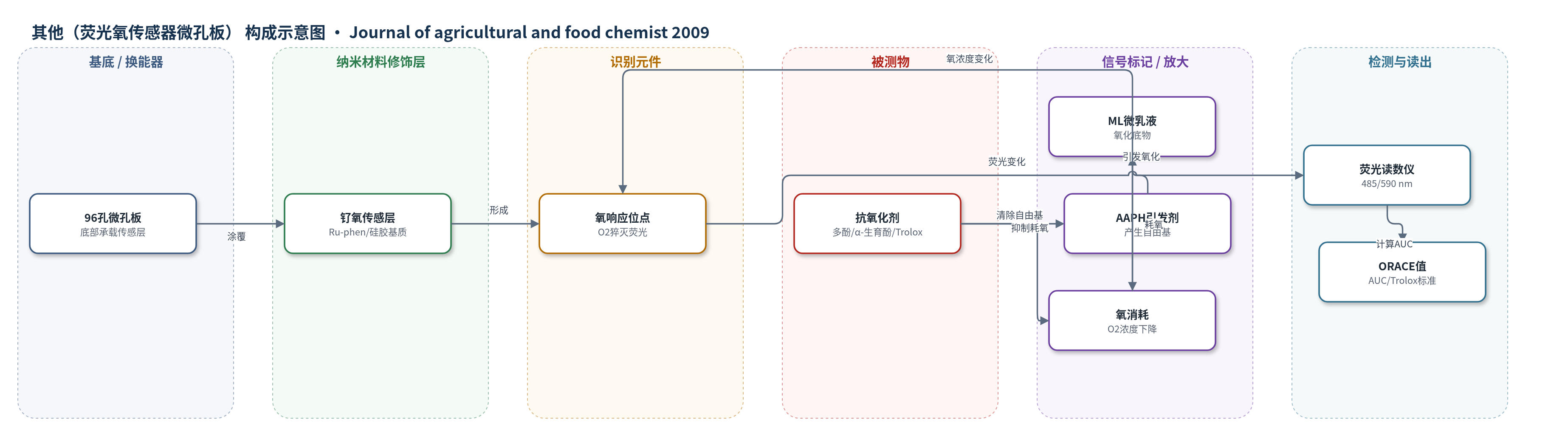
点击图片查看大图 · 依据论文自动绘制
传感器类型
其他(荧光氧传感器微孔板)
检测对象
抗氧化剂/抗氧化能力(antioxidant capacity):绿原酸(chlorogenic acid)、α-生育酚(α-tocopherol)、Trolox、儿茶素(catechin)、槲皮素(quercetin)、柚皮苷(naringin)、黄芩苷(baicalin)、抗坏血酸(ascorbic acid);样品基质为水包油微乳液(methyl linoleate/Tween-20/n-butanol/phosphate buffer microemulsion)
检测原理
AAPH在磷酸盐缓冲液中分解产生自由基,引发水包油微乳液油相中亚油酸甲酯的自动氧化链反应,并消耗溶解氧。抗氧化剂通过清除自由基、延长诱导期或降低氧消耗速率来抑制氧化。微孔板底部的钌菲罗啉氧传感层受溶解氧荧光猝灭,氧浓度下降使荧光信号改变;荧光读数仪以485 nm激发、590 nm发射连续监测,将信号转换为氧浓度-时间曲线。以空白扣除后的净曲线下面积(net AUC)表征抗氧化能力,并用Trolox标准曲线换算为μmol TE。该方法无基质干扰,可高通量评价酚类化合物在异相体系中的抗氧化能力。
检测灵敏度
LOD: 1.7 μMTE;LOQ: 5.6 μMTE;线性范围: 5.6–41.7 μMTE(Trolox 0–41.7 μM 时 R^2 = 0.99);斜率: 1.7468(96孔板)/1.6644(Clark电极)
效应效果
该方法2 h内可完成80个反应,日处理数百样品,较Clark电极效率提高近100倍,并与Clark电极标准曲线相近(96孔板 y=1.7468x-2.0176;Clark y=1.6644x-1.1508)。空白%CV为2.83(n=8),LOD和LOQ分别为1.7和5.6 μMTE。ORACE结果显示脂溶性抗氧化剂在微乳液中活性更高,α-生育酚为0.79 μmolTE/μmol,槲皮素1.54,绿原酸0.42;绿原酸与α-生育酚协同效应达44.8%,柚皮苷呈拮抗,维生素C无协同。作者认为其适用于食品和化妆品中乳化脂质体系的抗氧化评价。
传感器的构成
- 基底/换能器:96孔微孔板(96-well microplate),底部承载氧传感层并容纳反应液
- 传感修饰层:三(4,7-二苯基-1,10-菲罗啉)钌(II)氯化物(tris(4,7-diphenyl-1,10-phenanthroline)ruthenium(II) chloride)嵌入硅胶基质(silicone matrix),作为荧光氧传感元件
- 反应介质:水包油微乳液(o/w microemulsion),含12%亚油酸甲酯(methyl linoleate, ML)、29%Tween-20、15%正丁醇(n-butanol)、44% 75 mM磷酸盐缓冲液(pH 7.04)
- 自由基引发剂:2,2'-偶氮二(2-脒基丙烷)二盐酸盐(AAPH),分解产生自由基并引发ML氧化耗氧
- 被测物/标准品:绿原酸(chlorogenic acid)、α-生育酚(α-tocopherol)、Trolox、儿茶素(catechin)、槲皮素(quercetin)、柚皮苷(naringin)、黄芩苷(baicalin)、抗坏血酸(ascorbic acid),用于清除自由基或建立标准曲线
- 读出仪器:Synergy HT微孔板荧光读数仪(excitation 485 nm, emission 590 nm),将荧光变化转换为氧浓度-时间曲线
中文摘要
本文报道了一种由12%亚油酸甲酯(或苯乙烯)、29%Tween-20、15%正丁醇和44% 75 mM磷酸盐缓冲液(pH 7.04)组成的水包油微乳液。动态光散射测得亚油酸甲酯油滴粒径19.3 nm、多分散性0.103;苯乙烯体系粒径63 nm、多分散性0.047,并经聚合和扫描电镜证实约70 nm。两种微乳液可稳定两个月。以AAPH引发亚油酸甲酯氧化,采用涂覆氧传感器的96孔微孔板高通量监测氧消耗动力学,并以Trolox为标准计算抗氧化能力。作者测定了代表性黄酮类与α-生育酚的协同效应,其中绿原酸协同效应最强,达44.8%。该ORACE方法为食品和化妆品中酚类化合物在异相体系中的抗氧化能力评价提供了模型。
英文摘要
We report herein a characterization of an oil-in-water (o/w) microemulsion consisting of 12% methyl linoleate (or styrene in weight %), 29% surfactant Tween-20, 15% n-butanol, and 44% 75 mM potassium phosphate buffer (pH 7.04). The oil phase droplet size, determined by dynamic light scattering, is 19.3 nm with polydispersity at 0.103. When methyl linoleate is replaced with styrene, the droplet size increases to 63 nm but with much narrower polydispersity at 0.047. The droplet size of styrene is confirmed by polymerization of the styrene in the microemulsion. The polystyrene particles isolated have diameters of approximately 70 nm determined by a scanning electronic microscope. Both microemulsions remain stable for two months as expected for a thermodynamically stable system. The methyl linoleate oxidation is induced by AAPH, and the effects of radical scavengers are evaluated in a high throughput fashion using an oxygen sensor coated 96-well microplate Oxygen Biosensor Systems. From the oxygen consumption kinetic curves, the antioxidant capacity can be calculated using Trolox as the standard. The synergistic effect of hydrophilic antioxidants and alpha-tocopherol was measured for representative flavonoids. Chlorogenic acid has the best synergistic effect of 44.8%. The assay, coined as ORAC(E) standing for oxygen radical absorbance capacity in microemulsion, provides a model system in evaluating antioxidant capacity of phenolic compounds in a heterogeneous system relevant to food and cosmetic applications.