组成图示
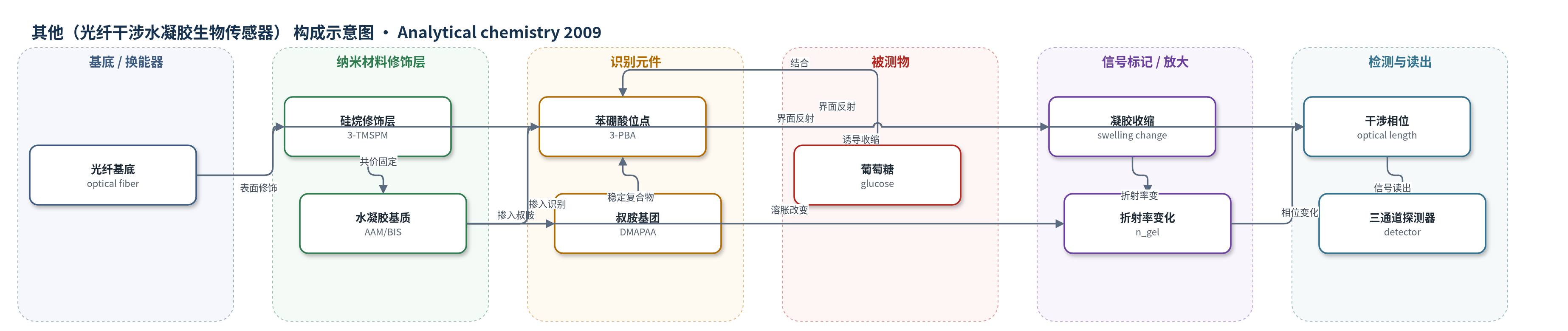
点击图片查看大图 · 依据论文自动绘制
传感器类型
其他(光纤干涉水凝胶生物传感器)
检测对象
葡萄糖(glucose, Glc);样品基质:磷酸盐缓冲液(PBS)和体外人血浆(blood plasma)
检测原理
葡萄糖进入样品后,与掺入水凝胶的3-苯硼酸(3-PBA)可逆结合;邻近叔胺基团(DMAPAA)稳定葡萄糖-苯硼酸负离子复合物,提高对葡萄糖的选择性。葡萄糖分子可同时桥接两个PBA位点,使凝胶网络交联密度增加,平衡溶胀度降低,凝胶物理长度和折射率随之改变。宽带光(1530–1560 nm)在光纤-凝胶和凝胶-溶液界面反射形成干涉,凝胶光学长度变化导致干涉相位移动,三通道探测器据此读出信号。葡萄糖浓度越高,PBA介导交联越多,光学长度变化越大;响应存在非线性,需校准。温度升高会加快结合动力学并降低平衡响应。
检测灵敏度
未报告LOD、线性范围、灵敏度斜率或相关系数。
效应效果
传感器在0–8 mM葡萄糖升降中无明显滞后,可逆性良好,特征时间约100–140 s。两个凝胶光学长度64.2和70.5 µm,相对平衡溶胀差异仅0.5–1%,重现性好。25–37℃下溶胀速率提高约4倍,平衡响应下降约35%。1 mM乳酸使灵敏度降约4%,5 mM降约17%;2 mM柠檬酸响应约为葡萄糖85%;肝素使响应降至约2/3且难恢复,EDTA调pH后无干扰。EDTA血浆中响应良好,与PBS差异在2 mM约15%,15 mM降至4%。作者认为分辨率约2 nm,可检测4–8 mM生理血糖,适合连续监测。
传感器的构成
- 基底/换能器:光纤(optical fiber),传导1530–1560 nm光并构成干涉腔一端
- 表面修饰层:3-(trimethoxysilyl)propylmethacrylate(硅烷甲基丙烯酸酯)修饰光纤端面,提供共价连接位点
- 水凝胶基质:丙烯酰胺(AAM)与N,N-亚甲基双丙烯酰胺(BIS)光聚合形成半球形水凝胶,作为响应基质
- 识别元件:3-苯硼酸(3-PBA,以3-丙烯酰胺苯硼酸形式掺入)与葡萄糖顺式二醇可逆结合,诱导凝胶交联/溶胀变化
- 选择性调节剂:N-(3-二甲基氨基丙基)丙烯酰胺(DMAPAA)叔胺基团稳定葡萄糖-苯硼酸负离子复合物,提高葡萄糖选择性
- 信号换能层:无外源标记,水凝胶溶胀/收缩改变物理长度和折射率,产生光学长度变化
- 读出系统:宽带光源/干涉仪与三通道探测器,检测光纤-凝胶和凝胶-溶液界面反射干涉信号
中文摘要
本文报道了一种用于连续监测血糖的功能化水凝胶-光纤生物传感器。作者将3-苯硼酸(3-PBA)和叔胺二甲基氨基丙基丙烯酰胺(DMAPAA)掺入丙烯酰胺水凝胶基质,并将凝胶共价固定在光纤末端,利用干涉法测量凝胶光学长度。葡萄糖与苯硼酸可逆结合后引起水凝胶收缩/溶胀变化,从而改变光程。研究进一步考察了溶胀动力学、平衡溶胀度、温度效应、尺寸差异、分子干扰和可逆性。结果表明,平衡溶胀和动力学均具有良好的可逆性;不同尺寸凝胶的相对响应高度重叠,重现性优良。温度从25℃升至37℃时,溶胀速率约提高4倍,平衡溶胀度下降。基于干扰实验选择EDTA作为体外血浆测定的抗凝剂。血浆中葡萄糖测定结果良好,干扰分子影响较小,表明该传感器有望用于体内连续血糖监测。
英文摘要
Glucose-selective optical sensors were fabricated by incorporating 3-phenylboronic acid and a tertiary amine, dimethylaminopropylacrylamide, into a hydrogel matrix. Determination of glucose in solution is based on the glucose-induced contraction of the hydrogel. The gel was fabricated on the end of an optical fiber, and the optical length was measured by an interferometric technique. Previously it was found the gel could be tuned for enhanced glucose sensitivity and selectivity by varying the 3-phenylboronic acid/tertiary amine ratio. The properties of the responsive hydrogel as a glucose sensor were determined in more detail with respect to swelling kinetics and equilibrium swelling degree. Temperature effects, size variation, molecular interference, and reversibility were addressed. Results showed there was a good degree of reversibility, both for equilibrium swelling and swelling kinetics. Fabricated hydrogel sensors with slight differences in size yielded an overlapping relative response indicating an excellent degree of sensor reproducibility. The sensor proved to be temperature-dependent; by increasing the temperature from 25 to 37 degrees C, the swelling was about 4-fold more rapid, and a concomitant decrease in equilibrium swelling was seen. Identified interference from other analytes with determination of glucose was used a basis for selecting ethylenediaminetetraacetic acid (EDTA) as an anticoagulant for in vitro determination of glucose concentration in blood plasma. Glucose measurements performed in blood plasma were promising, showing that the sensor is capable of measuring physiological glucose levels in blood with a minimal effect from interfering molecules. The obtained results indicate that the developed sensor is a candidate for continuous monitoring of glucose in blood.