组成图示
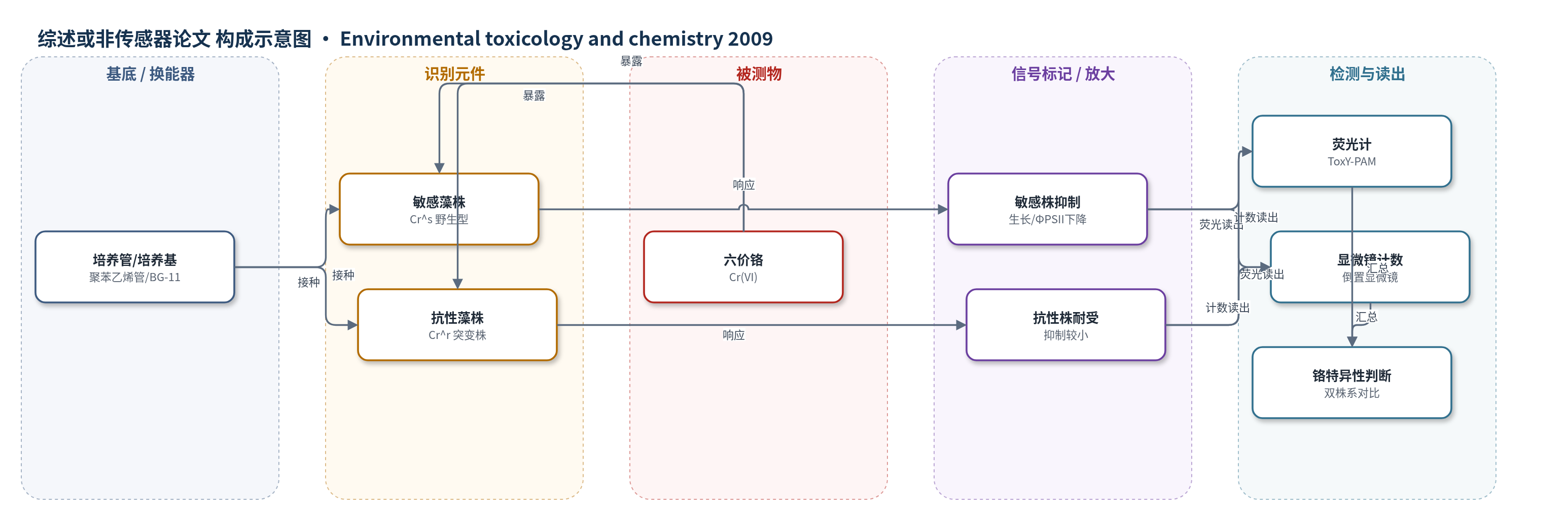
点击图片查看大图 · 依据论文自动绘制
传感器类型
综述或非传感器论文
检测对象
六价铬(Cr(VI));样品基质:水样/培养基(BG-11)
检测原理
该研究未构建正式传感器,但提出潜在检测原理:将铬敏感株 Cr^s 与铬抗性突变株 Cr^r 同时暴露于含 Cr(VI) 的样品中。Cr(VI) 进入细胞后干扰光合电子传递和细胞增殖,使敏感株的叶绿素荧光有效量子产率 ΦPSII 和生长率随铬浓度升高而下降;抗性株因预先存在的突变对 Cr(VI) 耐受,其 ΦPSII 和生长率受抑制程度较小。通过比较两株系在相同样品中的荧光/生长响应差异,可增强对铬的特异性,降低其他重金属或毒性物质造成的非特异抑制。信号变化主要来自生物识别单元(藻细胞)的生理响应,无外源标记或酶促放大。
检测灵敏度
未报道 LOD、线性范围、灵敏度斜率、相关系数。
效应效果
文中未报道 RSD、实际样品加标回收率或与 ELISA/HPLC/qPCR 等方法的直接对比。毒理实验显示,敏感株 72 h 生长和 ΦPSII 的 IC50 分别为 1.64 和 1.54 mg/L;抗性株分别为 20.61 和 17.26 mg/L,差异显著(p<0.05),抗性株约比敏感株耐受 12 倍。波动分析表明抗性来自暴露前自发突变,突变率 1.77×10^-6/细胞分裂,选择系数 s=0.125,抗性频率约 14 个抗性细胞/10^6 野生型细胞。作者主张利用敏感株提供灵敏度、抗性株提供特异性,开发铬特异性微藻生物传感器,用于水样中 Cr(VI) 的连续监测。
传感器的构成
- 识别元件:Dictyosphaerium chlorelloides 敏感株(Cr^s)与抗性突变株(Cr^r),作为铬响应生物识别单元
- 换能/读出:叶绿素荧光有效量子产率 ΦPSII 与细胞生长率,作为潜在信号输出
- 样品基质:含 Cr(VI) 的水样或 BG-11 培养基
- 信号标记物:无外源标记,依赖藻细胞自身光合与生长响应
- 读出装置:ToxY-PAM 荧光计与倒置显微镜血球计数板,用于测量 ΦPSII 和细胞密度
- 封闭剂:未报道
- 电子供体:未报道
中文摘要
工业排放常使重金属进入内陆水体,并对藻类造成严重破坏;但先前暴露可能使藻类种群产生耐受。由于藻类耐受重金属的机制尚不清楚,本研究分析六价铬对 Dictyosphaerium chlorelloides 生长和光合性能的影响,并探讨其对铬污染的适应机制。结果显示,10 mg/L Cr(VI) 可抑制藻细胞生长和光合性能,72 h 生长与光合有效量子产率 ΦPSII 的中位抑制浓度分别为 1.64 和 1.54 mg/L。在 25 mg/L 铬环境中继续培养 3 个月后,偶尔出现少数铬抗性细胞。Luria-Delbrück 波动分析表明,抗性细胞并非由铬诱导的生理适应产生,而是来自加铬前已发生的稀有自发突变,突变率为 1.77×10^-6/细胞分裂。作者认为,联合使用铬敏感株与铬抗性株可能构建用于铬检测的特异性微藻生物传感器。
英文摘要
Metals are often spilled by industries into inland water environments, with adverse consequences. Numerous papers have reported that heavy metals produce massive destruction of algae. Nevertheless, algal populations seem to become tolerant when they have had previous exposures to heavy metals. Because the mechanisms allowing heavy metal tolerance of algae are not yet known, the present study analyzed the effect of hexavalent chromium on growth and photosynthetic performance of Dictyosphaerium chlorelloides, stressing on the adaptation mechanisms to chromium contamination. Growth and photosynthetic performance of algal cells were inhibited by Cr(VI) at 10 mg/L, and the 72-h median inhibition concentration was established as 1.64 and 1.54 mg/L, respectively. However, after further incubation for a three month period in an environment with 25 mg/L of chromium, some rare, chromium-resistant cells occasionally were found. A Luria-Delbrück fluctuation analysis was performed to distinguish between resistant algae arising from rare, spontaneous mutations and resistant algae arising from physiological adaptation and other adaptive mechanisms. Resistant cells arose only by spontaneous mutations before the addition of chromium, with a rate of 1.77 x 10(-6) mutants per cell division. From a practical point of view, the use of both chromium-sensitive and chromium-resistant genotypes could make possible a specific algal biosensor for chromium.