组成图示
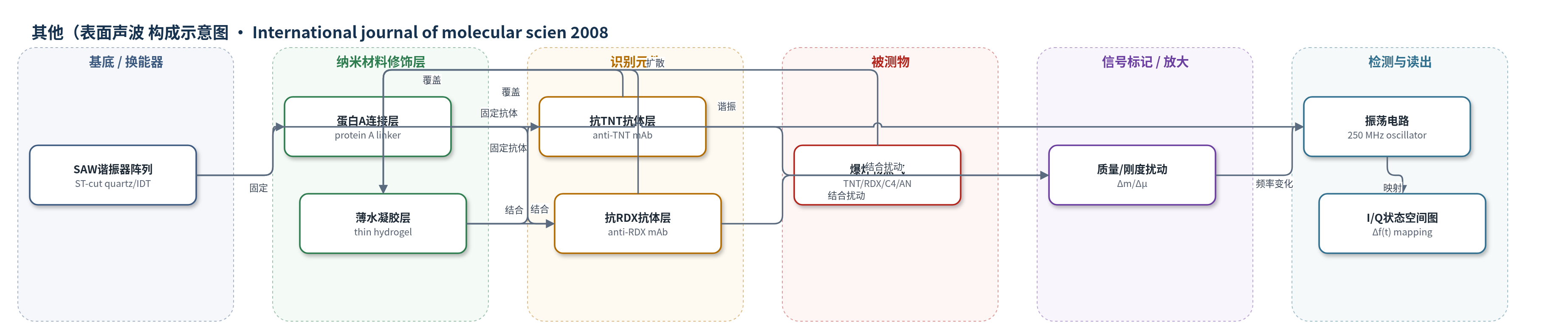
点击图片查看大图 · 依据论文自动绘制
传感器类型
其他(表面声波(SAW)生物传感器)
检测对象
三硝基甲苯(TNT)、黑索金(RDX)、C4炸药、硝酸铵(ammonium nitrate)、麝香油/麝香二甲苯(musk oil/musk xylene);样品基质:气相蒸气/顶空蒸气,以及含 TNT 和硝基酚类似物的土壤样品顶空蒸气。
检测原理
该传感器为无标记实时声学免疫传感。ST-cut石英SAW谐振器表面经蛋白A固定抗TNT或抗RDX抗体,并覆盖薄水凝胶。目标蒸气扩散进入水凝胶并与抗体结合;结合事件引起抗体层质量增加和界面刚度变化,改变SAW传播速度,使250 MHz谐振频率发生Δf(t)漂移。由于抗体亲和力不同,类似物在两个半正交通道中产生不同时间-频率响应。系统将X、Y通道频率信号映射为同相/正交(I/Q)状态空间图,按结合亲和力、浓度或蒸气压形成聚类,从而区分TNT、RDX等近似分子。方法不依赖酶或标记放大,而依靠双通道化学正交与抗体多反应性增强判别。
检测灵敏度
原文未报告具体 LOD、线性范围、灵敏度斜率或 R^2。
效应效果
实验在气相中直接检测,无需预处理/预浓缩;TNT 脉冲 50 pg、RDX 50.3 pg,流速 150 cc/min,分别 13.2°C/53°C,脉冲 0.3/3.2 s;C4、麝香油、硝酸铵用 5 μm 过滤采样头,距离 2.0/3.5/同距离。双通道状态空间图将 TNT、RDX、C4、硝酸铵、麝香油清晰聚类;三通道(anti-DNP)可分析土壤顶空 TNT 与硝基酚类似物。作者称可实时、低计算量区分质谱难以分辨的近似类似物。
传感器的构成
- 基底/换能器:ST-cut quartz 表面声波(SAW)谐振器,含叉指换能器(IDT),250 MHz,将表面质量/刚度变化转为频率变化
- 固定层:异双功能连接子(heterobifunctional linker,如 protein A),将抗体固定到 SAW 表面
- 识别元件:小鼠抗 TNT 单克隆抗体(anti-TNT)单层,识别 TNT 及其类似物蒸气
- 识别元件:小鼠抗 RDX 抗体(anti-RDX)单层,识别 RDX 及其类似物蒸气
- 可选识别元件:抗二硝基酚抗体(anti-DNP)单层,用于三通道状态空间扩展
- 微环境层:薄水凝胶层(thin hydrogel layer),支撑抗体并提供半水合环境
- 参考通道:参考 SAW 传感器(reference SAW sensor),用于基线/漂移补偿
- 读出系统:振荡电路(oscillator circuit)与笔记本电脑,记录频率变化 Δf(t) 并映射 I/Q 状态空间
中文摘要
声学波生物传感器是一种实时、无标记的生物传感技术,已用于蛋白质和细胞检测。传统方法通常将单层抗体固定在声学波器件表面以检测特定分析物。本文提出在两个独立的声学波器件表面分别固定两种不同抗体,用于检测多种结构类似分析物。分子识别的化学特异性来自抗体与抗原之间极高的纳摩尔至皮摩尔级结合亲和力。标准酶联免疫吸附试验(ELISA)步骤多且非实时,掩盖了分子识别的动态过程。已有研究表明抗体在结合过程中会发生构象变化,且部分抗体存在明显交叉反应,即抗体多反应性。本文将这些生化概念与数字无线电中的同相(I)和正交(Q)信号相结合,形成一种分子识别分析方法,可获得单独方法难以实现的判别与分析能力。作为示例,作者给出了抗体涂层声学波传感器检测三硝基甲苯(TNT)、黑索金(RDX)、C4、硝酸铵和麝香油的气相实验数据。
英文摘要
Acoustic wave biosensors are a real-time, label-free biosensor technology, which have been exploited for the detection of proteins and cells. One of the conventional biosensor approaches involves the immobilization of a monolayer of antibodies onto the surface of the acoustic wave device for the detection of a specific analyte. The method described within includes at least two immobilizations of two different antibodies onto the surfaces of two separate acoustic wave devices for the detection of several analogous analytes. The chemical specificity of the molecular recognition event is achieved by virtue of the extremely high (nM to pM) binding affinity between the antibody and its antigen. In a standard ELISA (Enzyme-Linked ImmunoSorbent Assay) test, there are multiple steps and the end result is a measure of what is bound so tightly that it does not wash away easily. The fact that this "gold standard" is very much not real time, masks the dance that is the molecular recognition event. X-Ray Crystallographer, Ian Wilson, demonstrated more than a decade ago that antibodies undergo conformational change during a binding event[1, 2]. Further, it is known in the arena of immunochemistry that some antibodies exhibit significant cross-reactivity and this is widely termed antibody promiscuity. A third piece of the puzzle that we will exploit in our system of acoustic wave biosensors is the notion of chemical orthogonality. These three biochemical constructs, the dance, antibody promiscuity and chemical orthogonality will be combined in this paper with the notions of in-phase (I) and quadrature (Q) signals from digital radio to manifest an approach to molecular recognition that allows a level of discrimination and analysis unobtainable without the aggregate. As an example we present experimental data on the detection of TNT, RDX, C4, ammonium nitrate and musk oil from a system of antibody-coated acoustic wave sensors.