组成图示
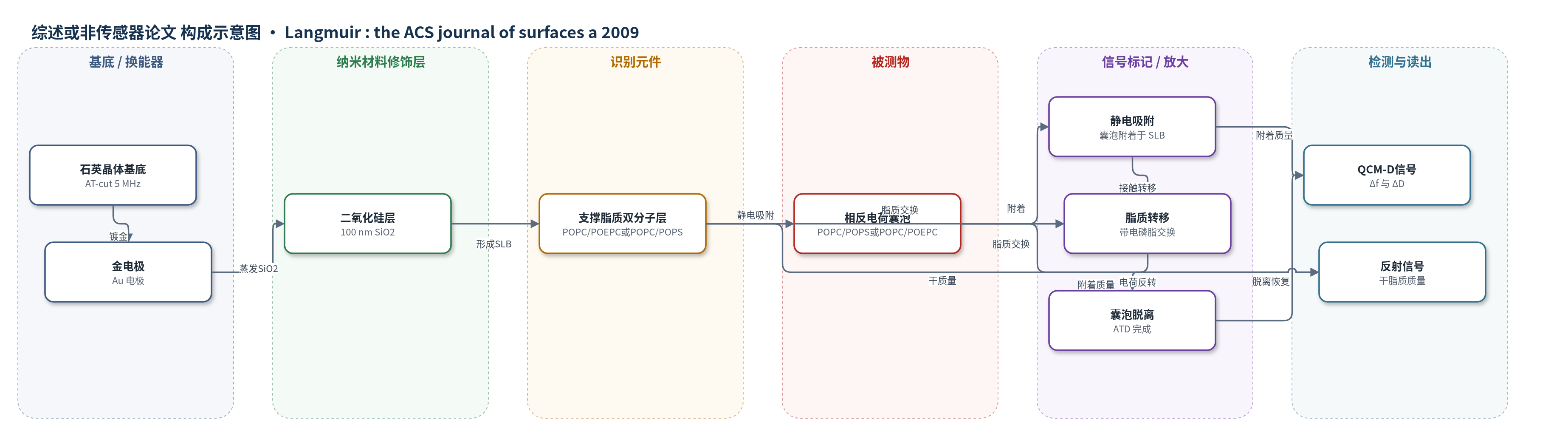
点击图片查看大图 · 依据论文自动绘制
传感器类型
综述或非传感器论文
检测对象
无明确检测分析物;研究对象为磷脂(phospholipids,POPC/POPS/POEPC)在支撑脂质双分子层(SLB)与单层囊泡(unilamellar vesicles)之间的转移;样品基质为 TRIS 缓冲液(10 mM TRIS、100 mM NaCl、pH 8)
检测原理
该工作并非针对特定分析物的传感检测,而是以 QCM-D 和反射法监测膜间脂质转移。带正电或负电的 SLB 与相反电荷囊泡因静电作用吸附,形成附着—转移—脱离(ATD)过程。囊泡附着使表面湿质量增加,QCM-D 频率下降、耗散上升;随后磷脂在 SLB 与囊泡膜间双向转移,SLB 表面电荷逐渐被中和或反转,静电吸引减弱或变为排斥,囊泡脱离,频率和耗散恢复至初始 SLB 水平。反射法同步测量不含耦合水的干脂质质量,与 QCM-D 湿质量结合可估算附着囊泡覆盖度。囊泡体相浓度主要影响初始供给速率,浓度越高,达到最大附着越快;转移完成时间则主要取决于膜间脂质转移和电荷反转程度。
检测灵敏度
原文未报告 LOD、线性范围、灵敏度斜率或相关系数。
效应效果
实验显示不同电荷比例下 ATD 时间约为 3–40 min;最大频率偏移 Δfmin 约 -80 至 -123 Hz,最大耗散 ΔDmax 约 11–15×10^-6。囊泡电荷比例越高,转移越快、附着量越小;SLB 电荷比例越高,转移越慢、附着量越大。静电对称但电荷符号相反的组合动力学不对称,归因于头部基团结构、膜内电荷分布和囊泡曲率差异。联用反射法估计 ATD 中最大囊泡覆盖约为完整单层的 25%–40%。中断实验表明,转移不完全时囊泡可被静电锁定在 SLB 上,继续供给囊泡并转移足够相反电荷脂质后才会脱离。作者认为该平台可用于研究膜间分子转移,并可控修饰 SLB 组成,服务于生物传感器和细胞培养应用。
传感器的构成
- 换能器基底:AT-cut 石英晶体(5 MHz)与 Au 电极,用于 QCM-D 频率和耗散测量
- 表面支撑层:100 nm SiO2 蒸发层,提供负电表面并支撑 SLB
- 支撑脂质双分子层:POPC/POEPC 或 POPC/POPS 二元磷脂混合物,形成带电 SLB
- 相互作用囊泡:POPC/POPS 或 POPC/POEPC 单层囊泡,作为相反电荷脂质供体/受体
- 缓冲介质:10 mM TRIS、100 mM NaCl、pH 8;负电 SLB 制备时加 10 mM CaCl2,洗涤用 EDTA
- 光学读出表面:QCM-D/反射联用传感器表面,用于区分干脂质质量与湿耦合水质量
中文摘要
本文利用石英晶体微天平带耗散(QCM-D)和光学反射法,研究二氧化硅(SiO2)上带电支撑脂质双分子层(SLB)与相反电荷单层囊泡间磷脂双向转移。SLB 和囊泡由 1-棕榈酰-2-油酰-sn-甘油-3-磷酸胆碱(POPC)与不同比例负电 POPS 或正电 POEPC 二元混合物制备。相互作用经历附着—转移—脱离(ATD)过程:囊泡先吸附并与 SLB 作用,随后脱离,留下组成改变的 SLB 和囊泡。过程完成后 SLB 总脂质质量无净增减,但已发生脂质交换。时间尺度为数分钟至数十分钟,取决于带电脂质类型及两膜中带电脂质比例。仅电荷符号相反的静电对称情形动力学定性相似但定量不同,归因于正负脂质头部基团结构差异及膜中带电脂质分布不对称。ATD 中附着囊泡最大量约为完整单层的 25%–40%。中断暴露和改变囊泡浓度实验表明,转移不完全时囊泡可被不可逆困在 SLB 上;继续供给并转移足够相反电荷脂质后,SLB 排斥附着囊泡并诱导脱离。文章讨论单体插入和半融合机制,并指出该平台可用于膜间分子转移研究及 SLB 组成可控修饰,如生物传感器和细胞培养应用。
英文摘要
The bidirectional transfer of phospholipids between a charged, supported lipid bilayer (SLB) on SiO(2) and oppositely charged, unilamellar vesicles was studied by means of quartz crystal microbalance with dissipation (QCM-D) and optical reflectometry techniques. SLBs and vesicles were prepared from binary mixtures of 1-palmitoyl-2-oleoyl-sn-glycero-3-phosphocholine (POPC) mixed with different fractions of either 1-palmitoyl-2-oleoyl-sn-glycero-3-[phospho-l-serine] (POPS) (negatively charged) or 1-palmitoyl-2-oleoyl-sn-glycero-3-ethylphosphocholine (POEPC) (positively charged). The interaction process consists of an attachment-transfer-detachment (ATD) sequence, where added vesicles first attach to and interact with the SLB, after which they detach, leaving behind a compositionally modified SLB and ditto vesicles. When the process is complete, there is no net addition or reduction of total lipid mass in the SLB, but lipid exchange has occurred. The time scale of the process varies from a few to many tens of minutes depending on the type of charged lipid molecule and the relative concentration of charged lipids in the two membranes. Electrostatically symmetric cases, where only the charge sign (but not the fraction of charged lipid) was reversed between the SLB and the vesicles, produce qualitatively similar but quantitatively different kinetics. The time scale of the interaction varies significantly between the two cases, which is attributed to a combination of the differences in the molecular structure of the lipid headgroup for the positively and the negatively charged lipids used, and to nonsymmetric distribution of charged lipids in the lipid membranes. The maximum amounts of attached vesicles during the ATD process were estimated to be 25-40% of a full monolayer of vesicles, with the precise amount depending on the actual charge fractions in the vesicles and the SLB. Interrupted vesicle exposure experiments, and experiments where the bulk concentration of vesicles was varied, show that vesicles in some cases may be trapped irreversibly on the SLB, when only partial transfer of lipid molecules has occurred. Additional supply of vesicles and further transfer induces detachment, when a sufficient amount of oppositely charged lipids has been transferred to the SLB, so that the latter becomes repulsive to the attached vesicles. Possible mechanistic scenarios, including monomer insertion and hemifusion models, are discussed. The observed phenomena and the actual SLB preparation process form a platform both for studies of various intermembrane molecular transfer processes and for modifying the composition of SLBs in a controlled way, for example, for biosensor and cell culture applications.