组成图示
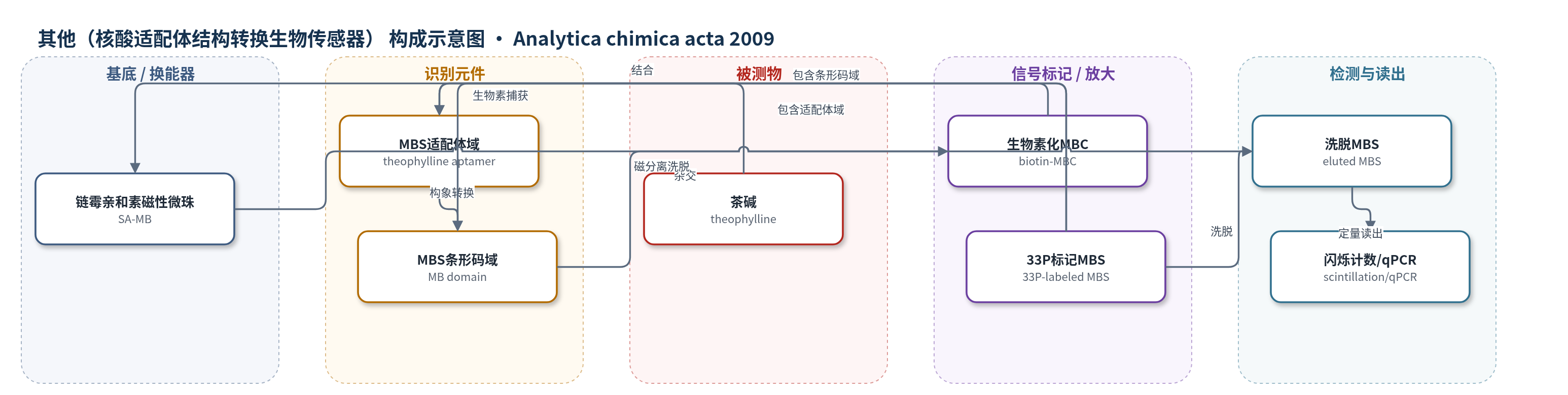
点击图片查看大图 · 依据论文自动绘制
传感器类型
其他(核酸适配体结构转换生物传感器)
检测对象
茶碱(theophylline),溶液样品(覆盖临床相关血浆浓度范围)
检测原理
MBS 由茶碱适配体域和分子条形码(MB)读出域组成,天然状态下 MB 形成 15 bp 分子内茎。茶碱结合适配体域后引起构象重排和链置换,使 MB 域暴露,MBS 与生物素化 MBC 的杂交亲和力由 9.9 nM 提高到 1.0 nM。暴露的 MB 与 MBC 杂交后,生物素化 MBC 被链霉亲和素磁性微珠捕获,从而富集含茶碱的 MBS-MBC 复合物。洗脱 MBS 后,33P 标记 MBS 用闪烁计数定量,无标记 MBS 经逆转录和 qPCR 放大后定量。洗脱 MBS 量随茶碱浓度增加而增加,背景来自无茶碱时 MBC 与 MBS 的基础杂交。
检测灵敏度
LOD: 0.5 μM(闪烁计数);线性范围: 0.5 μM–200 μM;LOD: 1 μM(RT-qPCR);线性范围: 1 μM–20 μM;最大S/N: ∼3.2;MBS-MBC KD: 9.9 ± 1.0 nM (R^2=0.884);1.0 ± 0.1 nM (R^2=0.957)
效应效果
该传感器在 0.5–200 μM 茶碱范围内可一致定量,覆盖临床相关血浆浓度 55–111 μM;qPCR 读出在 1–20 μM 动态范围内有效,最大 S/N 约 3.2。对结构类似物咖啡因具有近四个数量级区分能力,2 mM 咖啡因才出现显著高于背景的信号,血浆咖啡因 25–100 μM 不干扰。磁珠分离在四个数量级内定量准确,qPCR 模板标准曲线覆盖六个数量级。作者称其检测限低于现有茶碱传感技术,动态范围优于近期适配体茶碱传感方法,且仅需 3 μL 样品,适合小分子定量与并行分析。
传感器的构成
- 识别元件:茶碱适配体域(theophylline aptamer domain),特异性结合茶碱并触发 MBS 构象转换
- 读出域:分子条形码域(molecular barcode, MB),天然形成 15 bp 分子内茎,目标结合后暴露以接受 MBC 杂交
- 信号探针:生物素化 MBC(biotinylated molecular barcode complement, MBC),20-nt 互补链,与暴露 MB 杂交并连接磁性微珠
- 固相捕获基底:链霉亲和素包被磁性微珠(streptavidin-coated magnetic beads, SA-MB),通过生物素-链霉亲和素作用捕获 MBS-MBC 复合物
- 信号标记物:33P 标记 MBS(33P-labeled MBS),用于闪烁计数定量;无标记 MBS 用于 RT-qPCR
- 定量读出试剂:SuperScript III 逆转录酶、iQ SYBR Green Supermix 和 MyiQ Real Time PCR 系统,将洗脱 MBS 转化为可定量核酸信号
中文摘要
现代细胞功能分析工具旨在对某一类生物分子的所有成员进行定量测量。在各类分析物中,核酸的测量通常最易实现,既可针对单个分析物,也可并行检测,因此人们希望利用核酸生物传感器来测量其他细胞分子。在众多核酸生物传感器策略中,结构转换适配体(SSA)能够将目标分子识别与信号读出耦合,具有独特优势,但决定其信号保真度的关键参数仍缺乏系统表征。本研究基于 SSA 工程化了一种小分子生物传感器,用于在溶液中检测模型小分子茶碱。该传感器通过闪烁计数和定量 PCR 实现近三个数量级的茶碱定量检测。进一步分析表明,SSA 生物传感器的保真度主要取决于其两种构象之间的相对稳定性。
英文摘要
Modern tools for the analysis of cellular function aim for the quantitative measurement of all members of a given class of biological molecules. Of the analyte classes, nucleic acid measurements are typically the most tractable, both on an individual analyte basis and in parallel. Thus, tools are being sought to enable measurement of other cellular molecules using nucleic acid biosensors. Of the variety of potential nucleic acid biosensor strategies, structure-switching aptamers (SSAs) present a unique opportunity to couple sensing and readout of the target molecule. However, little has been characterized about the parameters that determine the fidelity of the signal from SSA biosensors. In this study, a small molecule biosensor based on a SSA was engineered to detect the model small molecule, theophylline, in solution. Quantitative theophylline detection over nearly three orders-of-magnitude was achieved by scintillation counting and quantitative PCR. Further analysis showed that the biosensor fidelity is primarily controlled by the relative stability of the two conformations of the SSA.