组成图示
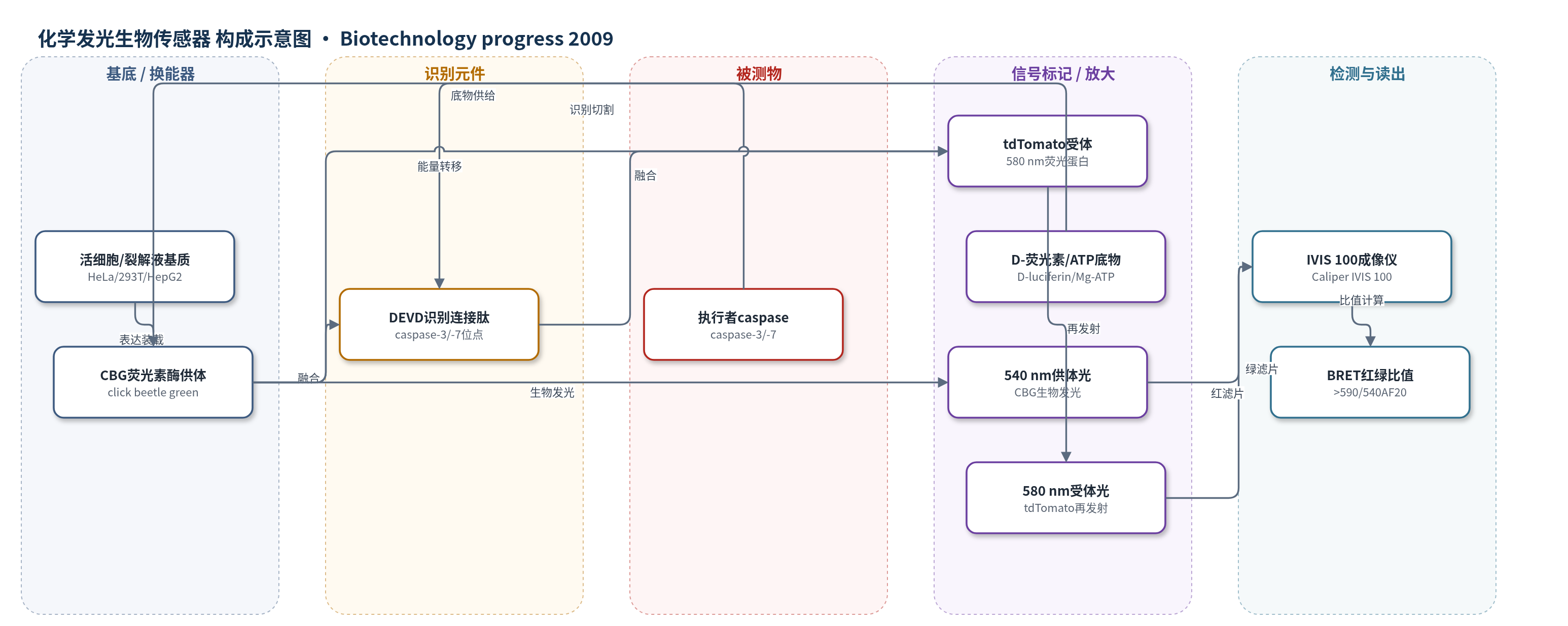
点击图片查看大图 · 依据论文自动绘制
传感器类型
化学发光生物传感器
检测对象
执行者 caspase 活性(executioner caspase activity,主要为 caspase-3、caspase-7);样品基质:活细胞(HeLa、HEK293T、HepG2、MCF7)及细胞裂解液
检测原理
CBG 与 tdTomato 通过 DEVD 连接肽形成单链融合蛋白。CBG 在 D-荧光素和 Mg-ATP 存在下催化氧化反应,发射 540 nm 生物发光;当 CBG 与 tdTomato 距离足够近时,发生距离依赖性 BRET(∝1/r^6),能量非辐射转移至 tdTomato,使其在 580 nm 再发射。未切割时红/绿比值高。执行者 caspase(caspase-3/-7)识别并切割 DEVD 后,tdTomato 扩散离开 CBG,BRET 效率下降,580 nm 信号降低、540 nm 相对升高,红/绿比值随 caspase 活性增加而下降。该过程无需外加激发光,活细胞中可重复成像;无额外信号放大,依靠 BRET 比值和持续生物发光底物供给;死细胞因 ATP 丧失而光学沉默。
检测灵敏度
相关系数: R^2 = 0.99(BRET 预测方程拟合);R^2 = 0.96(BRET 与 MTS 细胞活力相关);R^2 = 0.91(Ac-DEVD-CHO 抑制曲线);r = -0.73 或 r = -0.82(BRET 与活性 caspase-3 免疫印迹相关)
效应效果
活细胞纵向实验 S/N 约33、Z' 0.85,优于 Renilla BRET(BRET2 S/N 8.94、Z' 0.11;BRET1 S/N 6.67、Z' -0.45;eBRET1 S/N 6.00、Z' 0.30),适合高通量筛选。caspase 切割顺序 3>7>6>>9,Ac-DEVD-CHO 抑制 IC50 360 pM(R^2=0.91,95% CI 228–579 pM);HeLa BRET 下降与 MTS 活力相关(R^2=0.96),早12 h预测死亡;与活性 caspase-3 免疫印迹负相关(r=-0.73 或 -0.82)。MCF7 pBabe 响应弱、pCASP3 恢复,293T 无响应。D-荧光素水溶、无需外加激发光,可一次加底物后数天重复成像,死细胞因 ATP 丧失而光学沉默。
传感器的构成
- 供体换能层:click beetle green 荧光素酶(CBG),催化 D-荧光素(D-luciferin)氧化并在 540 nm 发射生物发光,作为 BRET 供体
- 识别元件:DEVD 连接肽(caspase-3/-7 共识序列),被执行者 caspase 切割,触发 BRET 信号变化
- 受体信号层:tdTomato 红色荧光蛋白,接受 CBG 能量并在 580 nm 再发射,作为 BRET 受体
- 对照元件:GGSS 连接肽(CBG-GGSS-tdTomato),不可被 caspase 切割,用于维持 BRET 对照
- 底物/辅因子:D-荧光素(D-luciferin)与 Mg-ATP,为 CBG 生物发光反应提供底物和能量
- 表达/细胞基质:pCBG-DEVD-tdTomato 质粒转染的 HeLa、HEK293T、HepG2、MCF7 等活细胞或细胞裂解液
- 光学读出层:IVIS 100 生物发光成像仪,使用 540AF20 nm 绿滤片和 >590 nm 长通红滤片计算 BRET 比值
中文摘要
生物发光共振能量转移(BRET)系统长期以蓝绿色 Renilla 荧光素酶(Rluc)为供体,但其底物苯基海鞘素昂贵且生化性质不利,限制应用。本文报道一系列基于利用 D-荧光素(D-luciferin)的荧光素酶的新型 BRET 供体-受体对,具有红移光子输出、更优生化性质和更高效率。作者建立改进的 Förster 方程预测最佳 BRET 荧光素酶供体-荧光蛋白受体组合,并确定 tdTomato 为 click beetle green 荧光素酶(CBG)的最佳红色荧光受体。通过在 CBG 与 tdTomato 之间插入 DEVD 连接肽,构建单链蛋白酶 BRET 生物传感器,可实时报告活细胞中执行者 caspase 活性,并用重组 caspase 及凋亡敏感/抵抗细胞系验证。活细胞纵向研究中获得高信噪比(约33)和 Z' 因子(0.85),适合高通量筛选。该工作展示了理性设计新型 BRET 系统的通用方法,并提供一种寿命长、红移、使用 D-荧光素的单链 BRET 蛋白酶生物传感器。
英文摘要
Bioluminescence resonance energy transfer (BRET) systems to date have been dominated by use of blue-green Renilla luciferase (Rluc) as the energy donor. Although effective in many cases, the expense and unfavorable biochemical attributes of the substrate (phenylcoelenterazine) limit utility of Rluc-based BRET systems. Herein we report a series of novel BRET pairs based on luciferases that utilize D-luciferin, resulting in red-shifted photonic outputs, favorable biochemical attributes, and increased efficacy. We developed a modified Förster equation to predict optimal BRET luciferase donor-fluorophore pairs and identified tdTomato as the optimal red fluorophore acceptor for click beetle green luciferase (CBG). A prototypical single-chain protease biosensor, capable of reporting on executioner caspase activity in live cells and in real-time, was generated by inserting a DEVD linker between CBG and tdTomato and validated in vitro with recombinant caspases and in cellulo with apoptosis-sensitive and -resistant cell lines. High signal-to-noise ratios ( approximately 33) and Z' factors (0.85) were observed in live cell longitudinal studies, sufficient for high-throughput screening. Thus, we illustrate a general methodology for the rational design of new BRET systems and provide a novel single-chain BRET protease biosensor that is long lived, red-shifted, and utilizes D-luciferin.