组成图示
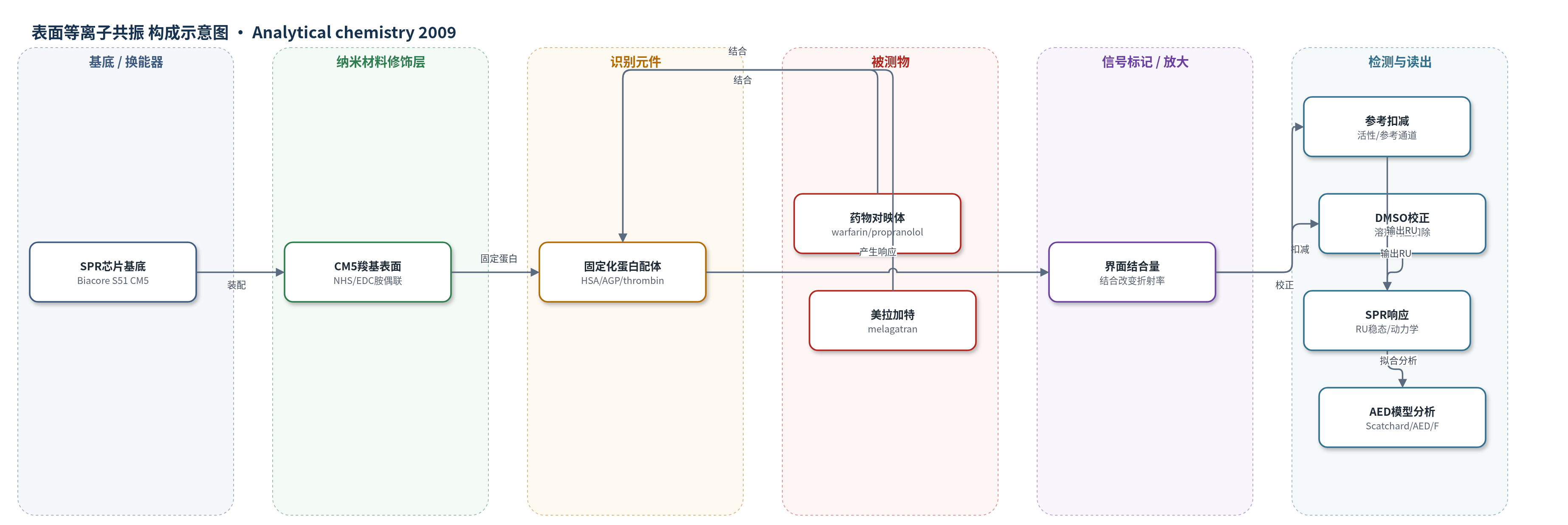
点击图片查看大图 · 依据论文自动绘制
传感器类型
表面等离子共振(SPR)生物传感器
检测对象
R/S-华法林(warfarin)、R/S-普萘洛尔(propranolol)、RS/SR-美拉加特(melagatran);样品基质为 10 mM PBS(pH 7.4,部分含 5% DMSO;凝血酶体系为 PBS-EP)
检测原理
SPR 传感器将 HSA、AGP 或凝血酶固定于 CM5 芯片表面,药物对映体从流动相注入并与固定蛋白结合。结合事件改变界面质量与折射率,SPR 换能器将其转换为响应单位 RU;稳态 RU 与表面结合量近似成正比。随药物浓度升高,响应按吸附等温线上升,单站点可用 Langmuir 模型,多站点/异质体系用 bi-Langmuir 等模型。作者用 Scatchard 图判断曲率,并用 AED 从原始 SPR 数据反演吸附能分布,估计位点数量、KD 和饱和容量,再以 F 检验选择模型。含 DMSO 的体系需扣除溶剂体积效应。该法无外源信号放大,依赖宽浓度范围和模型判别提高可靠性。
检测灵敏度
—
效应效果
方法经三次独立实验验证,报告均值与标准差。普萘洛尔-AGP 无 DMSO 时 KDR/KDS=1.30(0.13),KDR=10.05(3.02) µM、KDS=7.73(2.83) µM;5% DMSO 使手性 KD 约增大 4 倍。华法林-HSA 的 KDR/KDS=2.15(0.20),KDR=2.94(0.40) µM、KDS=1.39(0.33) µM。美拉加特 RS 与凝血酶结合 KD=0.7(0.06) nM,SR 几乎不结合;与 AGP 结合 KD 约 0.31/0.35 mM。与 HPLC、平衡透析等比较,SPR 适合中强结合,HPLC 适合弱结合。作者主张宽浓度范围、AED 模型选择和 DMSO 校正可避免单站点误判。
传感器的构成
- 基底/换能器:Biacore S51 SPR 芯片 CM5,通过表面等离子共振监测界面折射率变化,输出 RU 信号
- 功能化层:CM5 羧基表面,经 NHS/EDC 胺偶联固定 HSA 和凝血酶;AGP 先经 PDEA 修饰后以硫醇偶联固定
- 识别元件:固定化人血清白蛋白 HSA、α1-酸性糖蛋白 AGP 和人凝血酶 thrombin,作为配体捕获药物对映体
- 分析物:R/S-华法林 warfarin、R/S-普萘洛尔 propranolol、RS/SR-美拉加特 melagatran,以浓度系列注入流动相
- 信号标记物:无外源标记物,药物对映体结合直接改变界面折射率
- 缓冲/溶剂:10 mM PBS pH 7.4,部分体系含 5% DMSO;凝血酶体系使用 PBS-EP(含 EDTA 和 P20)
- 信号读出:SPR 稳态/动力学响应 RU,经参考通道扣减、零浓度扣减及 DMSO 体积效应校正后用于模型拟合
中文摘要
表面等离子共振(SPR)生物传感器已被用于小分子药物-蛋白相互作用分析,但许多研究未说明手性药物的对映体形式,或浓度范围过窄,导致结合常数偏差,甚至将多站点结合误判为单站点。本文提出可靠的实验与方法学指南,避免上述陷阱,并将基于物理化学的吸附能分布(AED)计算引入 SPR 传感社区。AED 可直接从 SPR 原始数据揭示结合位点异质性,在竞争模型拟合前缩小候选模型范围。作者分别演示了药物与转运蛋白(血浆蛋白)及靶蛋白结合时可靠平衡数据的测量:手性β受体阻滞剂普萘洛尔与α1-酸性糖蛋白(AGP)以及抗凝药华法林与人血清白蛋白(HSA)的结合均呈异质性,含少数强对映选择性位点和大量弱非选择性位点。研究还表明,浓度范围变窄会使多站点结合被错误地表现为单站点,缓冲液中 DMSO 会影响多站点药物-蛋白数据。抗凝血酶抑制剂美拉加特对映体与凝血酶及 AGP 的结合显示凝血酶对活性对映体有明显对映选择性,而 AGP 对两对映体结合相近;AED 验证两体系均为单峰能量分布,适合均质吸附模型。
英文摘要
The surface plasmon resonance (SPR) biosensor was recently introduced to the analytical biochemical society for measuring small drug-protein interactions. However, the technique has many times been used without specifying the type of enantiomeric form of the chiral drug measured and/or with using a too narrow drug concentration range resulting in biased values of binding coefficients and sometimes even assumptions about single-site bindings although the binding in reality comprises a multisite interaction. In this study we will give guidelines for reliable experimental and methodological approaches to avoid these pitfalls. For this purpose, we also introduce a new tool, based on physical chemistry, to the sensor community; the calculation of the adsorption energy distribution (AED). The AED-calculations reveal the degree of heterogeneity directly from the SPR raw data and thus guide us into a narrower selection of probable models before the rival model fitting procedure. We demonstrate how to measure reliable equilibrium data for the two typically different cases: drug binding to (i) transport (plasma) proteins and to (ii) a target protein. Both the binding of the chiral beta-blocker propranolol to alpha(1)-acid glycoprotein (AGP) and that of the anticoagulant warfarin to human serum albumin were heterogeneous, with a few strong enantioselective sites and many weak nonselective sites. We also demonstrate how the multisite binding rapidly falsely turns to single-site as the concentration range is narrowed and how adding dimethyl sulfoxide to the buffer affects multisite drug-protein data. The binding of the enantiomers of the thrombin inhibitor melagatran was investigated on both thrombin and the transport proteins, revealing clear enantioselectivity for thrombin in favor of the active enantiomer, but almost similar binding properties for both enantiomers to the transport protein AGP. The AED-calculations verified that both these system has a unimodal energy distribution and are best described with a homogeneous adsorption model.