组成图示
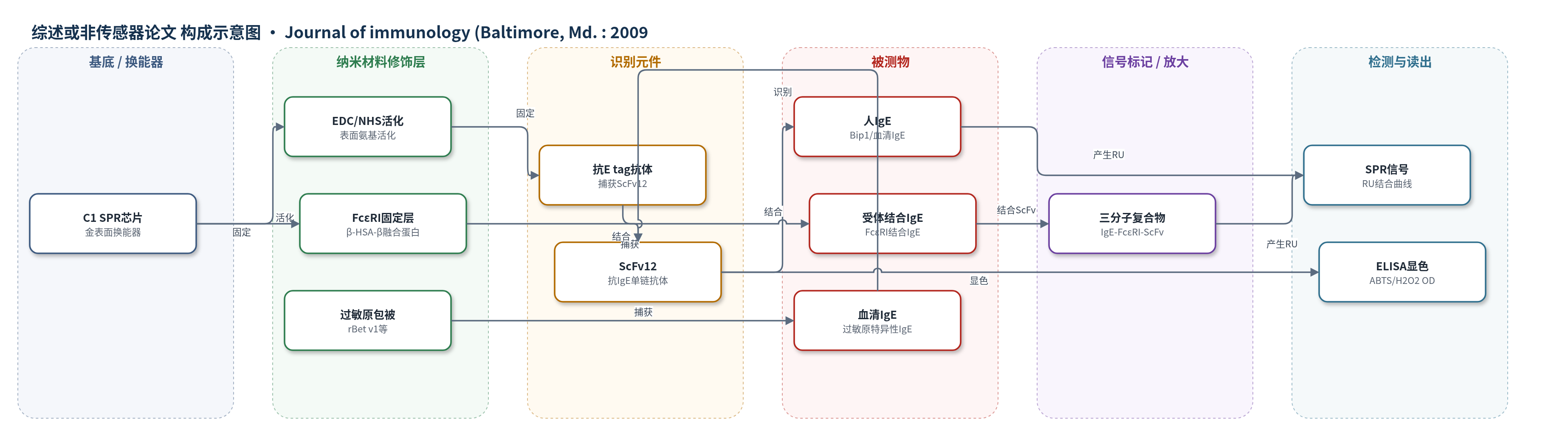
点击图片查看大图 · 依据论文自动绘制
传感器类型
综述或非传感器论文
检测对象
人 IgE(human IgE)、过敏原特异性 IgE(allergen-specific IgE);样品基质:血清、外周血单个核细胞/嗜碱性粒细胞、树突状细胞、B 细胞、浆细胞表面或培养体系
检测原理
本文并非构建新型传感器,而是以 SPR 和 ELISA 作为检测平台表征 ScFv12。SPR 实验中,C1 芯片经 EDC/NHS 活化后固定抗 E tag 抗体,捕获带 E tag 的 ScFv12;人 IgE 流过时与 ScFv12 结合,表面质量增加使共振单位(RU)升高,结合量随 IgE 浓度增加,解离曲线给出 KD、Ka、Kd。另一通道固定 FcεRI β-HSA-β,IgE 先结合受体,再注入 ScFv12 形成 IgE-FcεRI-ScFv 三分子复合物,信号反映 ScFv12 对受体结合 IgE 的识别;若 IgE 预先与 ScFv12 结合,则不能结合 FcεRI,信号降低。ELISA 中,重组过敏原包被后捕获患者血清中的过敏原特异性 IgE,ScFv12 识别 IgE,HRP 标记抗 E tag 二抗催化 ABTS 显色,OD 与 IgE 水平相关。
检测灵敏度
原文未报告 LOD、线性范围、灵敏度斜率或相关系数;SPR 结合常数:KD = 1.52 × 10^-10 M;Ka = 3.84 × 10^5/Ms;Kd = 5.84 × 10^-5/s。
效应效果
ScFv12 对人 IgE 具有高度特异性,ELISA 中不结合 IgM、IgG1-4;检测五种重组过敏原结合的患者血清 IgE 时,结果与 125I 标记抗 IgE 放射自显影一致。SPR 显示 KD 为 1.52×10^-10 M,Ka 3.84×10^5/Ms,Kd 5.84×10^-5/s,接近 IgE-FcεRI 相互作用。它能靶向嗜碱性粒细胞、树突状细胞、CD23 阳性 B 细胞和 U266 浆细胞上的 IgE,但不交联受体结合 IgE,不引起 CD203c 上调或组胺释放;皮肤试验中最高 2.29 μM 仅产生约 2 mm 风团,而完整 mAb12 在 0.29 μM 即有反应。小鼠腹腔注射后血清半衰期约 70 min。作者认为其可用于过敏诊断、IgE 清除和靶向 IgE 阳性细胞治疗。
传感器的构成
- 识别元件:重组单链抗体片段 ScFv12(single-chain variable fragment),特异性结合人 IgE 并阻断 FcεRI 结合
- 换能/检测平台:Biacore C1 表面等离子共振(SPR)芯片,固定抗 E tag 抗体或 FcεRI β-HSA-β,监测结合/解离
- 捕获/固定层:抗 E tag 单克隆抗体(anti-E tag mAb)或 FcεRI β-HSA-β 融合蛋白,用于捕获 ScFv12 或结合 IgE
- 信号标记/检测试剂:HRP 标记抗 E tag 抗体、ABTS/H2O2 显色体系、FITC/PE 标记二抗,用于 ELISA 和流式细胞术检测
中文摘要
IgE 是过敏性疾病的核心分子。本研究从抗人 IgE 小鼠单克隆抗体 mAb12 中分离重链和轻链可变区 cDNA,并在大肠杆菌中表达重组单链可变片段 ScFv12。质谱显示其分子量约 28 kDa,圆二色谱显示主要为 β 折叠。基于表面等离子共振的生物传感器研究表明,ScFv12 能迅速、稳定地结合人 IgE,解离常数 KD 为 1.52×10^-10 M,接近 IgE 与 FcεRI 的亲和力,并可识别 FcεRI 结合的 IgE、阻止 IgE 与 FcεRI 结合。ScFv12 特异性识别 IgE,不与其他免疫球蛋白亚型反应,可用于检测血清中过敏原特异性 IgE,并靶向表达 FcεRI 或 FcεRII 结合 IgE 的细胞及分泌 IgE 的细胞。负染电镜显示形成由两个 ScFv 和一个 IgE 组成的双分子复合物,以及由 IgE、FcεRI 和 ScFv 组成的三分子复合物;当 IgE 已结合 FcεRI 时仅一个 ScFv 可结合。ScFv12 不交联嗜碱性粒细胞表面 IgE,不诱导组胺释放或细胞活化,体内皮肤试验亦无过敏活性,提示其可作为 IgE 靶向治疗过敏的通用工具。
英文摘要
IgE is a central molecule in allergic disease. We have isolated cDNAs coding for the heavy and light chains of a murine mAb specific to human IgE and expressed a recombinant single-chain variable fragment (ScFv) derived thereof in Escherichia coli. The purified recombinant ScFv has a molecular mass of 28 kDa as measured by mass spectrometry and shows a beta-sheet fold as determined by circular dichroism. In biosensor-based studies it was demonstrated that the ScFv rapidly and stably binds to human IgE with an affinity of K(D) of 1.52 x 10(-10) M, which is almost as high as the affinity of IgE for FcepsilonRI, and that the ScFv is able to recognize FcepsilonRI-bound IgE and to prevent IgE binding to FcepsilonRI. The ScFv reacts specifically with IgE but not with other isotypes, allows the measurement of allergen-specific IgE in serum samples, and specifically targets cells that contain FcepsilonRI- or FcepsilonRII-bound IgE or that secrete IgE. Using negative-stain electron microscopy we demonstrated the formation of bimolecular complexes consisting of two ScFv molecules and one IgE and trimolecular complexes consisting of IgE, FcepsilonRI, and ScFv in which only one ScFv is able to bind to IgE. Accordingly, we found that the ScFv does not cross-link basophil-bound IgE and hence does not induce histamine release or activation of basophils as demonstrated by FACS analysis of CD203c expression and by histamine release experiments. In vivo skin testing confirmed the lack of allergenic activity of the ScFv. The recombinant ScFv may represent a universal tool for the IgE-targeted treatment of allergies.