组成图示
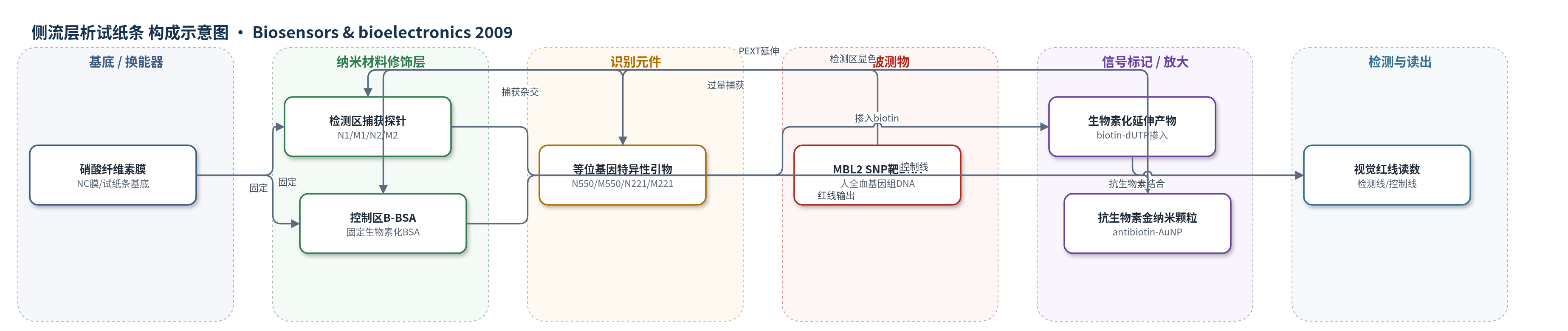
点击图片查看大图 · 依据论文自动绘制
传感器类型
侧流层析试纸条
检测对象
MBL2基因单核苷酸多态性等位基因(SNPs,-550 c.-619G>C、-221 c.-290G>C;N550/M550/N221/M221),样品基质为人全血基因组DNA(临床样本)
检测原理
从人全血提取基因组DNA,PCR扩增MBL2基因包含-550和-221两个SNP的479 bp片段。一次PEXT反应中,四个等位基因特异性引物的3′端与目标SNP完全互补时,Vent DNA聚合酶以dNTPs和biotin-11-dUTP延伸引物,将生物素掺入产物;不完全互补则不延伸。热变性后,PEXT混合物加到试纸条结合垫。杂交缓冲液毛细迁移时,四个检测区固定的互补寡核苷酸N1、M1、N2、M2捕获相应引物;只有延伸产物含生物素,被抗生物素抗体功能化金纳米颗粒结合,在对应检测区聚集形成红色线。过量金纳米颗粒被控制区固定的生物素化BSA捕获形成控制红线。信号随对应等位基因存在与否及延伸产物量变化,可肉眼或扫描读数。
检测灵敏度
未报告
效应效果
该传感器对20例临床全血样本中MBL2基因-550和-221两个SNP共40个等位基因进行基因分型,结果与直接DNA测序完全一致。交叉杂交实验显示各等位基因特异性引物仅被对应检测区捕获,无可见交叉杂交;与双分析物试纸条结果一致,说明PEXT无错引物延伸且检测区特异。重现性方面,扫描密度信号CV分别为7.7%、7.3%、5.9%、6.8%(n=6),包含PEXT的整体方法CV为9.3%、9.8%、7.4%、9.4%(n=6)。整个流程<1.5 h,无需仪器、纯化或洗涤,成本低,适合小型实验室和现场/即时检测。
传感器的构成
- 基底/膜:硝酸纤维素膜(nitrocellulose membrane),承载检测区与控制区并允许缓冲液毛细迁移。
- 检测区捕获层:固定寡核苷酸N1、M1、N2、M2,分别与N550、M550、N221、M221引物5′端特征段杂交,实现四区多分析物捕获。
- 控制区捕获层:固定生物素化牛血清白蛋白(biotinylated BSA, B-BSA),捕获过量金纳米颗粒形成控制红线。
- 结合垫:干燥抗生物素抗体功能化金纳米颗粒(antibiotin-functionalized AuNP),作为信号标记物与延伸产物中的生物素结合。
- 识别元件:等位基因特异性引物N550、M550、N221、M221,3′端互补于MBL2 SNP等位基因,5′端含可被捕获的24 nt特征段。
- 信号标记物:生物素-11-dUTP(biotin-11-dUTP),在PEXT中掺入延伸产物,供抗生物素-AuNP识别。
- 吸水垫:wicking pad,浸入杂交缓冲液,驱动液体沿试纸条迁移并连续洗涤检测区。
中文摘要
DNA生物传感器通过特异性探针与目标序列杂交实现分子识别,并用电化学、光学或重力换能进行检测。近年来发展的一次性试纸条型传感器可在无仪器条件下视觉检测DNA。本文报道一种多分析物DNA生物传感器,用于两个单核苷酸多态性(SNP)的视觉基因分型。以同时检测两个SNP涉及的四个等位基因为模型,先PCR扩增包含两个多态位点的片段,再进行单次引物延伸(PEXT)反应。反应使用四个等位基因特异性引物,每个引物含与等位基因互补的区域和用于在检测区捕获的特征片段;只有与目标序列完全互补时,引物才以dNTPs和biotin-dUTP延伸。将PEXT混合物加到传感器上,随着缓冲液沿试纸条迁移,四个检测区固定的寡核苷酸捕获相应引物,抗生物素抗体功能化金纳米颗粒检测延伸产物。若发生延伸,检测区呈红色,表示原样本中存在对应等位基因;过量纳米颗粒被控制区固定的生物素化白蛋白捕获,形成控制红线。该传感器成功用于MBL2基因两个常见SNP的20例临床样本基因分型。
英文摘要
DNA biosensors involve molecular recognition of the target sequence by hybridization with specific probes and detection by electrochemical, optical or gravimetric transduction. Disposable, dipstick-type biosensors have been developed recently, which enable visual detection of DNA without using instruments. In this context, we report a multianalyte DNA biosensor for visual genotyping of two single-nucleotide polymorphisms (SNPs). As a model, the biosensor was applied to the simultaneous genotyping of two SNPs, entailing the detection of four alleles. A PCR product that flanks both polymorphic sites is subjected to a single primer extension (PEXT) reaction employing four allele-specific primers, each containing a region complementary to an allele and a characteristic segment that enables subsequent capture on a test zone of the biosensor. The primers are extended with dNTPs and biotin-dUTP only if there is perfect complementarity with the interrogated sequence. The PEXT mixture is applied to the biosensor. As the developing buffer migrates along the strip, all the allele-specific primers are captured by immobilized oligonucleotides at the four test zones of the biosensor and detected by antibiotin-functionalized gold nanoparticles. As a result, the test zones are colored red if extension has occurred denoting the presence of the corresponding allele in the original sample. The excess nanoparticles are captured by immobilized biotinylated albumin at the control zone of the sensor forming another red zone that indicates the proper performance of the system. The assay was applied successfully to the genotyping of twenty clinical samples for two common SNPs of MBL2 gene.