组成图示
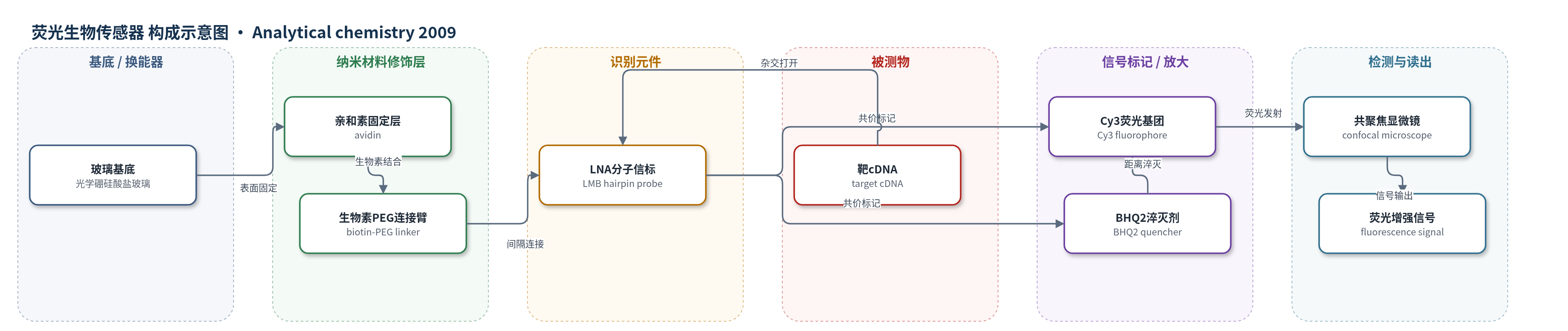
点击图片查看大图 · 依据论文自动绘制
传感器类型
荧光生物传感器
检测对象
靶cDNA(complementary DNA, cDNA)/靶核酸序列(target nucleic acid sequence);样品基质:PBS缓冲液、细胞裂解液、胎牛血清(FBS)
检测原理
LMB为发夹型核酸探针,茎区由LNA/DNA碱基交替组成,环区含靶序列互补区,5′端经生物素-亲和素固定于玻璃表面,并以PEG连接臂抬高探针。未结合靶时,Cy3与BHQ2距离接近,荧光被淬灭,背景低。加入靶cDNA后,靶序列与环区及茎区互补杂交,使发夹打开,Cy3与BHQ2分离,荧光恢复。共聚焦显微镜以543 nm激发、560 nm收集,荧光增强随靶浓度升高而增大,并在5 µM附近饱和。LNA提高茎区刚性和靶结合亲和力,减少表面扰动和核酸酶降解,从而增强表面传感稳定性。
检测灵敏度
检出限(DL): LMB 7.5 nM;RMB 25 nM;靶浓度范围: 1 nM–100 µM;饱和点: 5 µM;荧光增强: 25倍
效应效果
LMB表面固定后背景约为RMB的1/2.5,信号增强达25倍,而RMB为2.8–9.4倍;在4–50 °C范围内LMB背景稳定,信号增强约22倍,热稳定性更好。对单碱基错配靶序列,LMB选择性略优于RMB。在胎牛血清和细胞裂解液中,RMB信号增强下降,LMB基本保持检测能力,显示抗复杂基质干扰。LMB杂交速率较慢,RMB初始速率约为其7倍,但数分钟内可完成打开。作者认为该设计适用于核酸微阵列和表面生物传感器,并显示其作为表面核酸传感探针的潜力。
传感器的构成
- 基底/换能器:光学硼硅酸盐玻璃载玻片/盖玻片(optical borosilicate glass),提供表面固定与荧光成像基底。
- 固定层:亲和素(avidin),通过生物素-亲和素作用固定探针。
- 连接层:PEG连接臂(PEG linker,6 PEG units),增加探针与玻璃表面距离并减少表面相互作用。
- 识别元件:LNA/DNA分子信标(LMB)发夹探针,loop区含靶序列互补区,stem区含LNA/DNA碱基。
- 信号标记物:Cy3荧光基团与BHQ2淬灭剂(BHQ2),目标结合后发夹打开使荧光恢复。
中文摘要
DNA传感器和微阵列可通过分子信标(MB)实现核酸的快速、简单和实时检测,但MB用于固体表面生物传感器的潜力尚未充分发挥。主要原因是MB固定到固体表面后,发夹结构稳定性差,常导致信号增强较低。本文报道了一种新的MB设计,通过在信标结构中引入锁核酸(LNA)碱基,获得表面固定后仍具有稳健稳定性的LNA分子信标(LMB)。为评价LMB相对于普通DNA分子信标(RMB)的有效性,作者比较并评估了二者在检测靶序列时的选择性、灵敏度、热稳定性、杂交动力学和稳健性。结果表明,LMB在表面固定后可实现25倍信号增强,检出限达到低纳摩尔范围;与RMB相比,LMB生物传感器具有更好的稳定性、重现性、选择性和稳健性。因此,LNA碱基可作为常规DNA的替代,为DNA微阵列和生物传感器中的核酸探针设计提供了潜在工具。
英文摘要
DNA sensors and microarrays permit fast, simple, and real-time detection of nucleic acids through the design and use of increasingly sensitive, selective, and robust molecular probes. Specifically, molecular beacons (MBs) have been employed for this purpose; however, their potential in the development of solid-surface-based biosensors has not been fully realized. This is mainly a consequence of the beacon's poor stability because of the hairpin structure once immobilized onto a solid surface, commonly resulting in a low signal enhancement. Here, we report the design of a new MB that overcomes some of the limitations of MBs for surface immobilization. Essentially, this new design adds locked nucleic acid bases (LNAs) to the beacon structure, resulting in a LNA molecular beacon (LMB) with robust stability after surface immobilization. To test the efficacy of LMBs against that of regular molecular beacons (RMBs), the properties of selectivity, sensitivity, thermal stability, hybridization kinetics, and robustness for the detection of target sequences were compared and evaluated. A 25-fold enhancement was achieved for the LMB on surface with detection limits reaching the low nanomolar range. In addition, the LMB-based biosensor was shown to possess better stability, reproducibility, selectivity, and robustness when compared to the RMB. Therefore, as an alternative to conventional DNA and as a prospective tool for use in both DNA microarrays and biosensors, these results demonstrate the potential of the locked nucleic acid bases for nucleic acid design for surface immobilization.