组成图示
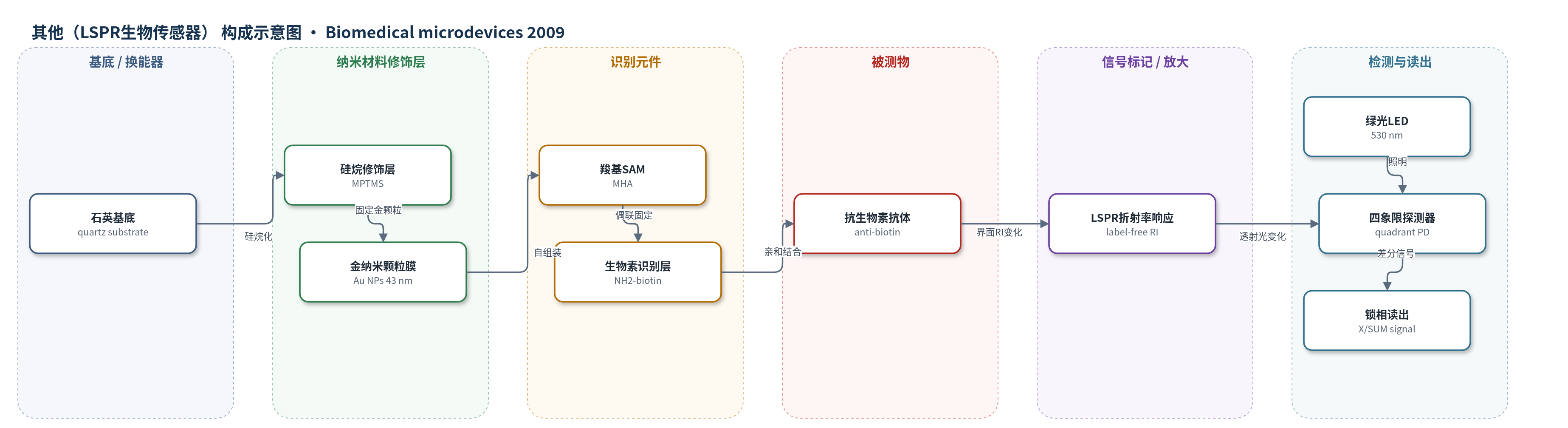
点击图片查看大图 · 依据论文自动绘制
传感器类型
其他(LSPR生物传感器)
检测对象
抗生物素抗体(goat anti-biotin),样品基质为HBS(Hepes Buffered Saline)缓冲液
检测原理
该传感器以43 nm金纳米颗粒(Au NPs)的局域表面等离子共振(LSPR)为换能机制。石英基底经MPTMS硅烷化后固定Au NPs,再自组装MHA形成含羧基的SAM,并用EDC/NHS将NH2-biotin共价偶联到表面,TEGMA封闭降低非特异结合。当HBS中的anti-biotin与表面biotin亲和结合时,传感界面局部折射率升高,Au NPs的LSPR吸收/透射特性随之改变。530 nm LED光穿过样品与参考流室,四象限光电探测器比较样品与参考透射光,锁相放大器输出X差分信号。信号随anti-biotin浓度增加而增大,实现无标记、实时、定量检测。
检测灵敏度
LOD/DL: 270 ng/mL;线性范围: 100 ng/mL–10 μg/mL;R^2 = 0.984;折射率分辨率: 10^-4 RIU
效应效果
系统可实时监测biotin/anti-biotin结合与解离,稳定信号偏差小于0.2%;用10 mM Glycine-HCl(pH 2.2)再生后信号回到基线,表明可重复使用。与静态孵育相比,微流控集成将anti-biotin孵育时间从约3 h缩短至约20 min,试剂消耗降至不足0.5 mL。与Biacore SPR系统对200 ng/mL–30 μg/mL anti-biotin的响应比较,相关系数为0.975,说明TPB信号与商用SPR定量趋势一致。作者认为该平台成本低、体积小、无需温控,适合现场和即时诊断应用。
传感器的构成
- 基底/换能器:石英基底(quartz substrate)作为光学透明基底与传感表面载体
- 纳米材料修饰层:3-巯基丙基三甲氧基硅烷(MPTMS)硅烷层作为分子胶固定金纳米颗粒;43 nm金纳米颗粒(Au NPs)形成LSPR传感膜
- 识别元件:16-巯基十六烷酸(MHA)自组装单分子层(SAM)提供羧基;氨基生物素(NH2-biotin)经EDC/NHS共价偶联作为识别配体
- 封闭剂:三乙二醇单胺(TEGMA)封闭表面并降低非特异结合
- 被测物:山羊抗生物素抗体(goat anti-biotin)溶于HBS缓冲液
- 信号标记:无标记LSPR折射率响应,无额外荧光/酶标记
- 微流控/读出:COC微流控芯片形成样品/参考流室;530 nm LED与四象限光电探测器(quadrant photodetector)实现透射光读出
中文摘要
本文报道了一种基于金纳米颗粒局域表面等离子共振(LSPR)性质、与微流控芯片集成的低成本生物传感器,可实现生物分子相互作用的无标记实时监测。该传感器采用新型四象限检测方案,连续测量穿过纳米颗粒修饰传感表面的透射光变化;以绿色发光二极管(LED)为光源并结合四象限检测,获得10^-4折射率单位(RIU)的分辨率,性能与传统LSPR生物传感器相当。研究采用生物素/抗生物素抗原抗体体系验证传感功能:在硫醇自组装单分子层(SAM)上固定生物素后,抗生物素的亲和结合被定量检测,抗生物素检出限为270 ng/mL。微流控芯片可将精确体积的样品输送至检测区,缩短反应时间并减少试剂消耗。结果与Biacore表面等离子共振(SPR)系统对同一结合事件的测量进行了比较,证明LSPR生物传感与微流控技术集成的可行性,有望成为低成本、便携式生物传感器候选平台。
英文摘要
A sensitive and low-cost microfluidic integrated biosensor is developed based on the localized surface plasmon resonance (LSPR) properties of gold nanoparticles, which allows label-free monitoring of biomolecular interactions in real-time. A novel quadrant detection scheme is introduced which continuously measures the change of the light transmitted through the nanoparticle-coated sensor surface. Using a green light emitting diode (LED) as a light source in combination with the quadrant detection scheme, a resolution of 10(-4) in refractive index units (RIU) is determined. This performance is comparable to conventional LSPR-based biosensors. The biological sensing is demonstrated using an antigen/antibody (biotin/anti-biotin) system with an optimized gold nanoparticle film. The immobilization of biotin on a thiol-based self-assembled monolayer (SAM) and the subsequent affinity binding of anti-biotin are quantitatively detected by the microfluidic integrated biosensor and a detection limit of 270 ng/mL of anti-biotin was achieved. The microfluidic chip is capable of transporting a precise amount of biological samples to the detection areas to achieve highly sensitive and specific biosensing with decreased reaction time and less reagent consumption. The obtained results are compared with those measured by a surface plasmon resonance (SPR)-based Biacore system for the same binding event. This study demonstrates the feasibility of the integration of LSPR-based biosensing with microfluidic technologies, resulting in a low-cost and portable biosensor candidate compared to the larger and more expensive commercial instruments.