组成图示
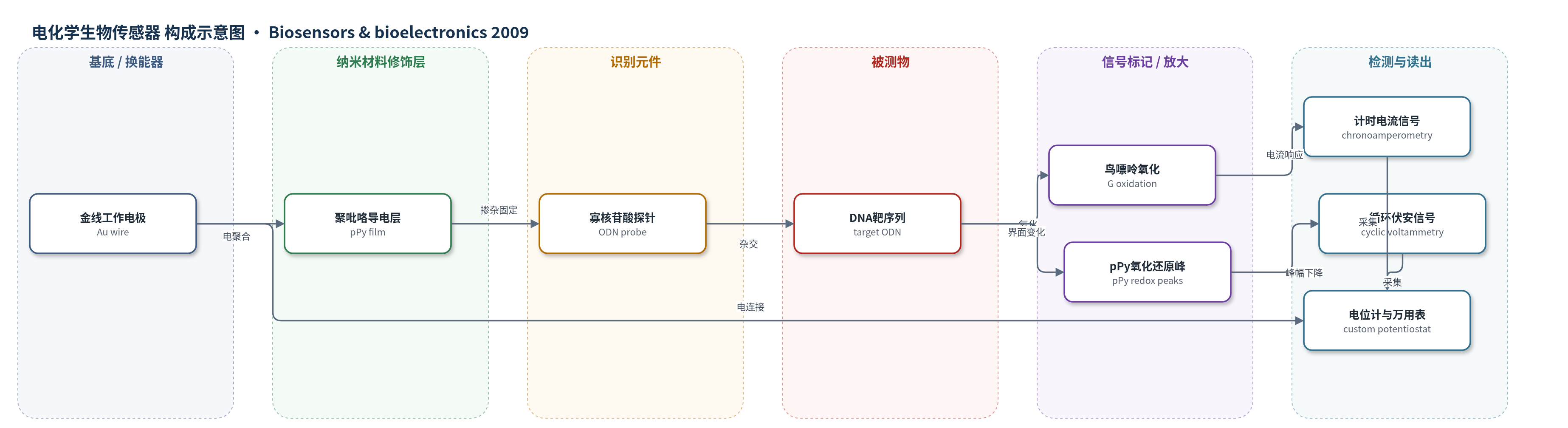
点击图片查看大图 · 依据论文自动绘制
传感器类型
电化学生物传感器
检测对象
DNA靶序列(target DNA/ODN,如oligo d[G]10、oligo d[TG]8、oligo d[AC]8);样品基质:PBS缓冲液中的寡核苷酸溶液(模拟含非互补序列的样品)
检测原理
该传感器为无标记电化学DNA传感器。寡核苷酸探针在聚吡咯电聚合过程中作为掺杂剂固定于金电极,碱基暴露。检测时,互补DNA靶序列与探针杂交。计时电流法中,电极固定于+1.0 V,靶序列中的鸟嘌呤在电极表面氧化,产生随靶量增加而增大的阳极电流;非互补序列不杂交,不产生该信号。循环伏安法中,杂交使靶DNA磷酸骨架暴露于溶剂,增加电子传递阻力并抑制阴离子掺入,导致聚吡咯氧化和还原峰幅值下降;峰下降程度随靶浓度增加。两种信号相互独立,无需酶、染料或纳米材料放大。
检测灵敏度
LOD: below 0.25 ng/mL or 53 pM(在2000×过量非互补序列中)
效应效果
该传感器在2000倍过量非互补序列存在下可检测53 pM(0.25 ng/mL)靶序列;二次孵育后pPy氧化峰降低18.4%,还原峰降低12.7%。互补靶使pPy峰显著下降甚至消失,非互补靶在注入条件下使峰增加,但长时间孵育下还原峰基本不变,显示一定选择性。循环伏安3–4次扫描无明显差异,电极可用0.5 M NaOH处理15 s并水洗再生。文中仅报告两次独立重复的最大/最小误差棒,未给出RSD、实际样品回收率或与ELISA/HPLC/qPCR的对比。作者认为双独立检测可互验,降低假阳性和假阴性,适合低成本现场基因检测。
传感器的构成
- 基底/工作电极:高纯度金线(Au wire,≥99.99%,1 mm),抛光清洗后作为换能器电极。
- 导电聚合物修饰层:聚吡咯(polypyrrole, pPy),由吡咯(pyrrole, 0.1 M)在+0.9 V电聚合形成,作为导电基质并参与氧化还原信号。
- 识别元件:寡核苷酸探针(oligonucleotide probes, ODNs,0.8 μg/μL),如oligo d[AC]8、oligo d[TG]8、oligo d[C]10,在电聚合中作为掺杂剂/反离子掺入pPy,通过磷酸骨架固定,碱基暴露用于杂交。
- 电解液/样品介质:PBS pH 7.4(137 mM NaCl、2.7 mM KCl、10 mM Na2HPO4、2 mM KH2PO4),提供离子环境。
- 参比电极:Ag/AgCl reference electrode,用于电位控制。
- 对电极:铅笔石墨(pencil graphite, Faber-Castell 2B)或铂线(platinum wire),作为辅助电极。
- 信号标记物:无外源标记物(label-free),信号来自靶序列鸟嘌呤氧化和pPy氧化还原峰变化。
中文摘要
本研究在Au/聚吡咯/寡核苷酸修饰电极上测试了两种直接、无试剂的DNA靶序列检测方法。第一种采用恒电位计时电流法监测鸟嘌呤氧化电流,使用自制简单电位计和数字万用表,无需昂贵电化学仪器,适合现场检测;第二种采用循环伏安法监测靶序列孵育或注入后聚吡咯氧化与还原峰幅值的下降。电极由抛光金线工作电极、电聚合聚吡咯层和作为掺杂剂固定的寡核苷酸探针构成,探针碱基暴露于溶液。在2000倍过量非互补序列存在下,方法可检测53 pM靶序列。同一传感器中两种独立检测方案可相互验证,有望显著降低假阳性和假阴性,适用于低成本、快速、可再生的基因传感器设计。
英文摘要
Two direct reagent-free detection methods were tested with Au/polypyrrole/oligonucleotide modified electrodes. Detection by monitoring guanine oxidation was realized amperometrically using an experimental setup which does not require any expensive electrochemical equipment and is therefore suitable for in situ detection. Target detection was also realized by monitoring the decrease in the amplitude of polypyrrole oxidation and reduction peaks in cyclic voltammetry experiments after incubation or injection of target into the electrochemical cell. Detection of 53 pM target within a 2000x excess of non-complementary sequences was possible. The possibility of a dual detection scheme in the same biosensor, with both detection schemes being totally independent from one another is very promising for genosensor design since it would result in a significant decrease in the number of false positive and false negative samples.