组成图示
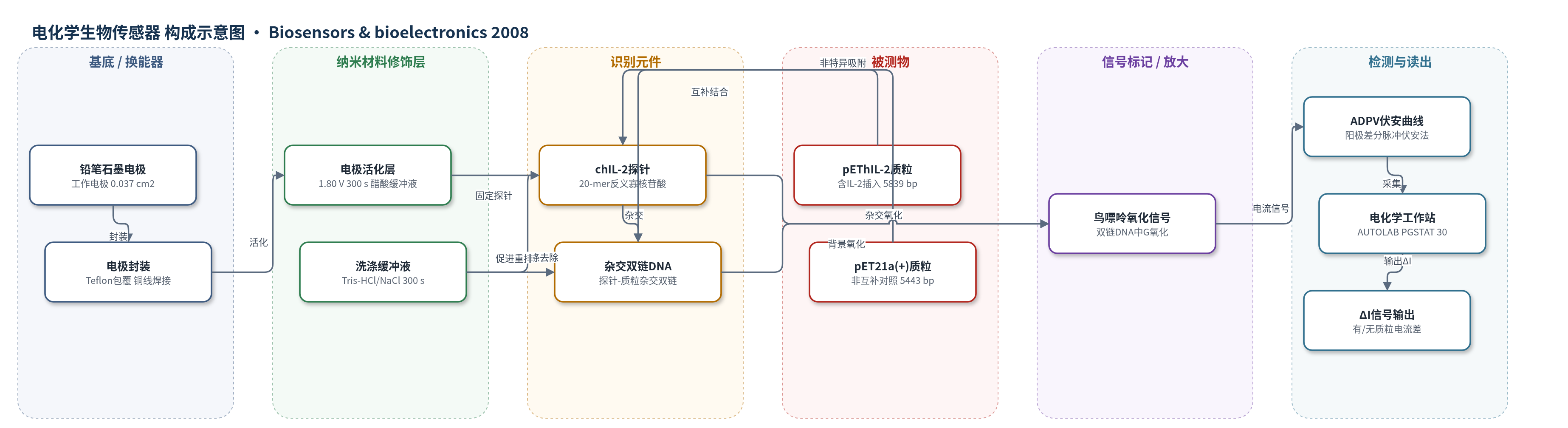
点击图片查看大图 · 依据论文自动绘制
传感器类型
电化学生物传感器
检测对象
重组质粒pEThIL-2(recombinant plasmid pEThIL-2,含人IL-2编码DNA);选择性对照:非互补质粒pET21a(+);样品基质:质粒溶液/Tris–HCl缓冲液(pH 7.0,含20 mM NaCl)
检测原理
将chIL-2探针电化学固定于活化PGE表面。当含IL-2互补序列的pEThIL-2质粒与探针杂交时,电极表面形成双链DNA,使更多鸟嘌呤(G)碱基靠近电极并参与阳极氧化。ADPV在0.50–1.15 V扫描,G氧化产生阳极电流;杂交后电流高于仅探针背景,差值ΔI随质粒浓度增加而增大,约5000 pg/µL饱和。非互补pET21a(+)主要发生非特异吸附或缺陷杂交,经300 s洗涤可解吸或降低信号,因此选择性提高。无外源标记或酶放大,信号直接来自DNA中G的氧化。
检测灵敏度
LOD: 10.31 pg/µL;线性范围: 0–500 pg/µL;R^2 = 0.9992;信号饱和: ca. 5000 pg/µL
效应效果
在优化条件下(PGE活化300 s、洗涤300 s),互补pEThIL-2使鸟嘌呤氧化电流由54.19±2.26 nA增至192.03±11.12 nA;非互补pET21a(+)仅由54.19±2.26 nA增至65.8±4.38 nA,c/n=2.92、n/p=1.21,表明对与骨架93%同源的质粒具有选择性。三个独立修饰电极在200 pg/µL下RSD为4.2%,重现性良好。检测限10.31 pg/µL,信号约5000 pg/µL饱和。未报告实际样品加标回收率或与ELISA/HPLC/qPCR的对比;作者认为该无标记PGE传感器可低成本、直接检测重组IL-2质粒并鉴别其表达载体。
传感器的构成
- 工作电极基底:铅笔石墨电极(PGE),直径2.0 mm,横截面积0.037 cm²,作为导电基底与电化学换能器。
- 电极封装:聚四氟乙烯(Teflon)包覆铅笔芯,铜线焊接金属夹,仅横截面接触溶液,防止侧向导电。
- 电极活化处理:0.50 M醋酸缓冲液(pH 4.80)含20 mM NaCl中1.80 V活化300 s,形成适合探针固定的活性表面并降低非特异吸附。
- 识别元件:20-mer反义单链寡核苷酸探针chIL-2(5′-CTAAATTTAGCACCTCCTCC-3′),在0.50 V下电化学固定于PGE,与pEThIL-2中IL-2互补序列杂交。
- 信号标记物:无外源标记,依赖杂交双链DNA中鸟嘌呤(G)的阳极氧化电流作为信号。
- 测量介质:20 mM Tris–HCl(pH 7.0)含20 mM NaCl,用于杂交后洗涤和ADPV测量。
- 参比/辅助电极:饱和甘汞电极(SCE)与铂丝,构成三电极系统用于ADPV测量。
中文摘要
本文报道了重组质粒pEThIL-2的构建及其基于白细胞介素-2(IL-2)DNA插入片段的电化学传感与鉴别。pEThIL-2通过PCR扩增IL-2编码DNA并克隆至pET21a(+)载体构建,总长5839 bp。采用无标记DNA杂交生物传感器检测该质粒:将与人IL-2基因相关的20碱基反义单链寡核苷酸探针chIL-2固定于铅笔石墨电极(PGE)表面,随后以阳极差分脉冲伏安法(ADPV)监测鸟嘌呤氧化信号变化。以不含IL-2编码DNA的非互补质粒pET21a(+)(5443 bp)评估选择性。通过优化电极活化条件与洗涤策略,消除非特异性吸附;发现PGE活化300 s后,在含20 mM NaCl的20 mM Tris–HCl(pH 7.0)中洗涤300 s可使非特异性吸附质粒解吸。该传感器检测限为10.31 pg/µL。
英文摘要
Construction, electrochemically biosensing and discrimination of recombinant pEThIL-2 plasmid, with 5839bp size, on the basis of interleukine-2 (IL-2) DNA insert are described. Plasmid pEThIL-2 was constructed by PCR amplification of IL-2 encoding DNA and subcloning into pET21a(+) vector using BamHI and SacI sites. The recombinant pEThIL-2 plasmid was detected with a label-free DNA hybridization biosensor using a non-inosine substituted probe. The proposed sensor was made up by immobilization of a 20-mer antisense single strand oligonucleotide (chIL-2) related to the human interleukine-2 gene on the pencil graphite electrode (PGE) as a probe and then the sensing of recombinant pEThIL-2 plasmid was conducted by anodic differential pulse voltammetry (ADPV) based on guanine oxidation signal. Selectivity of the detection was assessed with pET21a(+) non-complementary plasmid, with 5443bp size, lacking IL-2 encoding DNA. Different factors such as electrode activation conditions and washing strategy were tested in order to eliminate the nonspecific adsorption of pET21a(+). We have found that the PGE activation for 300s produces a condition in which desorption of nonspecifically adsorbed plasmids from the electrode surface can be achieved by 300s washing of the electrode in 20mM Tris-HCl buffer solution (pH 7.0) containing 20mM NaCl. Diagnostic performance of the biosensor is described and the detection limit is found to be 10.31pg/microL.