组成图示
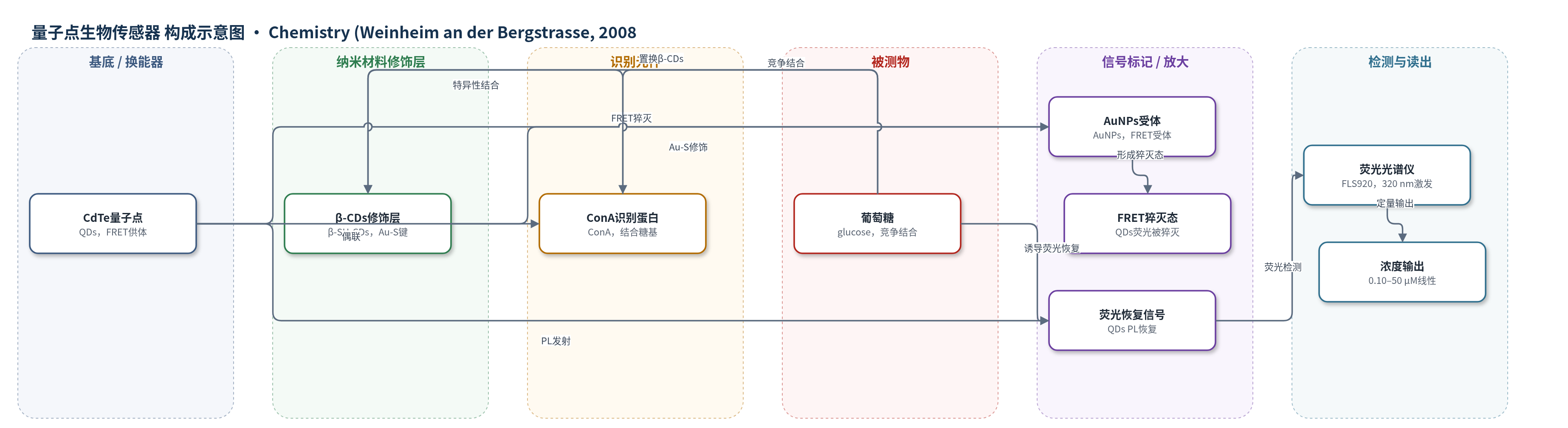
点击图片查看大图 · 依据论文自动绘制
传感器类型
量子点生物传感器
检测对象
葡萄糖(glucose,Glu);样品基质:正常成人人血清(human serum)
检测原理
传感器由ConA偶联CdTe量子点(QDs-ConA)与β-环糊精修饰金纳米颗粒(AuNPs-β-CDs)通过ConA与β-CDs的多价特异性结合组装而成。由于AuNPs的宽吸收与QDs发射谱重叠,且ConA四聚体结合位点间距约65 Å,使QDs与AuNPs处于FRET距离内,QDs荧光被AuNPs高效猝灭,形成低背景猝灭态。加入葡萄糖后,葡萄糖与β-CDs竞争ConA的糖结合位点,使AuNPs-β-CDs片段从QDs-ConA上解离,QDs与AuNPs距离增大,FRET效率下降,QDs荧光恢复。荧光恢复强度随葡萄糖浓度增加而增加,在0.10–50 μM范围内呈线性,通过320 nm激发、480–600 nm发射监测相对荧光强度即可定量葡萄糖。
检测灵敏度
LOD: 50 nM(原文抽取为 50 nm);线性范围: 0.10–50 μM(原文抽取为 0.10–50 mm)
效应效果
该传感器对葡萄糖具有良好选择性:在10 μM葡萄糖存在下,1000倍蔗糖、果糖、乳糖、麦芽糖、甘露醇及血清正常浓度离子、氨基酸、尿酸、胆红素、抗坏血酸、胆固醇等干扰物的相对误差大多在±5.0%以内,仅Co2+、Fe3+、苯丙氨酸、酪氨酸等少数略超。精密度良好,11个10 μM葡萄糖标准样品的RSD为2.3%。直接测定1 μL正常成人血清时,6次测定RSD为1.9%–2.4%,加标回收率为97.0%–104%,与OLYMPUS 5400自动生化分析仪认证值一致。荧光恢复效率约90%,作者认为可用于临床血清葡萄糖直接简便检测,并有望用于单细胞或细菌培养低水平葡萄糖监测。
传感器的构成
- 荧光供体核心:CdTe量子点(QDs),TGA稳定,作为FRET能量供体并提供荧光信号
- 识别元件层:刀豆蛋白A(ConA),经EDC/NHS偶联于QDs表面,特异性结合β-CDs和葡萄糖
- 能量受体核心:金纳米颗粒(AuNPs),约15 nm,作为FRET能量受体并猝灭QDs荧光
- 受体修饰/桥接层:巯基化β-环糊精(β-SH-CDs),通过Au–S键修饰AuNPs,与ConA结合组装FRET对
- 反应介质:PBS缓冲液(10 mM,pH 7.4),维持ConA活性及传感反应环境
- 信号读出:荧光光谱仪(FLS920),320 nm激发、480–600 nm发射监测荧光恢复
中文摘要
本文设计了一种新型组装纳米生物传感器 QDs-ConA-β-CDs-AuNPs,用于血清中葡萄糖的高灵敏、高选择性直接测定。该传感方法基于 CdTe 量子点(QDs)作为能量供体与金纳米颗粒(AuNPs)作为能量受体之间的荧光共振能量转移(FRET)。将刀豆蛋白 A(ConA)偶联的 QDs 与巯基化 β-环糊精(β-SH-CDs)修饰的 AuNPs 特异性结合,组装成超高效 FRET 纳米生物传感器。加入葡萄糖后,葡萄糖与 β-CDs 竞争 ConA 的结合位点,使 AuNPs-β-CDs 片段从传感器上解离,导致被猝灭的 QDs 荧光恢复。实验结果表明,在优化条件下,荧光强度增加量与葡萄糖浓度在 0.10–50 μM 范围内呈线性关系;该纳米生物传感器检测限低至 50 nM,并对血清中其他糖类及大多数生物干扰物具有优异选择性。该方法可直接用于正常成人血清中葡萄糖的测定,回收率和精密度令人满意。其高灵敏与良好选择性表明可用于临床血清葡萄糖的直接简便检测,并有望用于单细胞或细菌培养中低水平葡萄糖检测,展示了纳米生物技术组装传感器在体内或体外直接分析中的应用潜力。
英文摘要
A novel assembled nanobiosensor QDs-ConA-beta-CDs-AuNPs was designed for the direct determination of glucose in serum with high sensitivity and selectivity. The sensing approach is based on fluorescence resonance energy transfer (FRET) between CdTe quantum dots (QDs) as an energy donor and gold nanoparticles (AuNPs) as an energy acceptor. The specific combination of concanavalin A (ConA)-conjugated QDs and thiolated beta-cyclodextrins (beta-SH-CDs)-modified AuNPs assembles a hyperefficient FRET nanobiosensor. In the presence of glucose, the AuNPs-beta-CDs segment of the nanobiosensor is displaced by glucose which competes with beta-CDs on the binding sites of ConA, resulting in the fluorescence recovery of the quenched QDs. Experimental results show that the increase in fluorescence intensity is proportional to the concentration of glucose within the range of 0.10-50 muM under the optimized experimental conditions. In addition, the nanobiosensor has high sensitivity with a detection limit as low as 50 nM, and has excellent selectivity for glucose over other sugars and most biological species present in serum. The nanobiosensor was applied directly to determine glucose in normal adult human serum, and the recovery and precision of the method were satisfactory. The unique combination of high sensitivity and good selectivity of this biosensor indicates its potential for the clinical determination of glucose directly and simply in serum, and provides the possibility to detect low levels of glucose in single cells or bacterial cultures. Moreover, the designed nanobiosensor achieves direct detection in biological samples, suggesting the use of nanobiotechnology-based assembled sensors for direct analytical applications in vivo or in vitro.