组成图示
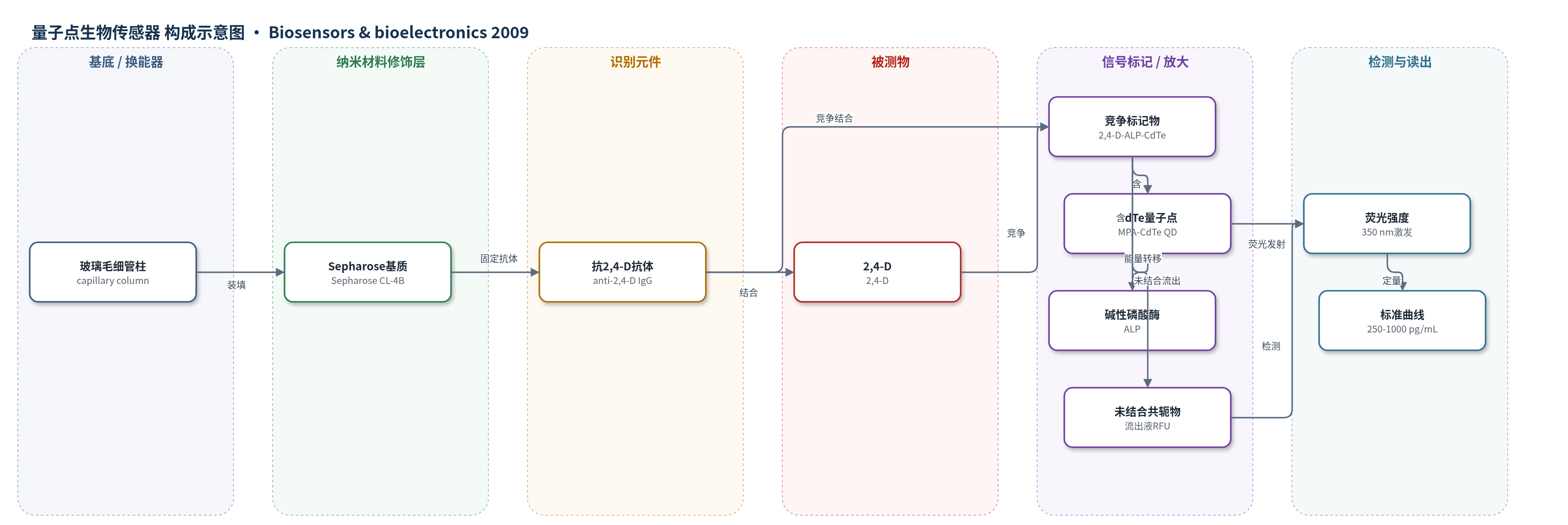
点击图片查看大图 · 依据论文自动绘制
传感器类型
量子点生物传感器
检测对象
2,4-二氯苯氧乙酸(2,4-D, 2,4-dichlorophenoxyacetic acid);样品基质:标准溶液(论文面向食品与环境样品)
检测原理
该传感器以 Sepharose CL-4B 为基质,将抗 2,4-D IgG 抗体固定于玻璃毛细管免疫反应柱中。检测时,样品中的游离 2,4-D 与已知量的 2,4-D–ALP–CdTe 共轭物竞争结合固定抗体。2,4-D 浓度越高,占据抗体结合位点越多,未结合的 2,4-D–ALP–CdTe 共轭物越多,随流出液进入检测体系。CdTe QD 在 350 nm 激发下产生荧光,ALP 与 CdTe QD 共价偶联后形成供体-受体对,发生类似 FRET 的共振能量转移,使共轭物具有可检测荧光。荧光分光光度计测量流出液相对荧光强度(RFU),RFU 随 2,4-D 浓度升高而升高,据此在 250–1000 pg/mL 范围内建立标准曲线定量。
检测灵敏度
LOD: 250 pg mL−1;线性范围: 250–1000 pg mL−1;R^2 = 0.9983
效应效果
该免疫反应柱荧光免疫分析对 2,4-D 的检测下限为 250 pg/mL,较文中间接竞争 ELISA 的 1000 pg/mL 更低;在 250–1000 pg/mL 范围内相对荧光强度与浓度呈良好线性,R^2=0.9983。方法特异性来自抗 2,4-D IgG 与 2,4-D 的免疫识别,以及 2,4-D–ALP–CdTe 竞争结合;作者强调通过保留 2,4-D 免疫原性设计竞争抗原,避免改变免疫识别。论文未报告 RSD、长期稳定性、抗干扰或实际样品回收率。作者认为量子点荧光免疫传感器具有快速、高灵敏、适合食品和环境痕量农药监测的应用价值。
传感器的构成
- 换能器/载体柱:玻璃毛细管柱(glass capillary column),用于容纳固定化抗体并实现流动相免疫反应
- 固定化基质:Sepharose CL-4B 琼脂糖微球,经高碘酸钠、1,6-二氨基己烷和氰基硼氢化钠活化,提供惰性载体与氨基功能化表面
- 识别元件:抗 2,4-D IgG 抗体(anti-2,4-D IgG),通过 Fc 段偶联固定于 Sepharose CL-4B,保留 Fab 段结合 2,4-D
- 信号标记物:2,4-D–ALP–CdTe 共轭物,其中 2,4-D 为竞争抗原,ALP 为连接蛋白,CdTe QD 为荧光标记
- 量子点纳米材料:巯基丙酸(MPA)包覆 CdTe QD,提供荧光发射并参与 ALP-CdTe 共振能量转移
- 偶联/活化试剂:EDC 与 NHS,用于活化 MPA-CdTe QD 羧基及 2,4-D 羧基,形成酰胺键偶联 ALP
- 读出系统:荧光分光光度计(spectrofluorimeter),激发 350 nm,监测未结合共轭物荧光强度
中文摘要
量子点(QD)是半导体荧光纳米颗粒,可用于高灵敏度环境监测。鉴于农药和除草剂在农业中大量使用,需要快速、灵敏、特异性地检测食品和环境样品中的痕量污染物。本研究开发了一种基于碲化镉量子点(CdTe QD)的可靠快速方法,用于分析和检测除草剂 2,4-二氯苯氧乙酸(2,4-D)。利用量子点荧光性质构建荧光免疫分析,将巯基丙酸(MPA)包覆的 CdTe QD 经 EDC/NHS 偶联到碱性磷酸酶(ALP),再将 ALP 与 2,4-D 分子偶联,形成 2,4-D–ALP–CdTe 共轭物。抗 2,4-D IgG 抗体以 Sepharose CL-4B 为惰性基质固定于免疫反应柱中。检测时,游离 2,4-D 与 2,4-D–ALP–CdTe 共轭物竞争结合柱内固定抗体,未结合共轭物随流出液收集,通过荧光强度定量。该方法可检测低至 250 pg/mL 的 2,4-D。研究还强调了 ALP 与 CdTe QD 生物偶联后产生的共振能量转移,可用于未来基于量子点-生物分子相互作用的生物传感器开发。
英文摘要
Quantum dots (QD) are semiconductor fluorescent nanoparticles, which can be made use of for environmental monitoring with high sensitivity. In view of the alarming levels of pesticides and herbicides being used in agriculture practices, there is a need for their rapid, sensitive and specific detection in food and environmental samples, as pesticides and herbicides are harmful to living beings even at trace levels. Present study was carried out to develop a reliable and rapid method for analysis and detection of 2,4-D (herbicide) using cadmium telluride quantum dot nanoparticle (CdTe QD). Fluoroimmunoassay based on the fluorescent property of quantum dot was used along with immunoassay to detect 2,4-D. CdTe capped with mercaptopropionic acid, was conjugated using N-(3-dimethylaminopropyl)-N-ethylcarbodiimide hydrochloride (EDC) and a coupling reagent like N-hydroxysuccinimide (NHS) to alkaline phosphatase (ALP) which was in turn conjugated to 2,4-D molecule. Anti 2,4-D-IgG antibodies were immobilized in an immunoreactor column using Sepharose CL-4B as an inert matrix. The detection of 2,4-D was carried out by fluoroimmunoassay-based biosensor using competitive binding between conjugated 2,4-D-ALP-CdTe and free 2,4-D with immobilized anti 2,4-D antibodies in an immunoreactor column. It was possible to detect 2,4-D upto 250pgmL(-1). Present study also emphasizes on the resonance energy transfer between ALP and CdTe QD as a result of bioconjugation, which can be used for future biosensor development based on quantum dot-biomolecular interactions.