组成图示
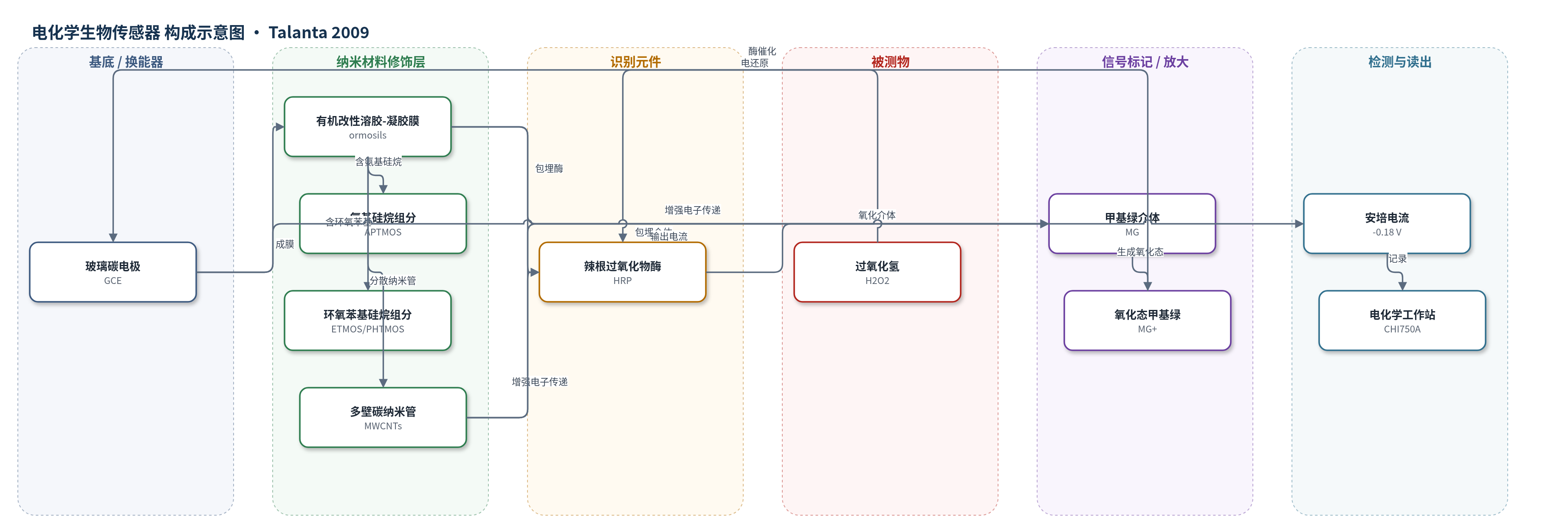
点击图片查看大图 · 依据论文自动绘制
传感器类型
电化学生物传感器
检测对象
过氧化氢(hydrogen peroxide, H2O2);样品基质:0.1 M磷酸盐缓冲液(PBS,pH 7.2)
检测原理
在0.1 M PBS(pH 7.2)中,H2O2扩散进入ormosils膜并与固定化HRP作用。HRP催化H2O2还原为水,自身由还原态POD(red)被氧化为POD(ox)。随后POD(ox)将甲基绿还原态MGH氧化为MG+,反应经自由基中间体分两步完成,使HRP再生。MG+在玻璃碳电极表面接受电子并质子化还原为MGH,产生可测阴极电流。MWCNTs分散在ormosils中,提高膜内电子传递速率和电极有效面积,使H2O2在约-0.18 V的低过电位下发生电催化还原,从而降低干扰并增强电流。稳态安培电流随H2O2浓度增加而增大,在5×10⁻⁷至2×10⁻⁵ M范围内呈线性。
检测灵敏度
LOD: 0.5 μM (S/N = 3);线性范围: 5 × 10⁻⁷–2 × 10⁻⁵ M;R^2 = 0.998
效应效果
该传感器在-0.18 V下响应时间小于10 s,线性范围5×10⁻⁷–2×10⁻⁵ M,检出限0.5 μM(S/N=3),表观米氏常数1.8 mM。选择性测试中,尿酸、多巴胺、抗坏血酸、葡萄糖、半胱氨酸、草酸、NADH和柠檬酸8种干扰物电流比为0.97–1.03,影响可忽略。4 ℃干燥保存30天后保留约90%初始活性,连续测试1个月仍保持90%响应,加标回收率98.6%。与MWCNT/MB/HRP、SG/MG/Nafion/HRP等文献电极相比,响应时间更短、检出限相当或更低。作者认为该ormosils/MWCNTs共包埋策略制备简便、灵敏度高、稳定性好,适用于H2O2快速检测。
传感器的构成
- 基底/换能器电极:玻璃碳电极(GCE,3 mm),经氧化铝抛光和超声清洗,作为工作电极与电子传导基底
- 有机改性溶胶-凝胶基质:APTMOS、ETMOS、PHTMOS水解缩合形成ormosils多孔膜,包埋酶与染料,提供生物相容微环境、机械强度和抗泄漏
- 纳米材料修饰层:多壁碳纳米管(MWCNTs,10–15 nm,DMF分散),分散于ormosils膜中,提高导电性、有效表面积和电子传递速率
- 识别元件:辣根过氧化物酶(HRP/POD,1 mg/mL,约1.4 μg负载),催化H2O2还原为水并氧化介体
- 信号标记/电子介体:甲基绿(MG,1 mM),作为可逆氧化还原介体,在HRP与电极间穿梭电子,其氧化态在电极上还原产生阴极电流
中文摘要
本文报道了一种用于分析检测过氧化氢的新型安培法生物传感器。该传感器基于辣根过氧化物酶(HRP)、甲基绿(MG)和多壁碳纳米管(MWCNTs)在有机改性溶胶-凝胶(ormosils)基质中共包埋制备,所用硅烷包括3-氨基丙基三甲氧基硅烷(APTMOS)、2-(3,4-环氧环己基)乙基三甲氧基硅烷(ETMOS)和苯基三甲氧基硅烷(PHTMOS)。APTMOS调节基质的亲疏水性,ETMOS和PHTMOS提高物理与机械强度。扫描电镜、紫外-可见光谱和电化学表征表明,MG与HRP共包埋后具有良好的稳定性,并能在固定化酶与电极之间有效穿梭电子;MWCNTs促进过氧化氢的电催化还原并降低过电位。固定化HRP的表观米氏常数为1.8 mM,说明其在ormosil基质中保持较高酶活和对H2O2的亲和力。传感器响应时间小于10 s,在5×10⁻⁷至2×10⁻⁵ M范围内线性良好,检出限为0.5 μM(S/N=3)。研究还考察了pH、酶量、稳态电位和温度的影响;干燥4 ℃保存30天后仍保留约90%初始活性。该传感器制备简便、灵敏度高且稳定性好。
英文摘要
A novel amperometric biosensor for the analytical determination of hydrogen peroxide was developed. The fabrication of the biosensor was based on the coimmobilization of horseradish peroxidase (HRP), methylene green (MG) and multiwalled carbon nanotubes within ormosils; 3-aminopropyltrimethoxysilane (APTMOS), 2-(3,4-epoxycyclohexyl)ethyltrimethoxysilane (ETMOS) and phenyltrimethoxysilane (PHTMOS). APTMOS determined the hydrophilicity/hydrophobicity of the ormosils and PHTMOS and ETMOS increased the physical and mechanical strength of the ormosil matrix. The ormosil modified electrodes were characterized with SEM, UV-vis spectroscopy and electrochemical methods. Cyclic voltammetry and amperometric measurements demonstrated the MG coimmobilized with HRP in this way, displayed good stability and could efficiently shuttle electrons between immobilized enzyme and electrode, and MWCNTs facilitated the electrocatalytic reduction of H(2)O(2) at reduced over potential. The Micheaelis constant of the immobilized HRP was 1.8mM, indicating a high affinity of the HRP to H(2)O(2) without loss of enzymatic activity in ormosil matrix. The prepared biosensor had a fast response of H(2)O(2), less than 10s, and excellent linear range of concentration from 5 x 10(-7) to 2 x 10(-5)M with the detection limit of 0.5 microM (S/N=3) under the optimum conditions. At the same time, the influence of solution pH, effect of enzyme amount, steady-state applied potential and temperature on the biosensor were investigated. The enzyme electrode retained about 90% of its initial activity after 30 days of storage in a dry state at 4 degrees C. The preparation of the developed biosensor was convenient and showed high sensitivity with good stability.