组成图示
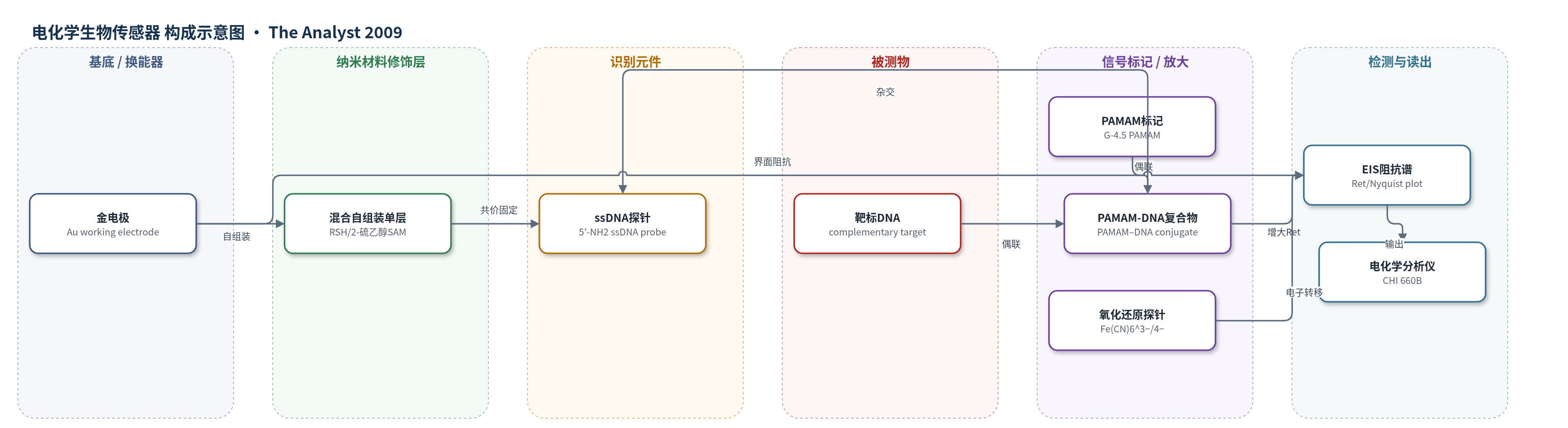
点击图片查看大图 · 依据论文自动绘制
传感器类型
电化学生物传感器
检测对象
靶标 DNA 序列(target DNA,含完全互补序列、三碱基错配序列、非互补序列);样品基质:PBS 缓冲液(杂交液 0.3 M PBS pH 7.0,检测液 0.1 M PBS pH 7.0)
检测原理
金电极上 RSH/2-硫乙醇混合 SAM 共价固定 ssDNA 探针。溶液中 G-4.5 PAMAM 经 EDC 与 5′-氨基靶标 DNA 酰胺键偶联形成 PAMAM–DNA 复合物。当互补靶标与探针杂交形成 dsDNA 后,外围带羧基的 G-4.5 PAMAM 锚定在杂交体上,其球形大分子结构和较多负电荷在电极界面形成静电排斥与空间位阻,阻碍 Fe(CN)6^3−/4− 氧化还原探针接近金表面,使界面电子转移电阻 Ret 增大。非互补或错配序列不能稳定杂交,Ret 变化小。ΔRet 与靶标浓度对数线性相关,实现无标记 EIS 检测。
检测灵敏度
LOD: 2.5 × 10^-12 M;线性范围: 10^-11–10^-8 M;灵敏度斜率: 306.4 ΔRet/log C;R = 0.9953;无 PAMAM 对照 LOD: 1.5 × 10^-10 M;灵敏度斜率: 153.6 ΔRet/log C;R = 0.9849
效应效果
该传感器对完全互补序列响应显著,非互补序列与三碱基错配序列的 ΔRet 变化很小,显示良好序列选择性;裸 G-4.5 PAMAM 孵育后阻抗无明显变化,说明无非特异吸附。与无 PAMAM 标记相比,PAMAM–DNA 偶联使检测限由 1.5 × 10^-10 M 降至 2.5 × 10^-12 M,灵敏度提高约 2 个数量级。作者认为其灵敏度优于近期报道的聚合物膜无标记 EIS DNA 传感器(检测限 0.5 nM 和 20 nM),虽低于酶放大单碱基突变检测(0.01 pM),但与带负电脂质体标记的 pM 级 DNA 传感方法具有竞争力。文中未报告 RSD、长期稳定性或实际样品回收率。
传感器的构成
- 基底/换能器电极:金电极(Au electrode),提供电子转移界面并用于 EIS 测量。
- 自组装单层:巯基乙酸(RSH)与 2-硫乙醇(2-thioethanol)混合 SAM(3:1),固定探针并减少非特异吸附。
- 识别元件:5′-氨基修饰 24 碱基单链 DNA 探针(ssDNA probe),通过 EDC 与 RSH 羧基酰胺键共价固定,识别互补靶标 DNA。
- 信号标记/放大元件:第 4.5 代羧基端聚酰胺胺(G-4.5 PAMAM)与 5′-氨基靶标 ssDNA 经 EDC 酰胺键偶联形成 PAMAM–DNA 复合物,杂交后锚定在 dsDNA 上,以负电荷和空间位阻放大 Ret。
- 氧化还原探针:1 mM K3[Fe(CN)6]/K4[Fe(CN)6](Fe(CN)6^3−/4−),作为 EIS 电子转移指示剂。
- 检测缓冲液:0.1 M PBS(pH 7.0),提供低离子强度背景电解质以增强信背比。
中文摘要
本文报道了一种基于 DNA–聚酰胺胺(PAMAM)纳米偶联物、采用电化学阻抗谱(EIS)的新型简单灵敏 DNA 生物传感器。该传感器以金电极为基底,通过巯基乙酸自组装单层共价固定单链 DNA 探针,使其与溶液中第 4.5 代(G-4.5)PAMAM–靶标 DNA 复合物杂交。杂交形成双链 DNA 后,外围带羧基的 G-4.5 PAMAM 锚定在杂交体上,利用 Fe(CN)6^3−/4− 氧化还原探针测量电极界面电子转移电阻(Ret)变化。结果表明,只有完全互补序列能与探针形成 dsDNA–PAMAM 并显著增大 Ret;非互补序列和三碱基错配序列的阻抗变化可忽略。G-4.5 PAMAM 的球形结构及其外围较多负电荷可显著放大杂交信号,使完全互补序列检测限达到 pM 级。
英文摘要
A novel, simple and sensitive DNA biosensor based on DNA-poly(amidoamine) (PAMAM) dendrimer nanoconjugates was developed by using the electrochemical impedance spectroscopy (EIS) technique. In this context, the assay relies on the hybridization of the single-stranded DNA (ssDNA) probe covalently conjugated on a mercaptoacetic acid self-assembled monolayer on gold electrodes, with the generation 4.5 (G-4.5) PAMAM-target DNA complex in solution. Once the double-stranded DNA (dsDNA) formed on the gold electrodes, G-4.5 PAMAM bearing carboxyls on the periphery was anchored on the hybrids; the changes of interfacial electron-transfer resistance (R(et)) of the electrodes were measured using an Fe(CN)(6)(3-/4-) redox probe by electrochemical impedance spectroscopy. The results showed that only a complementary sequence could form a dsDNA-PAMAM with the DNA-PAMAM probe and give an obviously enlarged R(et) value. The non-complementary and three-base mismatched sequence exhibited negligible impedance change compared with the blank measurement (the blank measurement means: ssDNA probe-modified gold electrode was directly measured by EIS). The unique spherical structure combining with more negative charges on the G-4.5 PAMAM periphery anchored on the hybrids could significantly amplify the hybridization signal (R(et) value), and the detection limit for measuring the full complementary sequence is down to pM level.