组成图示
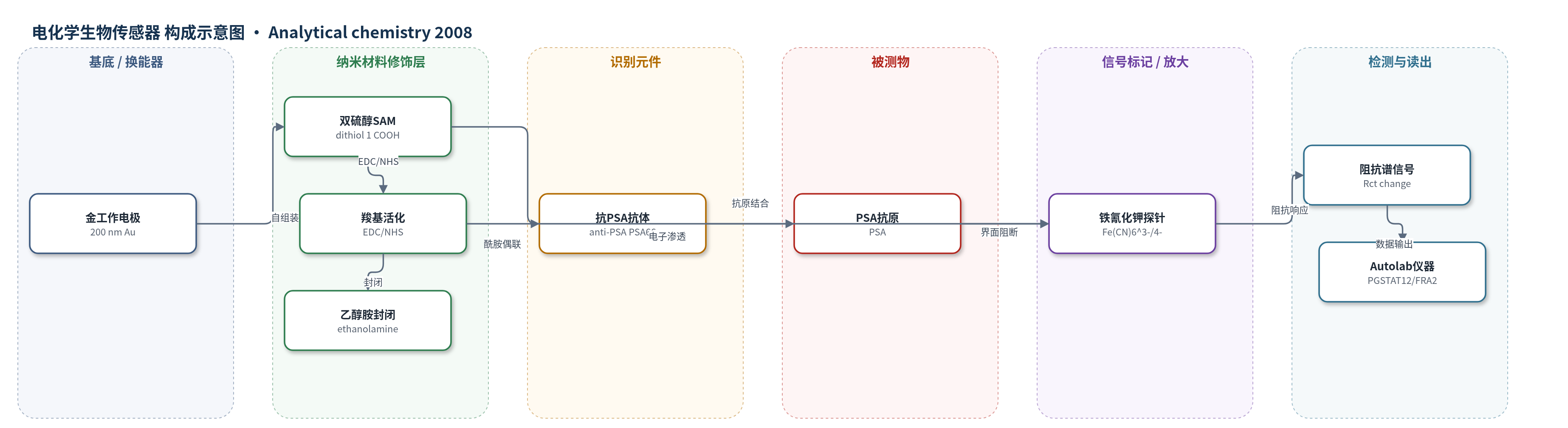
点击图片查看大图 · 依据论文自动绘制
传感器类型
电化学生物传感器
检测对象
前列腺特异性抗原(PSA);样品基质:标准溶液(NaCl/PBS/Tris 缓冲液),临床相关基质为血清/血液
检测原理
金电极表面自组装双硫醇 1 形成含羧基端基的电子可渗透 SAM。SAM 羧基经 EDC/NHS 活化形成琥珀酰亚胺酯,抗 PSA 抗体通过酰胺键共价固定,乙醇胺封闭剩余羧基以降低非特异性结合。检测时,溶液中的 PSA 与固定抗体特异性结合,形成抗体-抗原复合物,使电极/溶液界面空间位阻和电荷转移阻力增加。以 Fe(CN)6^3-/4- 为可逆氧化还原探针,EIS 测量电荷转移电阻 Rct;PSA 浓度升高时,界面电子传递受阻增强,Rct 增大,信号在约 100 ng/mL 后趋于饱和,符合 Langmuir 等温吸附。该过程为无标记阻抗免疫检测,不依赖酶标二抗或化学发光/荧光标记。
检测灵敏度
LOD: 9 ng/mL (0.3 pM);线性范围: 0–50 ng/mL (0–1.6 pM);灵敏度: 706 kΩ·mL·ng^-1
效应效果
该传感器非特异性结合较低:裸双硫醇 1 SAM 对 1 µg/mL PSA 的 NSB 为 12.4%,固定非特异性抗 CEA 抗体后降至 6.6%;固定抗 PSA 抗体后对 1 µg/mL CEA 的 NSB 为 10.9%。双硫醇 2 的 NSB 为 24.3%,故选用双硫醇 1。SAM 在 3–5 h 内形成,表面覆盖度为 (1.1–2.8)×10^-10 mol/cm²,且电子可渗透。100% 双硫醇 1 表面固定抗体后,1 µg/mL PSA 使总阻抗增至约 3 倍。Langmuir 拟合得 Zmax=170 kΩ、K=13.5 pM^-1(1.35×10^-11 M^-1),与文献抗体亲和力一致。LOD 9 ng/mL 位于前列腺癌临床诊断常用范围 4–10 ng/mL,作者认为该单组分双硫醇 SAM 可作为电化学生物传感器支撑层。
传感器的构成
- 基底/换能器电极:硅片上溅射 200 nm 金工作电极(Au),配 Ag/AgCl 参比电极和 Pt 对电极,提供电化学换能界面
- 双硫醇修饰层:双硫醇 1(3,5-二羟基苄醇衍生物,含羧基端基)在金表面自组装形成 SAM,双硫醇锚定并提供羧基连接位点
- 羧基活化层:EDC/NHS 将 SAM 羧基活化为琥珀酰亚胺酯,用于抗体共价偶联
- 识别元件:抗 PSA 单克隆抗体(anti-PSA,PSA66)通过酰胺键固定,特异性识别 PSA
- 封闭层:乙醇胺盐酸盐(ethanolamine hydrochloride,pH 8.5)封闭剩余羧基,降低非特异性结合
- 电化学探针:铁氰化钾/亚铁氰化钾(Fe(CN)6^3-/4-)作为可逆氧化还原探针,用于 EIS 无标记检测
中文摘要
含硫化合物自组装单分子层(SAMs)由硫醇基团在金属表面自发化学吸附形成。在生物传感器中,SAMs 常用于将生物识别分子共价固定于换能器表面,从而控制传感元件取向、分布和间距,并降低非特异性相互作用。本文在金表面制备了含羧基和羟基端基的 3,5-二羟基苄醇双硫醇衍生物自组装单分子层,并用循环伏安法和电化学阻抗谱进行表征。阻抗测量表明,随着双硫醇分子吸附逐步阻断铁氰化钾的法拉第响应,SAM 形成在暴露 3–5 h 后基本完成。通过还原脱附实验估算的表面覆盖度为 (1.1–2.8)×10^-10 mol/cm²。为展示双硫醇 SAM 的潜力,建立了肿瘤标志物前列腺特异性抗原(PSA)检测模型:SAM 羧基经琥珀酰亚胺活化,抗 PSA 抗体通过酰胺键共价固定。修饰后的 SAM 用于 EIS 无标记检测 PSA,检测限为 9 ng/mL。结果表明,这类双硫醇修饰 SAM 可作为电化学生物传感器的支撑层,其性能与双硫醇结构特征相关。
英文摘要
Self-assembled monolayers (SAMs) of thiolated compounds are formed by the spontaneous chemisorption of thiolate groups on metal surfaces. In biosensors, they are most commonly used to covalently immobilize a biorecognition molecule onto the surface of the transducer, thus offering the possibility of controlling the orientation, distribution, and spacing of the sensing element while reducing nonspecific interactions. In this paper, self-assembled monolayers of dithiolated derivatives of 3,5-dihydroxybenzyl alcohol containing carboxyl and hydroxyl end groups have been prepared on gold surfaces and characterized by cyclic voltammetry and electrochemical impedance spectroscopy. Impedance measurements revealed that SAM formation is essentially completed after 3-5 h of exposure by observing the successive blocking of the faradic response of ferricyanide anion due to the adsorption of the dithiol molecules. The surface coverage of these molecules, estimated by reductive desorption experiments, was in the range of (1.1-2.8) x 10-10 mol/cm2. To demonstrate the potential of the dithiol SAM, a model system for detection of a tumor marker, prostate-specific antigen (PSA), was developed. The carboxyl groups of the SAM were succinimide-activated, and an anti-PSA antibody was covalently immobilized via amide bonds. The modified SAM was used for the label-free detection of prostate-specific antigen using EIS with a detection limit of 9 ng/mL. The results described here demonstrate that this kind of dithiol-modified SAM can be used as supports in electrochemical biosensors and the results are explained in terms of the structural features of these dithiols.