组成图示
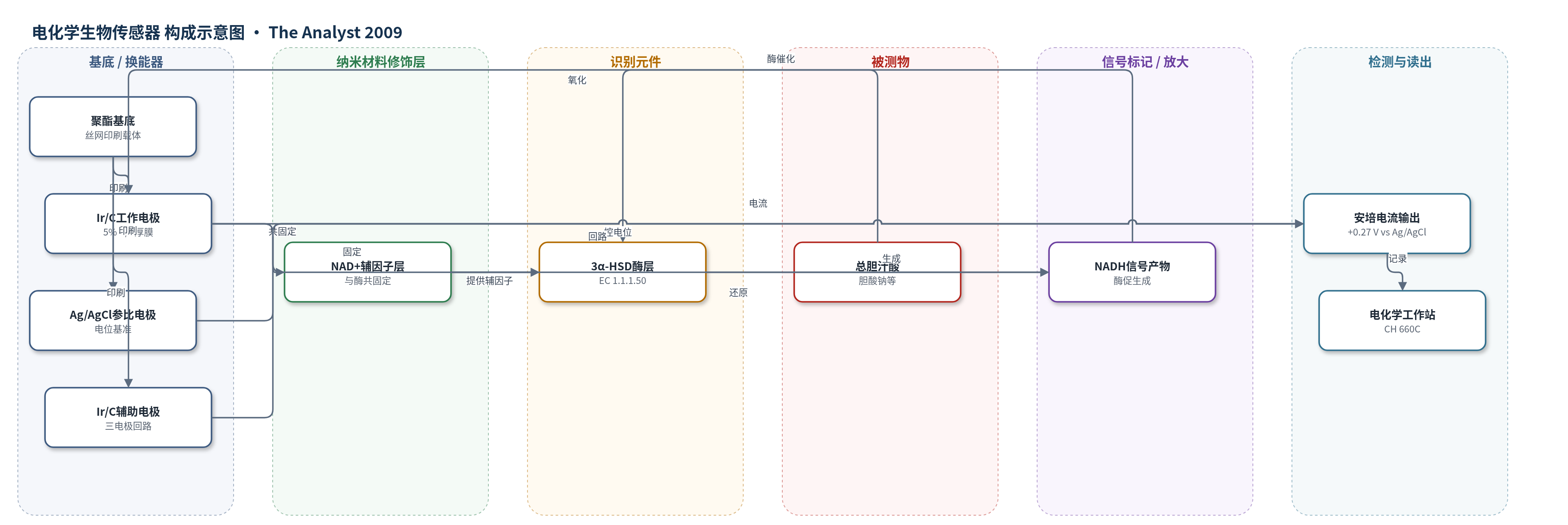
点击图片查看大图 · 依据论文自动绘制
传感器类型
电化学生物传感器
检测对象
总胆汁酸(total bile acids,包括胆酸钠 sodium cholate、牛磺胆酸 taurocholic acid、牛磺鹅去氧胆酸 taurochenodeoxycholic acid);样品基质:磷酸盐缓冲液、牛血清(calf/bovine serum)
检测原理
固定于 Ir/C 工作电极的 3α-HSD 催化胆汁酸与 NAD+ 反应,将胆汁酸氧化并生成 NADH。NADH 作为酶促产物扩散至电极表面,在 +0.27 V(vs Ag/AgCl)发生电化学氧化,释放电子形成安培电流。由于 NADH 生成量与胆汁酸浓度成正比,稳态或计时电流随总胆汁酸浓度升高而增大。Ir/C 电极可在较低电位氧化 NADH,避免抗坏血酸、尿酸等常见干扰物氧化,因此无需选择性膜。提高 pH 和温度可促进酶反应完全,增强电流响应。
检测灵敏度
线性范围: 0–200 mM(总胆汁酸,磷酸缓冲液和牛血清);NADH 线性范围: 0–200 mM
效应效果
传感器在磷酸缓冲液和牛血清中对总胆汁酸在 0–200 mM 范围内呈良好线性,且对单一酸和混合酸均有效。与需 >+0.45 V 并依赖选择性膜的电化学方法相比,本方法在 +0.27 V(vs Ag/AgCl)下工作且无膜,可降低抗坏血酸、尿酸等干扰并减少扩散阻力。实验证实无酶时无响应,说明信号来自酶促 NADH;37 °C 电流高于 25 °C,但 25 °C 在 0–200 mM 仍线性。胆酸钠线性最佳,牛磺鹅去氧胆酸在 ≥200 mM 略偏离线性。作者认为该一次性原型可用于快速、简便的总胆汁酸检测和早期肝病筛查。
传感器的构成
- 基底与三电极:聚酯基底(polyester)上丝网印刷 Ir/C 工作电极、Ir/C 辅助电极和 Ag/AgCl 参比电极,印刷银作电连接。
- 工作电极催化层:5% Ir/C 颗粒厚膜丝网印刷层,提供 NADH 在 +0.27 V(vs Ag/AgCl)的氧化活性。
- 识别元件:3α-HSD(EC 1.1.1.50)固定于工作电极,催化胆汁酸氧化。
- 辅因子层:NAD+ 与酶共固定,作为氧化还原辅因子被还原为 NADH。
- 缓冲/电解质:磷酸盐缓冲液(phosphate buffer)和 KCl,维持 pH 与离子强度。
- 信号产物:NADH,酶促生成后在工作电极氧化产生安培电流。
- 界面设计:无选择性膜,依靠低电位减少干扰并降低扩散阻力。
中文摘要
本研究开发了一种基于厚膜丝网印刷 Ir/C 工作电极和辅助电极的电化学生物传感器,用于检测生理流体中的总胆汁酸浓度,以辅助肝病患者的早期诊断与管理。现有电化学总胆汁酸检测方法通常需要高于 +0.45 V(vs Ag/AgCl)的氧化电位并依赖选择性渗透膜;本方法无需膜,并在 +0.27 V(vs Ag/AgCl)下工作,从而降低抗坏血酸、尿酸等干扰。传感器将 3α-羟基类固醇脱氢酶(3α-HSD,EC 1.1.1.50)固定于工作电极表面,利用酶催化胆汁酸(如胆酸钠、牛磺胆酸、牛磺鹅去氧胆酸)与 NAD+ 反应生成 NADH,再通过安培法检测 NADH 氧化电流。恒电位实验表明,在磷酸缓冲液和牛血清中,传感器在 0–200 mM 范围内对总胆汁酸呈良好线性响应,并考察了温度和 pH 的影响。该一次性原型可用于总胆汁酸的快速、简便检测,具有早期肝病筛查应用潜力。
英文摘要
An electrochemical sensor, based on thick-film screen-printed Ir/C working and counter electrodes, was developed for the detection of total bile acid concentration in a physiological fluid for potential patient management in patients with liver disease. Current electrochemical methods of detecting total bile acid levels involve the use of potentials greater than +0.45 V, versus an Ag/AgCl reference electrode, and require a selectively permeable membrane. The proposed detection method did not require any membrane and used a potential of +0.27 V versus Ag/AgCl. This biosensor used 3-alpha-hydroxysteroid dehydrogenase (3alpha-HSD) (EC 1.1.1.50) immobilized on the thick-film screen-printed working electrode to detect the enzymatically generated NADH. The production of the NADH resulted from the reaction of the enzyme with bile acids such as sodium cholate, taurocholic and taurochenodeoxycholic acid, which could then be used to quantify the total bile acid. Constant potential measurements showed that this biosensor had good linear performance over a 0-200 microM concentration range in the phosphate buffer and the bovine serum. The sensor performance was also examined at different temperatures and pH conditions. This sensor prototype could be used for single use, disposable detection of total bile acids, extending its applicability for simple and early detection of liver disease.