组成图示
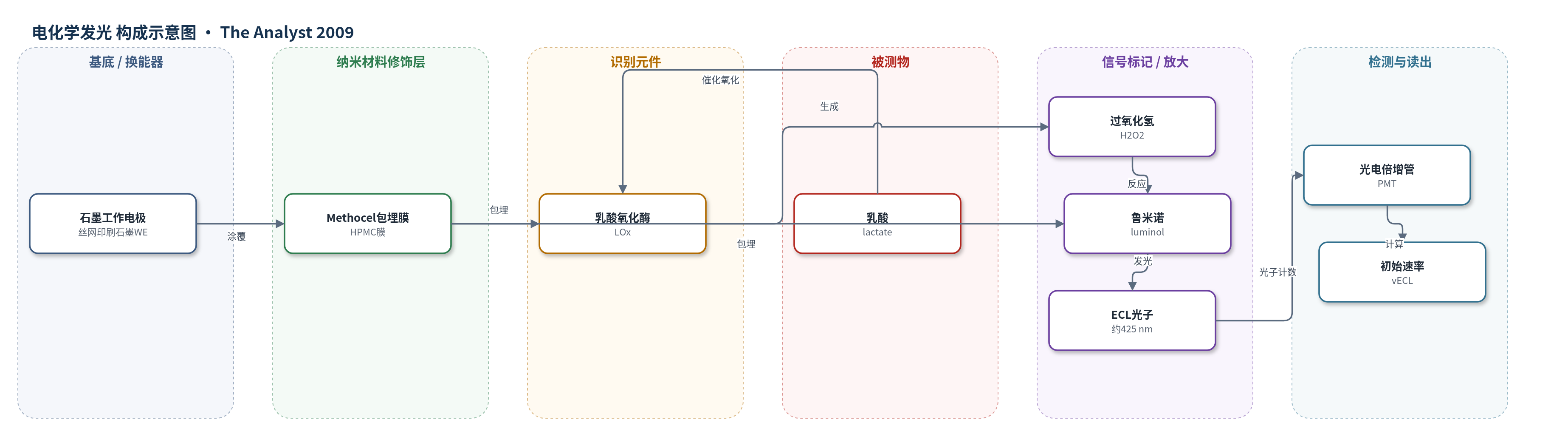
点击图片查看大图 · 依据论文自动绘制
传感器类型
电化学发光(ECL)生物传感器
检测对象
乳酸(lactate,L-lactate);样品基质:人唾液(human saliva),标准缓冲液
检测原理
在 pH 9.0 磷酸盐缓冲液中,样品中的乳酸扩散进入 Methocel 膜,被包埋的乳酸氧化酶(LOx)催化氧化,生成过氧化氢(H2O2)。随后在石墨工作电极上施加 0.5 V、1 s 脉冲,膜内鲁米诺(luminol)被电化学氧化为二氮杂醌,并与 H2O2 反应生成激发态 3-氨基邻苯二甲酸,退激发射约 425 nm 的 ECL 光子。PMT 记录光子计数,由于 H2O2 生成速率与乳酸浓度相关,ECL 初始速率 vECL 随乳酸浓度升高而增大,采用双对数线性化 log vECL = a log[lactate] + b 定量。唾液样品先施加 0.4 V、4 s 预氧化抗坏血酸,并用无酶传感器内部空白校正尿酸干扰。
检测灵敏度
LOD: 5 × 10^-6 M;线性范围: 10^-5–5 × 10^-4 M;斜率: 0.91 ± 0.04;R^2 = 0.992
效应效果
该传感器在 20 s 内完成测量,量程中点(2×10^-4 M)传感器间 RSD 为 3.30%,同一丝网印刷池重复制备 10 次 RSD 为 3.68%,空白 RSD 为 5.13%。避光 4 ℃ 保存寿命约 2 个月,成本约 1.06(原文货币符号)/支。唾液主要干扰为抗坏血酸和尿酸;样品经 1:4 稀释、0.40 mm 过滤、0.4 V 预氧化 4 s 消除抗坏血酸,并用无酶内部空白校正尿酸。与 Boehringer Mannheim 酶学参考法比较 3 份唾液,方法比较百分比分别为 99.6%、82.2%、99.4%。与文献中其他乳酸传感器相比,其线性范围较短但精度良好。作者认为其快速、廉价、选择性好,可作为血乳酸的非侵入性替代。
传感器的构成
- 基底/换能器电极:商用丝网印刷电化学池,含石墨工作电极(WE)、石墨对电极(CE)和银伪参比电极(PSE),塑料支撑;工作电极上白色胶带围成 50 µL 样品腔
- 包埋膜/修饰层:Methocel 90HG(羟丙基甲基纤维素,HPMC)膜,涂覆于石墨工作电极,包埋试剂并允许乳酸扩散进入
- 识别元件:乳酸氧化酶(LOx),催化乳酸氧化生成过氧化氢(H2O2)
- 信号标记物:鲁米诺(luminol),碱性介质中被电化学氧化后与 H2O2 反应产生 ECL 光子
- 稳定剂/封闭剂:牛血清白蛋白(BSA),稳定 LOx 并促进鲁米诺 ECL 信号
- 缓冲/电解质:磷酸盐缓冲液(制膜 pH 8.5;工作 pH 9.0)和 NaCl,维持酶活、导电性和 ECL 反应
中文摘要
本文报道并表征了一种基于电化学发光(ECL)的一次性乳酸生物传感器。乳酸识别体系采用乳酸氧化酶(LOx),换能体系采用鲁米诺(luminol)。鲁米诺、LOx、牛血清白蛋白(BSA)、电解质和缓冲液均包埋于置于丝网印刷电化学池工作电极上的 Methocel 膜中。将 50 µL 样品加入带有圆形样品腔的丝网印刷池后,通过光子计数探头测量 ECL 信号。作者优化了膜组成和反应条件以获得足够灵敏度。在施加两个 1 s、0.5 V 脉冲后,传感器约 20 s 内对乳酸响应,并以 ECL 初始速率作为分析参数。乳酸的双对数线性化关系显示动态范围为 10^-5 至 5×10^-4 M,检出限为 5×10^-6 M,在量程中点处传感器间重复性相对标准偏差(RSD)为 3.30%。该 ECL 一次性生物传感器用于人唾液中乳酸分析,作为非侵入性获取乳酸水平的替代方法。唾液成分干扰被研究并以简便方式消除。通过与酶学参考方法比较,验证了其在人唾液中的应用。所提方法快速、廉价、选择性好、灵敏度高,并可使用常规 ECL 仪器。
英文摘要
An electrochemiluminescence-based disposable biosensor for lactate is characterized. The lactate recognition system is based on lactate oxidase (LOx) and the transduction system consists of luminol. All the needed reagents, luminol, LOx, BSA, electrolyte and buffer have been immobilized by a Methocel membrane placed on the working electrode of the screen-printed electrochemical cell. The measurement of the electrochemiluminescence (ECL) is made possible via a photocounting head when 50 microl of sample is placed into the screen-printed cell with a circular container containing the disposable sensing membrane. The compositions of the membrane and reaction conditions have been optimized to obtain adequate sensitivity. The disposable biosensor responds to lactate after 20 s when two 1 s pulses at 0.5 V are applied to obtain the analytical parameter, the ECL initial rate. The linearized double logarithmic dependence for lactate shows a dynamic range from 10(-5) to 5 x 10(-4) M with a detection limit of 5 x 10(-6) M and a sensor-to-sensor repeatability, as relative standard deviation, RSD, of 3.30% at the medium level of the range. The ECL disposable biosensor was applied to the analysis of lactate in human saliva as an alternative procedure for obtaining the lactate level in a non-invasive way. Interferences coming from components of saliva were studied and eliminated in a simple way that was easy to handle. The procedure was validated for use in human saliva, comparing the results against an enzymatic reference procedure. The proposed method is quick, inexpensive, selective and sensitive and uses conventional ECL instrumentation.