组成图示
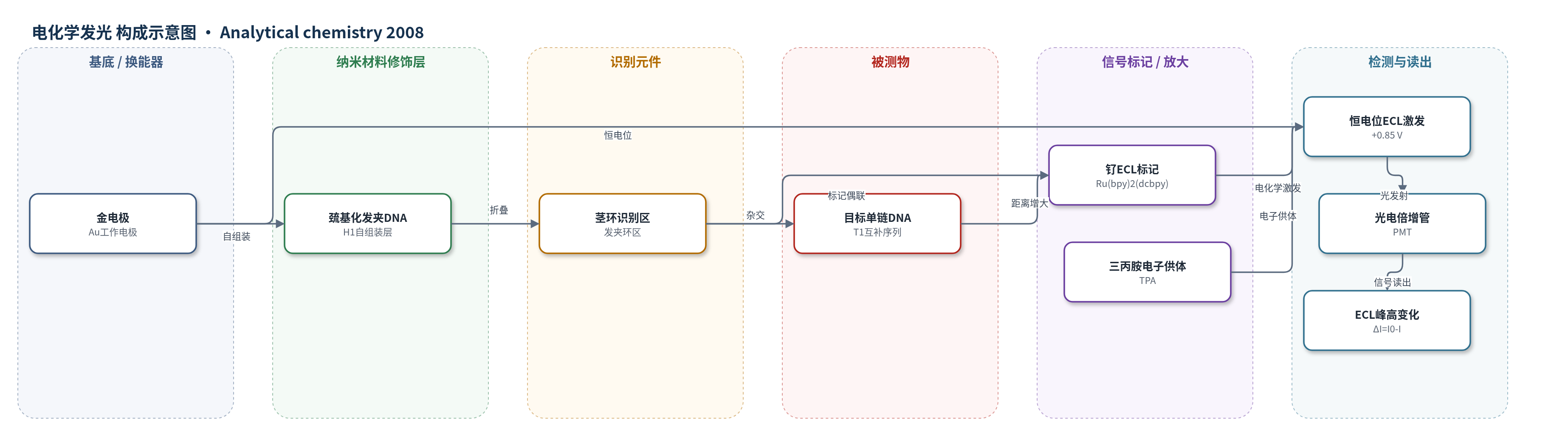
点击图片查看大图 · 依据论文自动绘制
传感器类型
电化学发光(ECL)生物传感器
检测对象
目标单链DNA(target ss-DNA, T1/T2/T3);样品基质:10 mM PBS(pH 7.40)中的DNA溶液
检测原理
传感器以自组装在金电极上的巯基化发夹DNA为识别元件,其3′端连接Ru(bpy)2(dcbpy)钌复合物作为ECL标记。无目标时,发夹呈折叠茎环构象,钌标记靠近电极,在+0.85 V下被氧化,并与溶液中的三丙胺(TPA)发生共反应,生成激发态钌复合物,退激发出强ECL。加入互补目标ss-DNA后,目标与发夹环区杂交,茎环打开为线性双螺旋,使钌标记远离电极,电子转移和ECL效率降低,峰高下降。目标浓度越高,杂交比例越大,ΔI=I0-I越大,形成关断型定量响应。
检测灵敏度
LOD: 9 × 10^-11 M;线性范围: 2.7 × 10^-10–4.0 × 10^-9 M 与 4.0 × 10^-9–5.4 × 10^-8 M(8.5 × 10^-8 M P1);5.4 × 10^-8–5.4 × 10^-6 M(8.5 × 10^-6 M P1);灵敏度斜率: 281、839、189(ΔI 对 log C_ss-DNA);相关系数: 0.9967、0.9952、0.9939
效应效果
该传感器对互补目标ss-DNA具有良好选择性:4.0×10^-8 M T1使ECL下降65%,而100倍浓度非互补NT1仅下降1.3%。对单碱基错配T1M1,4.0×10^-8 M和4.0×10^-6 M分别下降5.5%和12%,对应互补序列下降65%和95%,错配与完全匹配信号差异为8–12倍,作者认为高于荧光芯片报道的2.8–12倍。1.0×10^-9 M互补序列的RSD为3.9%(n=7)。LOD 9×10^-11 M低于电化学法0.2和0.34 nM及荧光法10 nM。90 °C热再生后信号下降约48%,作者认为需增强共价固定以改善重复使用性,并认为其可用于单碱基突变检测。
传感器的构成
- 基底/换能器电极:金电极(Au),经抛光和电化学清洗,作为ECL工作电极
- 识别/信号探针自组装层:巯基化发夹DNA(H1/H2/H3),5′端巯基自组装于Au表面,茎环结构用于识别目标DNA
- 识别元件:发夹DNA环区(loop 16/21/30 bases),与互补目标ss-DNA杂交
- 信号标记物:Ru(bpy)2(dcbpy)NHS偶联的钌(II)复合物,标记于发夹DNA 3′端氨基,作为ECL发光体
- 封闭剂:1-巯基己醇(mercaptohexanol),封闭未覆盖Au表面
- 电子供体/共反应剂:三丙胺(TPA),在0.10 M PBS中参与ECL反应
- 信号读出:恒电位+0.85 V下用光电倍增管(PMT)检测ECL峰高变化ΔI
中文摘要
本文报道了一种基于发夹DNA探针和钌复合物的电化学发光(ECL)DNA生物传感器,用于高选择性检测目标单链DNA(ss-DNA)。将标记有钌复合物的巯基化发夹DNA自组装到金电极表面,构成ECL探针。无目标DNA时,发夹探针保持折叠茎环构象,钌标记靠近电极,产生较强ECL信号;加入互补目标ss-DNA后,探针茎环区与目标杂交并打开为线性双螺旋,使钌标记远离电极表面,ECL强度下降,形成“关断”型响应。ECL峰高变化随目标DNA浓度增加而增大,检出限为9×10^-11 M互补目标ss-DNA。该传感器能有效区分互补序列与单碱基错配序列,并研究了不同环长发夹DNA对选择性的影响。结果表明,采用具有合适茎长和环长的发夹DNA作为识别元件,可显著提高ECL DNA生物传感器的灵敏度和特异性。
英文摘要
A highly selective electrogenerated chemiluminescence (ECL) biosensor for the detection of target single-strand DNA (ss-DNA) was developed using hairpin DNA as the recognition element and ruthenium complex as the signal-producing compound. The ECL-based DNA biosensor was fabricated by self-assembling the ECL probe of thiolated hairpin DNA tagged with ruthenium complex on the surface of a gold electrode. In the absence of target ss-DNA, the ECL probe immobilized on the surface of the electrode was in the folded configuration in which its termini were held in close proximity to the electrode, and thus a strong ECL signal could be generated. In the presence of target ss-DNA, a stem-loop of the ECL probe on the electrode was converted into a linear double-helix configuration due to hybridization, resulting in the tag moving away from the electrode surface, which in turn decreased the ECL signal. The ECL intensity of the DNA biosensor generated a "switch off" mode, which decreased with an increase of the concentration of target DNA, and a detection limit of 9 x 10(-11) M complementary target ss-DNA was achieved. Single mismatched target ss-DNA was effectively discriminated from complementary target ss-DNA. The effect of different loop lengths of the hairpin DNA on the selectivity of the ECL DNA biosensor has been investigated. This work demonstrated that the sensitivity and specificity of an ECL DNA biosensor could be greatly improved using a hairpin DNA species which has an appropriate stem and loop length as the recognition element.