组成图示
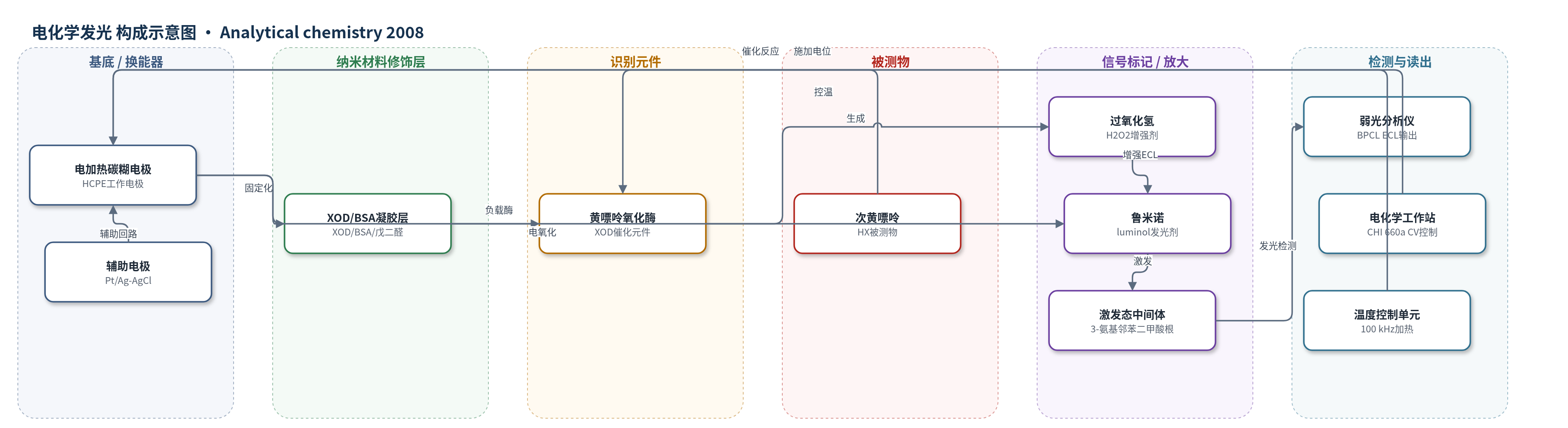
点击图片查看大图 · 依据论文自动绘制
传感器类型
电化学发光(ECL)生物传感器
检测对象
次黄嘌呤(hypoxanthine, HX);样品基质:0.2 mol/L PBS 标准溶液(应用背景为鱼类产品/生物组织)
检测原理
该传感器以 XOD 作为识别/催化元件:溶液中的 HX 在 XOD 催化下与 O2 反应生成尿酸和 H2O2。HCPE 通过高频交流电局部升温,使电极表面温度可控,从而提高 XOD 活性并增强电极附近发光物质的扩散与对流。鲁米诺在 HCPE 表面被电化学氧化生成阴离子及重氮化合物,酶反应产生的 H2O2 以 HOO• 或 O2•− 形式进一步氧化中间产物,产生 3-氨基邻苯二甲酸根激发态;激发态回到基态时发出 ECL 光。HX 浓度越高,生成的 H2O2 越多,鲁米诺 ECL 强度越强,因此可通过 ECL 强度定量 HX。
检测灵敏度
LOD: 0.1 μM (35 °C, S/N=3);线性范围: 0.6–200 μM (35 °C);R^2 = 0.9960;LOD: 3 μM (25 °C, S/N=3);线性范围: 8–300 μM (25 °C);R^2 = 0.9950
效应效果
在 0.2 mol/L PBS(pH 7.0)中,35 °C 下 HX 线性范围 0.6–200 μM,R^2 = 0.9960,LOD 0.1 μM;25 °C 下线性范围 8–300 μM,R^2 = 0.9950,LOD 3 μM,35 °C 检出限比室温低 30 倍。4 °C 保存后,25 或 35 °C 测试前 5 天响应基本恒定,10 天后降至初始 70%;45 °C 下每次测试后响应下降,酶失活不可恢复。重现性 RSD 为 7.5%(25 °C)和 6.8%(35 °C,n = 6)。未报告实际样品回收率或定量方法对比,但作者认为电极易清洁更新,适合与毛细管电泳/色谱联用。
传感器的构成
- 基底/换能器电极:电加热碳糊电极(HCPE),碳糊(含矿物油)工作电极,可通高频交流电实现局部加热
- 固定化/修饰层:黄嘌呤氧化酶(XOD)与牛血清白蛋白(BSA)混合后以戊二醛(glutaraldehyde)交联成凝胶层,用于固定酶并封闭非特异吸附
- 识别/催化元件:XOD,催化次黄嘌呤(HX)与 O2 反应生成尿酸和 H2O2
- 信号发光剂:鲁米诺(luminol),在 HCPE 表面电化学氧化,经 H2O2 增强后产生 ECL 发光
- 信号增强剂:H2O2(酶反应产物),以 HOO• 或 O2•− 形式参与鲁米诺 ECL 反应
- 缓冲介质:0.2 mol/L 磷酸盐缓冲液(PBS, pH 7.0),维持 XOD 活性和 ECL 反应条件
- 辅助电极:铂丝对电极和 Ag/AgCl 参比电极,构成三电极体系并施加循环伏安电位
- 温度控制单元:函数发生器与变压器,输出 100 kHz 交流加热电流,控制 HCPE 表面温度
中文摘要
本文设计并构建了一种基于电加热碳糊电极(HCPE)表面修饰黄嘌呤氧化酶(XOD)的电化学发光(ECL)生物传感器,用于检测次黄嘌呤(HX)。该传感器利用高频交流电直接加热电极表面,而不改变本体溶液温度。XOD 催化 HX 与分子氧反应生成尿酸和过氧化氢(H2O2),H2O2 可增强鲁米诺(luminol)在电极表面的 ECL 强度,且 ECL 信号与 HX 浓度呈线性关系。由于 XOD 活性高度依赖温度,电极温度同时影响酶反应和发光物质在电极附近的扩散与对流,因此需控制最佳电极温度。实验表明,在 0.2 mol/L 磷酸盐缓冲液(pH 7.0)中,35 °C 时传感器灵敏度最佳,线性范围为 0.6–200 μM,相关系数 R^2 = 0.9960,检出限为 0.1 μM,比 25 °C 时的 3 μM 低 30 倍。
英文摘要
A new electrochemiluminescent (ECL) biosensor based on an electrically heated carbon paste electrode (HCPE) that was surface modified by xanthine oxidase (XOD) was designed and constructed in this work. It was found that the ECL intensity of luminol could be enhanced at the surface of XOD/HCPE by adding hypoxanthine (HX) to the solution, and there was a linear relationship between the ECL intensity and the concentration of HX. On the basis of this, an ECL enzyme biosensor can thus be developed to detect HX. However, because the activity of XOD is highly dependent on temperature, the biosensor is very sensitive to the temperature of the electrode. Also, because the temperature of the electrode may also affect the diffusion and convection of the luminescent compounds near the electrode surface, a suitable temperature for XOD/HCPE has to be controlled to achieve the best ECL signal. The key feature of the designed biosensor is that the temperature of the electrode is controllable so the most suitable temperature for the enzyme reaction can be obtained. The obtained results showed that the ECL enzyme biosensor exhibited the best sensitivity at an electrode temperature of 35 degrees C for the detection of HX. The detection limit was 30-fold lower than that at room temperature (25 degrees C).